Kitan Club
July 1953
← Back to magazine archive
Issue Details
- PDF pages
- 173
Summary
The July 1953 issue of Kitan Club combines translated Western sadomasochistic fiction, Japanese punishment history, confessional and epistolary writing, fetish psychology, queer material, illustrated studies of restraint, staged bondage photography, historical discussions of violence, and continuing serialized fiction. The issue’s central concern is the transformation of unusual desire into a communicable form. Desires are not merely enacted in stories. They are recorded in diaries, addressed to other contributors, diagrammed, historicized, photographed, and placed into named categories through which readers might recognize themselves.
Read full summary Close full summary
Table of Contents 29 items
-
Restraint Depicted in Illustrations
Summary
Miki Hiroshi surveys the depiction of female rope restraint in postwar Japanese erotic illustrations, tracing recurring scenes such as women bound to posts, trees, or other structures. The article compares examples from contemporary erotic magazines with historical and theatrical motifs, emphasizing how artists visually staged bondage and punishment imagery.
-
The Sufferings of Christine, Part Two
Summary
A translated serialized erotic narrative recounting Christine’s captivity and repeated abuse by Paul and other men. The story emphasizes coercion, restraint, humiliation, sexual violence, and Christine’s attempts to resist or escape, while shifting between her perspective and the captors’ sadistic control.
-
My Wife Will Not Let Me Tie Her
Summary
A first-person narrative follows a husband whose fixation on binding women conflicts with his wife’s initial refusal to participate. His fantasies, attempts to reproduce images of bound women, and eventual efforts to bind and discipline his wife expose the tensions between marital intimacy, coercion, and erotic desire.
-
Longing for Seppuku
Summary
A historical erotic narrative set among samurai households, in which jealousy, adultery, family honor, and revenge culminate in ritual suicide and violent abdominal cutting. The story eroticizes seppuku, bodily injury, submission, and the psychological intensity of punishment and death.
-
To Kawabata Tanako
Summary
A personal letter from Kyōko Hamura to Tanako Kawabata apologizes for a delayed reply and discusses their continuing correspondence, exchanged photographs, and an intense erotic fascination with the recipient’s body. The letter functions as intimate reader-to-reader communication within the magazine’s participatory erotic culture.
-
The Legs That Reign over the Altar
Summary
A serialized erotic narrative about a man captivated by the legs and feet of the glamorous Eiko, whose encounters with Yuko and other women develop into increasingly fetishistic and sexually charged scenes of admiration, display, and submission. The story emphasizes leg and foot worship, voyeuristic spectatorship, and power relations between men and women.
-
Longing for Seppuku: A Personal Experience
Summary
A first-person account centered on a woman’s fascination with seppuku and the narrator’s participation in an increasingly intense scenario involving knives, exposed flesh, blood, and ritualized abdominal cutting. The piece blends personal confession with eroticized imagery of death, self-harm, and historical Japanese execution motifs.
-
On Cultural Prohibitions
Summary
An essay on the aesthetic and psychological appeal of female kinbaku, considering how cultural standards, fashion, artistic representation, and historical context shape perceptions of beauty. The author argues that restrained female forms can evoke powerful emotional and imaginative responses when presented with artistic sensitivity.
-
Memories of Prison
Summary
A first-person memoir of incarceration in a juvenile prison, describing prisoner classification, uniforms, labor, meals, inspections, restraints, guard procedures, and disciplinary punishments. The account emphasizes the regimented routines, humiliations, and physical hardships of prison life.
-
Kabuki and Sadism
Summary
An essay examines sadistic motifs in kabuki, discussing scenes of bloodshed, torture, mutilation, punishment, and supernatural violence alongside the theatrical conventions and visual staging that make such cruelty dramatically compelling. It also considers how kabuki narratives connect violence with eroticized beauty, fear, and spectacle.
-
The Criminal History of the Tyrant Ivan, Part Three
Summary
The third installment of Takatori Nagaharu’s sensational historical narrative recounts the brutality of Ivan the Terrible, including executions, torture, arbitrary punishment, political violence, and cruelty toward family members and subjects. The serialized account presents Ivan’s tyranny through lurid episodes of sadism, bloodshed, and psychological terror.
-
From a Masochist’s Notebook, Part Two
Summary
A serialized first-person notebook in which a self-identified masochist recounts erotic fantasies, domestic scenarios, imagined female authority, fetishized clothing and footwear, bodily humiliation, and related reflections on masochistic psychology. The later sections also discuss literary and cinematic representations of submissive desire and the changing postwar sexual imagination.
-
To Shida Yōko
Summary
A personal letter responding to Shida Yōko’s published sexual confession and discussing intimate bodily experiences, erotic experimentation, masochistic and sadistic feeling, marriage, and the frankness of sexual self-expression. It functions as reader correspondence that extends the magazine’s exchange of personal testimony and advice.
-
Questions and Answers on Perversion, Part Three
Summary
A continuation of the magazine’s question-and-answer feature on “perversion,” presented as an extended dialogue about unusual sexual desires, marital and domestic situations, fetishistic interests, and imagined or enacted sadistic behavior. The discussion combines psychological interpretation with practical advice and reflections on changing sexual tastes and relationships.
-
The Princess Who Became Gravel
Summary
An erotic historical fiction narrative set in a feudal Japanese setting, in which a princess and another woman are subjected to captivity, interrogation, binding, public punishment, and execution. The story emphasizes elaborate coercive scenarios, ritualized restraint, humiliation, and the transformation of a noblewoman into an object of spectacle and suffering.
-
Four-Ma-Road and Its Surroundings
Summary
A first-person travelogue of Shanghai’s Four-Ma Road district and its surrounding streets, describing public transportation, neighborhood divisions, signage, restaurants, shops, and the contrast between Chinese, Japanese, and foreign spaces. The later sections recount visits to Chinese restaurants and encounters with women, combining urban observation with sexualized, cross-cultural impressions and personal anecdote.
-
A New Sadism
Summary
An essay examining “new sadism” through cinematic and dramatic scenes of pursuit, capture, gagging, and cruel restraint. It treats sadism as a psychological and aesthetic structure, emphasizing the interplay of male brutality, female vulnerability, fear, beauty, and spectatorship in film.
-
Five Forms of Cruel Restraint
Summary
A photographic feature presenting five staged forms of cruel restraint, with female models bound by rope in varied positions around furniture and posts. Captions identify the arrangements and models, emphasizing practical rope binding, immobilization, and gagging.
-
Love Slave, Part Seven
Summary
The seventh installment follows a husband who frames his wife Harumi’s extramarital encounters as an erotic form of enslavement. He secretly observes, facilitates, and eventually orchestrates her meetings with other men, dwelling on jealousy, humiliation, sexual rivalry, and the transformation of their marriage through shared forbidden desire.
-
My Theme
Summary
A first-person erotic confession/narrative recounts the development of a woman’s bondage interests through school experiences, memories of childhood punishment, and an intense relationship with Akiko. The story features reciprocal female domination and submission, rope restraint, gagging, forced undressing, athletic-clothing fetishism, and fascination with feet and white socks.
-
Diary of a Puritan, Part Two
Summary
The second part of a puritan’s diary describes a physically charged wrestling encounter between the narrator and a male friend, focusing on restraint, bodily strength, submission, and fascination with the male body. The narrator’s reflections frame the episode as a personal exploration of same-sex desire and eroticized male intimacy.
-
The One-Eared Legend
Summary
An Edo-period erotic tale unfolds around a popular performer and a young woman whose encounter becomes entangled in deception, pursuit, captivity, and violent retribution. The illustrated serial narrative emphasizes bodily suffering, coercive power, and the creation of the “one-eared” legend within a theatrical and urban setting.
-
My Confession: The Severed Chapter, Part Two
Summary
A first-person confessional narrative tracing the author’s developing interest in sexology, abnormal psychology, literature, art, and erotic experience. It recounts postwar work and relationships while reflecting on private desires, observation, and the formation of the narrator’s sexual consciousness.
-
The Pleasure of Being Tickled
Summary
A first-person erotic narrative about the narrator’s escalating pleasure and distress while being tied, gagged, and repeatedly tickled by an older woman. Detailed scenes of rope restraint, bodily immobilization, teasing, and forced endurance make tickling the central fetish motif.
-
Cinema, Sadism, and Other Matters
Summary
A film-cultural essay examines depictions of cruelty, sadism, eroticized violence, and voyeuristic spectacle in films, focusing especially on Sergei Eisenstein’s *Ivan the Terrible* and related historical and sensational cinema. It also reflects on changing film tastes and the relationship between visual culture and sexual fantasy.
-
A Female Prisoner’s Experience of Private Punishment, Part Two
Summary
A serialized account of female imprisonment describes women subjected to coercive and humiliating punishments, including stripping, forced dancing and postural exercises, bodily exposure, and degrading toilet-related treatment. The narrative emphasizes captivity, institutional power, endurance, and enforced submission among female prisoners and attendants.
-
Fire, Part Seven
Summary
The seventh installment of Matsui Kōko’s serialized erotic novel follows a married couple through jealousy, coercion, and escalating bondage during travel and domestic encounters. The narrative features rope restraint, gagging, forced positions, humiliation, and sadomasochistic marital conflict.
-
After Fog, Rain
Summary
A diary-style erotic narrative describes a rainy mountain excursion that develops into an outdoor bondage and photographic scenario. Rope restraint, nudity, exposure, discomfort, and the voyeuristic staging of the bound body form the story’s central motifs.
-
Publication Notices and Advertisements
Summary
A concluding notices and advertising page for Kitan Club, featuring subscription and back-issue information, special membership recruitment, manuscript submissions, editorial guidelines, reader inquiries, and publisher details. It also promotes the K.K. Tsūshin supplement and solicits reader participation in the magazine’s publishing activities.
Highlights
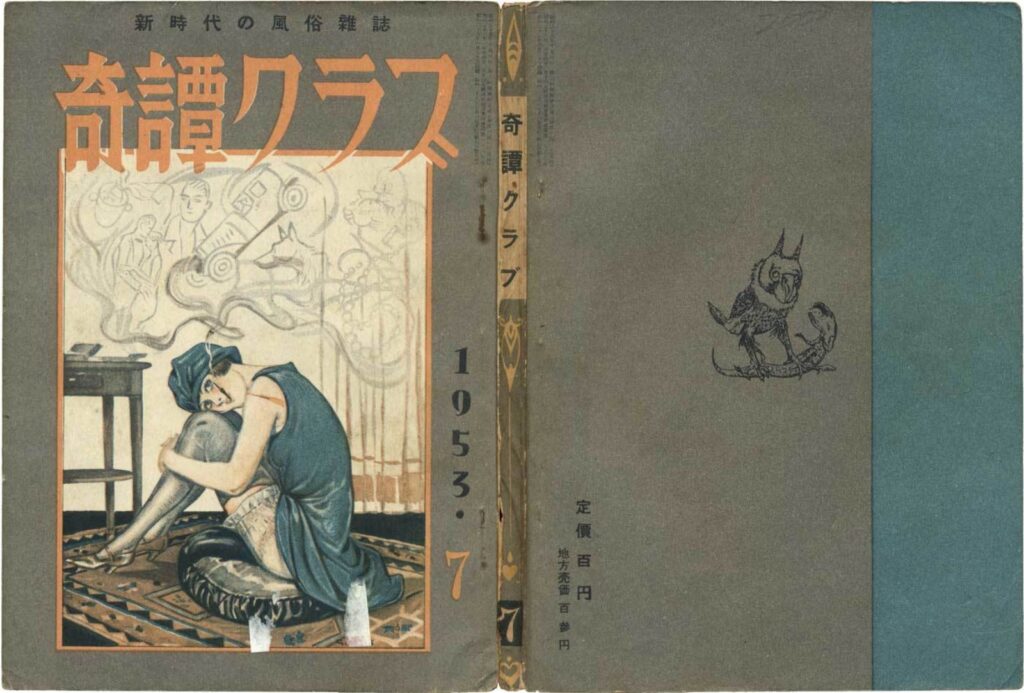
- The cover turns an intimate interior into a theater of secret desire, with grotesque faces on the screen looming over the central pair (PDF p. 1).
- The opening European punishment scenes and Japanese demon procession place historical cruelty beside supernatural fantasy, establishing the issue’s double register of archive and nightmare (PDF pp. 2–3).
- Restraint Depicted in Illustrations assembles women tied, suspended, exposed, or placed against architectural structures into a comparative visual catalogue (PDF pp. 6–9).
- The Sufferings of Christine, Part Two continues a translated Western narrative through which erotic suffering acquires an international literary genealogy (PDF pp. 11–26).
- My Wife Will Not Let Me Tie Her acknowledges the gap between an individual’s rope fantasy and a spouse’s willingness to participate, an unusually direct domestic conflict for the period (PDF pp. 27–32).
- Longing for Seppuku uses the exposed abdomen, historical ritual, and bodily danger to turn Japanese punishment history into an object of erotic contemplation (PDF pp. 33–40).
- To Kawabata Tanako demonstrates how contributors addressed one another directly, transforming the magazine into a continuing correspondence network (PDF pp. 41–42).
- The Legs That Reign over the Altar frames fetishism as worship, elevating a body part into a symbol of authority and submission (PDF pp. 43–48).
- Memories of Prison and the Ivan series use confinement and tyranny as historical structures through which domination can be examined at a safe narrative distance (PDF pp. 55–68).
- From a Masochist’s Notebook, Part Two gives masochism an apparently first-person interior voice rather than describing it solely through external diagnosis (PDF pp. 69–78).
- The question-and-answer and personal-address sections stabilize a vocabulary of specialized desire by allowing pseudonymous writers and readers to respond across issues (PDF pp. 79–88).
- Four-Ma-Road and Its Surroundings turns Shanghai into an erotic geography shaped by memory, wartime mobility, and urban spectatorship (PDF pp. 93–103).
- Five Forms of Cruel Restraint removes most narrative scenery and compares rope, gagging, posture, and bodily compression through controlled photographic variation (PDF pp. 106–109).
- Love Slave, Part Seven and My Theme show two ways the magazine constructs erotic identity: recurring serialized persona and direct autobiographical self-definition (PDF pp. 111–128).
- The closing sequence moves from tickling and cinema to prison punishment, Fire, Part Seven, and After Fog, Rain, demonstrating the issue’s full range from bodily sensation to extended fiction (PDF pp. 147–172).
Contributors
Named contributors represented in this issue:
- Azuma Minoru
- Chiba Saburō
- composition by Tsujimura Takashi; photography by Tsukamoto Tetsuzō
- credit appears to read Kameoka Shichirō
- Hamura Hiroshi
- Hamura Kyōko
- Himeumi Shirō
- Izumi Tatsunosuke
- Kawabata Tanako
- Kitō Kōichirō
- Kosaka Tamie
- Kurishima Hiroshi
- Matsui Kōko
- Miki Hiroshi
- Miyauchi Yoshio
- Mizunai Takeo
- Moriwa Ayako
- Numa Shōzō
- Okada Eiko
- Okada Keisuke
- Sudō Tsuneo
- Takatori Nagaharu
- translated by Azuma Minoru
- Ukiya Takasaburō
- Yamamoto Yuri