Fuzoku Soshi
January 1954
← Back to magazine archive
Issue Details
- PDF pages
- 215
Summary
The January 1954 issue of Fūzoku Sōshi opens the new year by presenting bondage and seme not as isolated curiosities, but as a dense visual and conceptual field. Its 150 PDF pages combine staged rope photography, color illustration, Western spanking imagery, Japanese and foreign bondage art, confessional fiction, queer case studies, erotic crime stories, historical punishment, sadistic and masochistic psychology, reader-oriented reportage, and Kita Reiko’s seasonal series. The issue shows the magazine moving fluidly between art, purported testimony, pathology, entertainment, and practical knowledge.
Read full summary Close full summary
Table of Contents 22 items
-
Splendid Pictures of Cruelty
Summary
A photographic feature presenting staged scenes of women restrained, bound, and subjected to corporal punishment in domestic and theatrical settings. The accompanying presentation treats cruelty and physical vulnerability as fetishized visual spectacle.
-
Grand Collection of Perverse Buttock Beating
Summary
A photo-and-illustration feature framed as an account of American female sadism, with scenes involving teachers, students, discipline, buttock beating, and elaborate restraint. Its images and captions emphasize humiliation, exhibition, and the sexualization of institutional punishment.
-
Tears of Submission
Summary
Nakagawa Ayako’s illustrated and photographic feature depicts women bound, gagged, immobilized, and displayed in scenes of forced submission, distress, and punishment. The recurring motif is the “tears” and facial expression of a restrained subject within staged sadomasochistic tableaux.
-
Images of a White Toy
Summary
An illustrated erotic feature depicting a woman in elaborate rope bondage and staged restraint scenarios, accompanied by Japanese commentary on the scenes and their performers. The sequence emphasizes theatrical posing, physical display, and sadomasochistic imagery.
-
Snake
Summary
A single erotic illustration by Kitahara Tamaki showing a nude woman accompanied or confronted by snakes and a partially visible male figure. The composition uses the snake as a motif of danger, sensuality, and fantasy.
-
Lustful Rain, Unextinguished
Summary
An ongoing erotic novel centered on Chikako and her encounters in an artist’s studio, where modeling, voyeurism, coercion, and progressively severe restraint become intertwined. The installment develops a tense artist–model relationship and ends as a continuing serial.
-
White Altar
Summary
An erotic fictional narrative set around a male teacher’s encounters with A-ko, a seventeen-year-old student. Across several chapters, classroom and private-room settings become stages for voyeuristic observation, sexual initiation, and an unequal teacher–student relationship, accompanied by fetishistic illustrations.
-
Stalking Diary
Summary
A diary-style erotic story follows a man’s obsessive pursuit and surveillance of women, recording his movements, observations, and increasingly intimate encounters in urban and private settings. The accompanying illustrations reinforce the work’s themes of stalking, sexualized looking, and coercive erotic pursuit; the concluding pages also include a brief reader-communications section.
-
The Voyeur’s Room
Summary
A serialized erotic narrative set in a private “voyeur’s room” depicts men observing, exposing, and sexually exploiting women through a series of encounters organized into numbered sections. Its illustrations emphasize nude bodies, forced intimacy, hidden spectatorship, and the eroticization of enclosed domestic interiors.
-
Tale of Strange Homosexuality
Summary
A sexological and anecdotal account of unusual male same-sex desire and gendered sexual behavior. The discussion combines case-style observations with fictionalized or illustrative scenes involving erotic experimentation, cross-gender presentation, and social attitudes toward homosexuality.
-
The Man Possessed by an Enema Syringe
Summary
A first-person erotic confession about a man whose sexual fixation centers on an enema syringe and related medical procedures. The narrative presents fetishistic desire, repeated encounters with medical settings, and the tension between compulsive sexuality and everyday social life.
-
The Rout at Aizuwakamatsu Castle
Summary
A historical adventure narrative depicting the retreat and defeat of Aizu forces during the late-Edo civil wars, including the siege of Aizuwakamatsu Castle. It emphasizes battlefield confusion, samurai loyalty, wartime hardship, and the experiences of women and civilians caught in the conflict.
-
Desire for Rape
Summary
An erotic confessional narrative centered on a man’s fixation with rape fantasies and his encounters with women who become involved in coercive sexual situations. The piece presents sexual violence through the subjective language of fetishistic desire.
-
The Awakened Masochist
Summary
An erotic narrative about a woman’s gradual discovery and acceptance of masochistic desire through sexually dominant encounters, including restraint, spanking, and other forms of bodily control. It emphasizes sexual awakening and the changing power dynamics between partners.
-
Various Hanging Torments
Summary
An illustrated discussion of varied hanging punishments and suspension-based torments, combining historical commentary with descriptions and depictions of eroticized bodily restraint. The feature treats hanging, bondage, and staged physical suffering as visual and sexual practices.
-
Reiko’s Twelve Months: Pine
Summary
An erotic seasonal vignette from the “Reiko’s Twelve Months” series, centered on the pine/New Year motif. The accompanying illustrations and narrative depict a sexual encounter moving between an interior setting and a pine-filled outdoor landscape.
-
The Maimed Fairy
Summary
An erotic supernatural story about Takashi and Michiko, whose doctor-patient relationship becomes entangled with hidden identity, psychological desire, and a strange fairy- or monster-like transformation. Dreamlike illustrations reinforce the story’s motifs of bodily otherness, seduction, and violence.
-
Tormenting a Virgin
Summary
A sadistic erotic story explicitly framed as a “sadism story,” depicting a man’s coercive encounters with women and the sexualized torment of a virgin. Across its episodes, the narrative emphasizes domination, restraint, humiliation, and violence, accompanied by graphic erotic illustrations.
-
Toilet Mania
Summary
A humorous first-person essay about the author’s fascination with toilets, recounting observations and experiences in factory and public lavatories. The piece combines scatological comedy with gendered restroom settings and sexually voyeuristic situations.
-
Male-Colored Café, Continued
Summary
A continuation of a guide to male-oriented cafés and meeting places, describing venues, clientele, access routes, local atmospheres, and coded forms of recognition. Maps and hand-sign illustrations document the geography and social practices of Japan’s male homosexual café subculture.
-
Sickening Humiliation
Summary
An erotic illustrated narrative centered on coercive sexual domination, bondage, physical restraint, and humiliating treatment. Its prose and images emphasize sadomasochistic power relations and the victim’s ordeal.
-
Lesbos Correspondence
Summary
An erotic first-person correspondence feature exploring women’s same-sex desire, intimate relationships, jealousy, and sexual experimentation. The prose is accompanied by highly sensual illustrations of nude and embracing women, presenting a stylized “Lesbos” salon of female sexuality.
Highlights
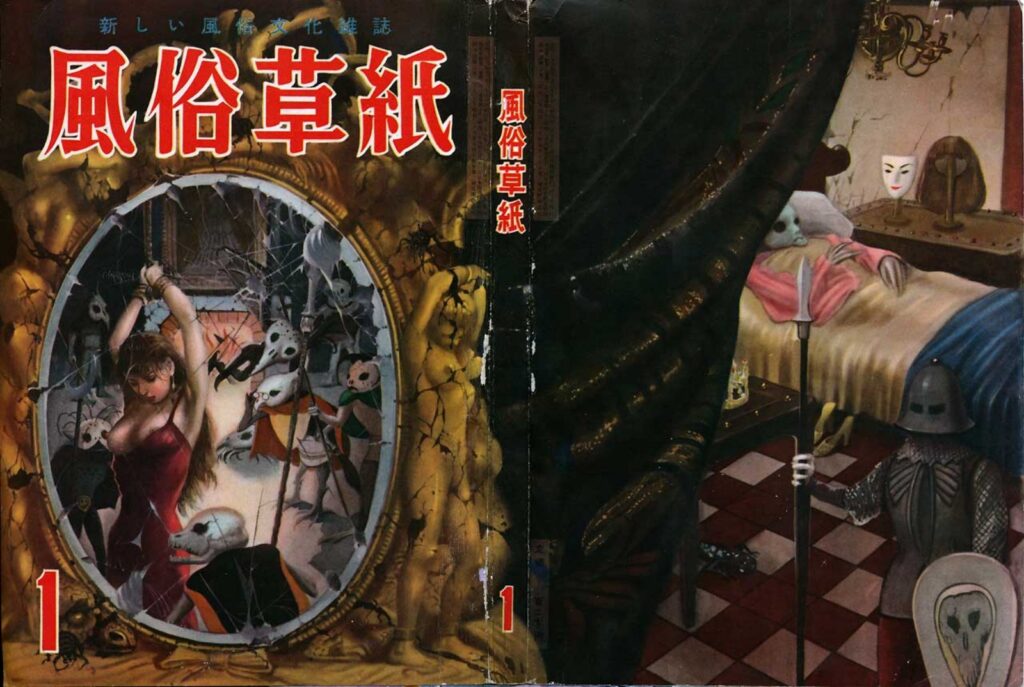
- The surreal cover creates a theatrical chamber of masks, mannequins, concealed figures, and erotic observation (PDF p. 1).
- A color plate places a kimono-clad woman beneath an older man using a bamboo pole, blending historical punishment with erotic control (PDF p. 3).
- “Splendid Scenes of Cruelty” presents staged Japanese bondage photography in floor, pillar, chest, and leg restraints (PDF pp. 4–7).
- A major illustrated feature on American women’s sadism surveys whipping, spanking, public punishment, fetish costume, and female authority (PDF pp. 8–12).
- Japanese staged photographs of bound women in traditional dress connect imported spanking imagery to domestic rope culture (PDF p. 13).
- Nakagawa Ayako’s “Tears of Submission” studies gagging, exhaustion, strained posture, and apparent surrender (PDF pp. 14–16).
- “Images of White Toys” presents women restrained through ropes, boards, supports, and mechanical arrangements (PDF pp. 17–20).
- “Madam of the Lustful Rain” opens an urban abnormal-erotic novel of nightlife, commerce, coercion, and bodily vulnerability (PDF pp. 25–36).
- “White Altar” turns restraint and exposure into a ritualized scene of sacrifice and worship (PDF pp. 37–45).
- “Diary of a Strange Maniac” uses first-person confession to blur testimony, pathology, and erotic fantasy (PDF pp. 46–52).
- “The Room of Exhibitionism” examines exposure, voyeurism, humiliation, and the watched body (PDF pp. 53–62).
- “A Strange Homosexual Tale” presents same-sex desire through observation, confession, and the search for compatible partners (PDF pp. 63–71).
- “The Man Enchanted by an Enema Device” turns a highly specific medical fetish into a named erotic identity (PDF pp. 72–76).
- “The Fall of Aizu Castle” uses military defeat, capture, restraint, and female vulnerability as historical erotic material (PDF pp. 77–85).
- “Reiko’s Twelve Months: Pine,” “The Hanging Torment,” Lesbos Correspondence, and the mapped guide to male-colored cafés connect seasonal art, suspension history, queer communication, and real urban geography (PDF pp. 102–150).
Contributors
Named contributors represented in this issue:
- Hinatsu Yukio; illustrations by Mizusawa Fukayuki
- Itō Seiu
- Iwahori Hikaru; illustrations by Nozaki Kōsaku
- Kayabiya Kazuhiko
- Kayama Shigeru; illustrations by Hamada Minoru
- Kita Reiko
- Kitahara Tamaki
- Kitō Kōichirō
- Kurisu Teruo
- Matsui Kōko
- Mizusawa Fukayuki
- Nakagawa Ayako
- Sagara Saburō; illustrations by Hamada Minoru
- Shimada Seiichi
- Sonomura Keiko; illustrations by Mizusawa Fukayuki
- Tada Akihito
- Takahashi Tetsu; illustrations by Hamada Minoru
- Yagiwa Hideo
- Yorioka Mafuyu