Fuzoku Soshi
December 1953
← Back to magazine archive
Issue Details
- PDF pages
- 186
Summary
The December 1953 issue of Fūzoku Sōshi closes the year with one of the magazine’s richest combinations of historical punishment, bondage photography, artistic classification, sexual psychology, pathological case history, translated sadistic fiction, and Japanese seme. Across its pages, the issue repeatedly asks how torment becomes pleasure, how the bound body can be organized as an image, and how abnormal desire might be studied as both personal disposition and cultural phenomenon.
Read full summary Close full summary
Table of Contents 20 items
-
Research Notes on Wooden-Horse Torture
Summary
Shimazaki Satoshi examines the historical wooden-horse punishment, comparing its use in Japan and the West and discussing the bodily effects of its posture and pressure. The article also documents contemporary experiments with a female subject using wooden apparatuses, ropes, and related restraint positions to recreate and assess the technique.
-
The Pleasure of Binding and Being Bound
Summary
Takahashi Tetsu examines the erotic and psychological appeal of binding and being bound, drawing on sexological discussion, criminal and psychiatric case reports, marital examples, and accounts of male and female desire. Illustrated scenes depict rope restraint, bondage apparatus, positional restraint, and other forms of coercive or consensual sexual play.
-
The Garden of Beasts
Summary
A first-person account by a zoo worker describes years spent caring for captive animals and observing their habits, especially their mating behavior. The narrator reflects on animal instinct, human sexuality, curiosity, and the unsettling overlap between the worlds of people and beasts.
-
Dream Demon, Continued
Summary
A continuation of Matsui Kōko’s serialized erotic fiction in which Natsuko is pursued, captured, and repeatedly subjected to elaborate rope and cord restraints, humiliation, and punitive treatment. The narrative moves between domestic interiors, theatrical settings, and outdoor scenes, with accompanying illustrations emphasizing staged scenes of captivity and bondage.
-
The Sexual Desire of Filth Fetishism
Summary
A sexological essay examining sexual arousal associated with excrement, urine, odors, and other forms of filth fetishism. It combines historical and cultural references with purported case examples, psychological speculation, and illustrated depictions of scatological and urophilic scenarios.
-
The Aphrodisiac Therapist
Summary
A serialized erotic narrative follows a wealthy married couple who invite a massage therapist into their home, with the treatment gradually becoming an orchestrated scene of sexual experimentation, voyeurism, and submission. The accompanying illustrations depict the story’s staged nude encounters and physical domination.
-
What Kind of Man Is a Masochist?
Summary
A sexological and psychological essay examines the characteristics of the masochistic man, contrasting masculine and feminine traits and discussing recurring patterns of submission, humiliation, dependency, and attraction to dominant women. It proposes several behavioral types and relates them to sexual conduct, personality, and domestic relationships.
-
The Razor Man
Summary
A sensational case narrative follows a man whose resentment toward women, sexual frustration, and fixation on razor blades develop into violent fantasies and attacks. Through confession-like narration and lurid illustrations, the piece explores the relationship between fetishistic objects, sadistic violence, crime, and abnormal sexual psychology.
-
Illustrated Hell of Execution by Fire
Summary
An illustrated historical account of fire-based executions and related punishments in Japan, drawing on Edo-period legal records and famous criminal cases. It describes procedures, implements, public spectacle, and the suffering of condemned prisoners, accompanied by dramatic depictions of bound and burning figures.
-
How a Perverted Sexual Murderer Kills
Summary
A sensational true-crime feature examines several sexual murder cases, recounting the perpetrators’ behavior, the murders and treatment of victims’ bodies, and the police investigations that identified them. Framed through contemporary ideas about abnormal sexuality, it combines case reportage with criminological and psychological interpretation.
-
Buttock Mania
Summary
An autobiographical-style essay explores the author’s sustained erotic fixation on women’s buttocks, discussing their shape, movement, visual appeal, and the fantasies they provoke. Illustrated scenes and references to erotic images reinforce the feature’s focus on bodily fetishism and spectatorship.
-
Reiko’s Twelve Months: Fog
Summary
A chapter from the serialized Reiko narrative, set in fog, depicts Reiko being drawn into a threatening encounter involving captivity, forced exposure, and coercive sexual domination. The accompanying illustrations dramatize the story’s atmosphere of danger, humiliation, and eroticized restraint.
-
Slave Festival, Continued
Summary
In this continuation of the serialized fiction, a group of women are displayed, restrained, and subjected to a public “slave festival” involving auctions, contests, and staged scenes of humiliation. Rivalry among the participants and spectators intensifies as the women are forced through increasingly degrading forms of exposure, bondage, and physical discipline.
-
The Pack of Wolves
Summary
A serialized erotic crime narrative follows Sumiko as she is abducted, restrained, and subjected to escalating abuse by a group of men. The illustrated episodes emphasize rope bondage, captivity, coercion, humiliation, and the perpetrators’ sadistic control.
-
Two Tales of Perverse Rape
Summary
Two grotesque narrative episodes depict sexually violent and coercive encounters, framed through sensationalized erotic storytelling and popular entertainment. The material combines perverse rape scenarios with historical or traditional cultural settings.
-
The Female Mantis
Summary
An illustrated discussion of Edo-period rakugo and erotic scatological narratives, presenting comic performance scenes, dialogue, and commentary on excrement- and urine-related humor in traditional popular entertainment. The piece situates these tales within the history of rakugo performance and changing sexual tastes.
-
Can Homosexuality Be Cured?
Summary
A sexological essay asks whether male homosexuality can be medically or psychologically “cured,” reviewing psychoanalytic, behavioral, and other therapeutic approaches. It contrasts homosexuality with heterosexuality, discusses gender identity and sexual development, and questions the assumptions underlying attempts to eliminate same-sex desire.
-
A Rakugo Tale of Excrement and Urine
Summary
A rakugo-style erotic narrative recounting obscene and scatological episodes involving married couples, village doctors, sexual curiosity, and excrement and urine. The story blends comic anecdote with fetishistic fantasy and transgressive domestic sexuality.
-
Dream Demon, Continued
Summary
A continuation of an epistolary erotic narrative in which Yoshiko and other women exchange intimate letters describing secret female same-sex encounters, romantic longing, and sensual experimentation. The illustrated serial emphasizes lesbian desire, secrecy, and the emotional intimacy of women’s correspondence.
-
The Closed Female Body
Summary
A serialized erotic narrative follows Chikako as she seductively maneuvers Ōgaki from a nightlife setting to her home, where he encounters her refined but physically weakened husband. The “female mantis” motif frames Chikako as an enigmatic, potentially predatory woman whose domestic and sexual relationships conceal an undercurrent of control.
Highlights
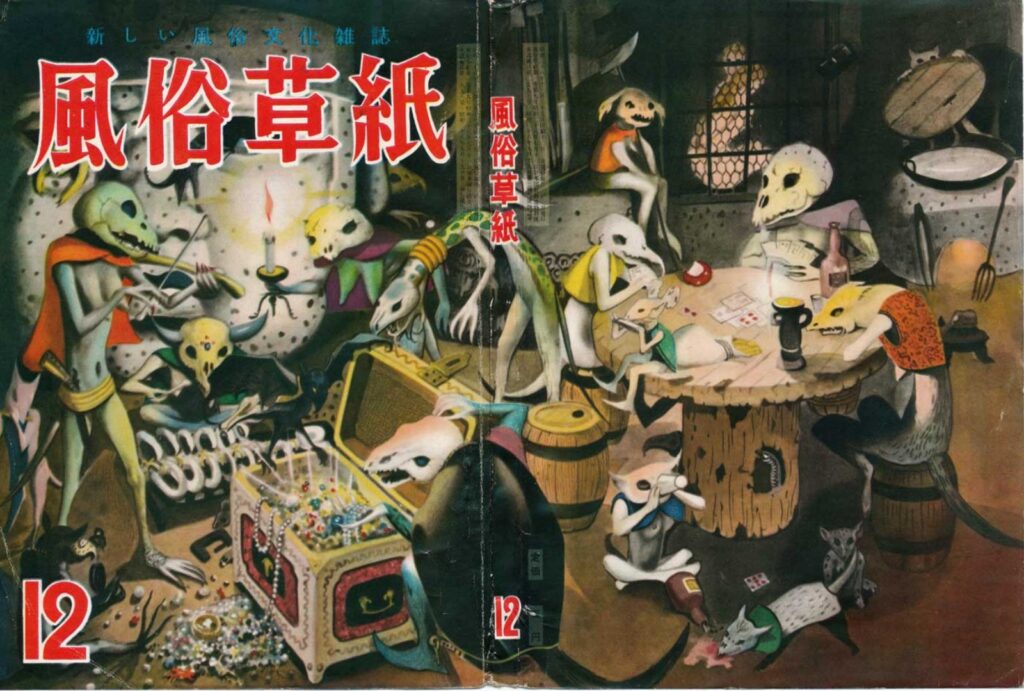
- The cover depicts a secret indoor society of skeletal and masked creatures drinking, gambling, playing music, and gathering around treasure (PDF p. 1).
- Kitahara’s color plate presents a woman tightly bound and arched over a cylindrical support, emphasizing rope as sculptural composition (PDF p. 3).
- Nakagawa Ayako’s “The Woman Exhausted of Strength” shows women suspended or collapsed against trees, posts, and beams (PDF pp. 4–6).
- Itō Seiu introduces Meiji-period punishment prints, linking historical cruelty directly to the postwar magazine’s visual archive (PDF pp. 7–8).
- Kita Reiko’s “Six States of the Victim” classifies women through six arrangements of binding, inversion, compression, and exposure (PDF pp. 9–11).
- “The Structure of Humiliation,” directed by Itō Seiu, uses staged photography to analyze rope, furniture, posture, costume, and unequal gaze (PDF pp. 12–15).
- Kita Reiko’s “Pictures of Ecstatic Cruelty” turns etsugyaku into an almost abstract visual genre in which the arrangement itself performs the torment (PDF p. 16).
- “Research Notes on the Wooden Horse” combines punishment history, experiential inquiry, and illustrations of women positioned on wooden devices (PDF pp. 20–25).
- “The Pleasure of Binding and the Pleasure of Being Bound” explicitly divides rope experience into active and receptive forms of pleasure (PDF pp. 26–34).
- “The Room of the Beast” uses first-person confession to blur testimony, animality, compulsion, and erotic fantasy (PDF pp. 35–41).
- The continued “Dream Demon” carries bondage into a shifting world of nightmare, altered consciousness, and involuntary desire (PDF pp. 42–52).
- “The Sexual Desire of Filth-Fetishism” combines psychiatric classification with detailed accounts of dirt, waste, smell, and contamination (PDF pp. 53–59).
- “The Hypnotic Therapist” uses medical authority and hypnosis to turn treatment into a structure of erotic control (PDF pp. 60–71).
- “What Kind of Man Is a Masochist?” attempts to classify male masochism as an identifiable personality and erotic disposition (PDF pp. 72–75).
- “The Knife Man,” “Hell of Fire Punishment,” the abnormal-murder study, and Kita Reiko’s “Reiko’s Twelve Months: Fog” connect cutting, historical torture, criminology, and seasonal bondage (PDF pp. 76–104).
Contributors
Named contributors represented in this issue: