KK Correspondence
December 1952
← Back to magazine archive
Issue Details
- Volume
- 6
- Issue
- 12
- PDF pages
- 4
Summary
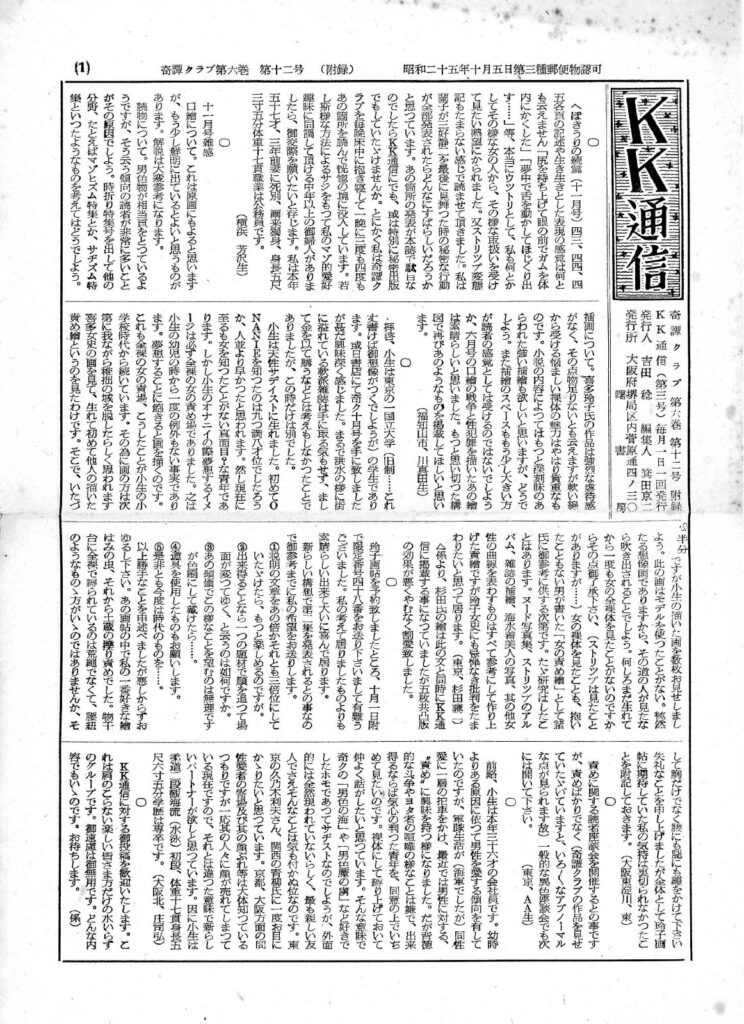
This December 1952 issue of KK Correspondence is a compact four-page supplement to Kitan Club, Volume 6, Number 12. It functions less as an independent magazine than as a reader-community bulletin combining correspondence, serialized fiction, critical commentary, notices, and short literary material. Its editorial identity is strongly participatory: readers respond to earlier issues, discuss personal interests, propose meetings, comment on visual art and erotic literature, and negotiate the practical boundaries of an emerging community organized around Kitan Club.
Read full summary Close full summary
Loading PDF…
Highlights
- The opening correspondence section documents readers attempting to organize meetings, exchange photographs and publications, and build personal connections through the magazine’s postal network. (PDF p. 1).
- Gyōda Kazuko’s “Picture of Hell” begins as a sensational first-person story of marriage, betrayal, jealousy, crime, and planned revenge, accompanied by an illustration of a restrained woman. (PDF p. 2).
- The reader-forum essay “Seeing the Belgian Modern Art Exhibition” discusses modern images of distorted, exposed, and suffering bodies, connecting avant-garde art with the magazine’s interest in cruelty and eroticized vulnerability. (PDF p. 3).
- Kita Reiko’s “‘Torment’ and Me” reflects on the psychological and bodily meaning of seme, combining fear, fascination, memory, and artistic imagination in a personal critical voice. (PDF p. 3).
- Advertisements for bondage photographs, manuscript submissions, subscriptions, and direct-purchase membership show the commercial infrastructure supporting the magazine’s reader culture and visual archive. (PDF p. 3).
- Kosugi Eiichi’s “True Affection” uses rapid dialogue among several characters to dramatize secrecy, jealousy, sexual rivalry, and emotional manipulation. (PDF p. 4).
- The closing short-correspondence column and editorial notices return the issue to its central function as a forum linking readers, writers, artists, collectors, and the editorial office. (PDF p. 4).