Sun & Moon
December 1977
← Back to magazine archive
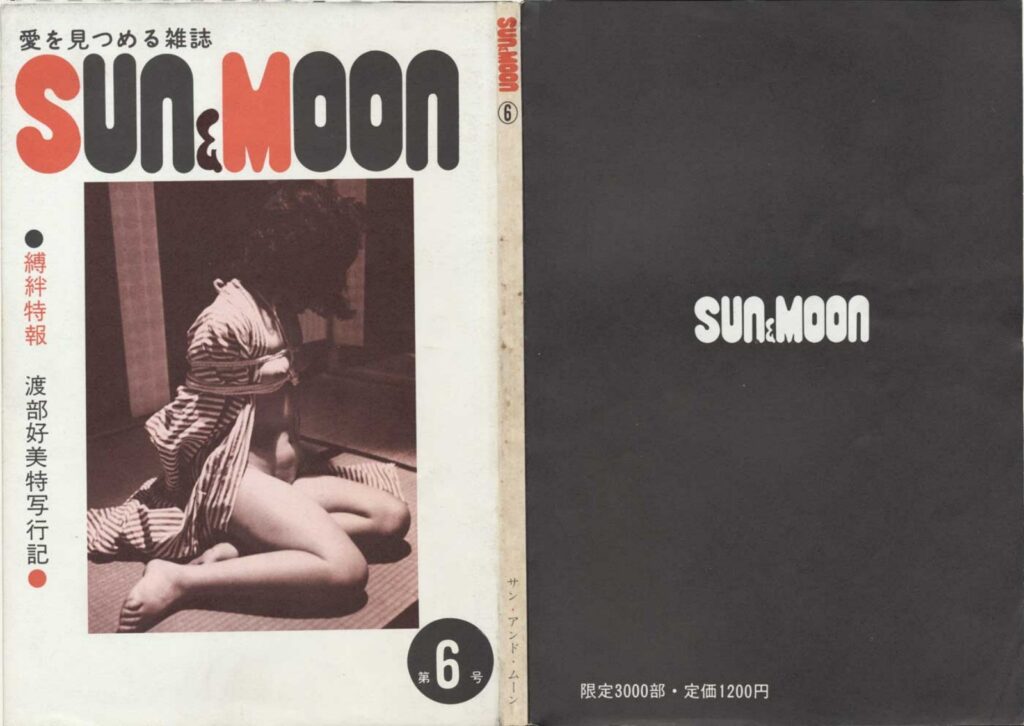
Issue Details
- PDF pages
- 118
Summary
The sixth issue of Sun & Moon, published in December 1977, continues the magazine’s distinctive project of turning private SM practice into a participatory print culture. Its central subjects are amateur photography, domestic rope play, practical equipment design, marital relationships, personal confession, bodily fetishism, and the exchange of ideas among readers.
Read full summary Close full summary
Table of Contents 25 items
-
Special Photographs of Watanabe Yoshimi
Summary
A photographic feature on Watanabe Yoshimi depicts a model in staged rope-bondage scenes, including overhead suspension, spread-eagle restraint, blindfolding, and bindings arranged across the body.
-
Photographic Record of Watanabe Yoshimi
Summary
A photographic feature documenting Watanabe Yoshimi through an accompanying narrative about staged rope-bondage sessions arranged with her husband and photographer Seta Kaiichi. The images show her blindfolded, gagged, tied in varied positions, and suspended or restrained in domestic settings.
-
Design for an SM Playroom
Summary
Taga Kin presents a detailed concept for constructing an SM playroom, framed as a synagogue-like private space and illustrated with exterior, floor-plan, interior, and construction images. The proposal incorporates movable and temporary posts, suspension pulleys, platforms, curtains, and adaptable wooden structures for varied bondage and suspension activities.
-
On Making SM Films
Summary
A behind-the-scenes account of producing SM films, centered on the making of 貴婦人・縛り壺 and related productions. The director discusses casting, scripts, budgets, locations, rope arrangements, performer direction, filming techniques, censorship, and the practical difficulties of staging bondage scenes, accompanied by film stills.
-
Forms of Love
Summary
An essay reflecting on changing representations of bondage and SM, questioning rigid distinctions between normal and abnormal desire. It presents SM as one possible form of love and considers the roles of personal feeling, social judgment, and erotic media.
-
Bondage Memoir: The Pleasure of Serving as a Beast of Burden
Summary
A mixed memoir and photographic feature recounting a married woman’s submission to her husband through domestic rope bondage, gagging, blindfolding, crawling, and suspension. The accompanying images document staged scenes of ritualized restraint and service within the home.
-
The Woman Who Came from the North Like a Wild Goose
Summary
A photographic feature presenting a woman from “the North” in a sequence of staged rope-bound poses, including kneeling, reclining, and floor-based restraint. The imagery emphasizes theatrical erotic submission and the visual display of bondage.
-
Record of Bondage and Erotic Torment
Summary
Ichinose Sōshi’s photographic record documents elaborate scenes of bondage and erotic torment, with a woman tied, blindfolded, and arranged in varied seated, standing, and reclining positions. The feature foregrounds rope work, restrictive posture, and staged erotic spectacle.
-
An M-Woman Is Better Plump
Summary
A photographic portfolio presenting a plump “M-woman” in staged scenes of nudity, collaring, blindfolding, chaining, and submissive display. The images emphasize her body and ritualized restraint as erotic spectacle.
-
Pet Miko
Summary
A photographic feature depicting “Miko” as a collared and leashed pet, posed on the floor and subjected to controlled, physically restrictive positions. The imagery combines pet-role presentation with staged dominance and submission.
-
Tanigawa Kiyoshi Photo Report
Summary
A photographic report by Kiyoshi Tanigawa depicting models subjected to elaborate rope bondage, restraint, blindfolding, gagging, and staged punishment scenes. The sequence includes indoor positional bondage and outdoor/tree-based restraint imagery.
-
S’s Wife: A Record of Late-Night Outdoor Torment
Summary
A photographic record of S’s wife undergoing a late-night outdoor bondage scene, with the restrained and blindfolded woman posed against a tree and a vehicle. The images emphasize public or outdoor exposure, immobilization, and staged torment.
-
Yamagata-Style Pillar Frame
Summary
An illustrated feature presenting a Yamagata-style pillar-frame apparatus for securing a person in a spread-eagle posture. Diagrams show the frame’s construction and attachment points, emphasizing its use as a structured bondage device.
-
My SM Play Technique, Part Three: Variant Suspension
Summary
The third installment of a practical SM technique series explaining variant suspension methods. It combines instructional text, diagrams, and photographs of rope suspensions involving different body positions, attachment points, and support arrangements, with attention to stability and minimizing discomfort.
-
Urethral Masturbation and Foreign-Object Insertion
Summary
An instructional and anecdotal article on urethral masturbation and the insertion of foreign objects, discussing devices, techniques, bodily sensations, and reported experiences involving both men and women. It also addresses precautions, hygiene, possible complications, and the use of catheters and other implements, accompanied by erotic illustrations.
-
Sex-Slave Record, Part One
Summary
The first part of Suzui Koreo’s personal “sex-slave record” combines autobiographical testimony with photographs and diagrams of bondage scenes, restraints, and handmade devices. It describes experiences of submission, sensory restriction, gagging, penetration, and the construction and use of specialized apparatus, while reflecting on sexual preference, pain, fantasy, and the presentation of SM practices in specialist publishing.
-
First Bondage Experience of a Sow-Type M-Woman
Summary
An erotic reportage account follows an M-oriented woman through her first extended bondage session, arranged and photographed by the author. The sequence depicts rope bondage in several positions, escalating restraint and exposure, verbal direction, and an enema-related scene as part of the staged experience.
-
Fantasies Inspired by Beautiful Breasts
Summary
An extended discussion of breast-focused SM fantasies and practices, drawing on Scandinavian and Japanese erotic magazines, personal reactions, and photographic examples. It considers breast sensitivity, bondage and suspension techniques, clamps, impact, nursing imagery, and the relationship between physical pain, restraint, and erotic response.
-
Echoes from the City
Summary
An illustrated reader/artist feature centered on a drawing of a bound, heavy-set woman and the artist’s stated preference for depicting fat women. The accompanying text discusses erotic and SM illustration, artistic aims, reader requests, and the possibility of continuing this kind of visual work.
-
I Am a Witness to a Married Couple’s SM Play
Summary
A first-person account of a married couple’s SM practice, presenting marital play as a stable and mutually satisfying form of participation. The article also discusses SM photography, magazine exchange, and the need for readers to contribute images and support specialist publishing.
-
Miscellaneous Thoughts on Valuable Photographs
Summary
An essay on the aesthetics and emotional effect of “punishment photographs,” arguing that convincing images should convey pain, disorientation, vulnerability, and a threatening environment rather than merely staged enjoyment. It considers camera direction, models’ expressions and posture, disordered clothing or hair, and dark or decaying settings as elements of photographic realism.
-
The Fourth Afterword
Summary
An editorial afterword reflects on the planning and production of the fourth issue, arguing that restraint photography should have artistic and research value rather than become mere pornography. It also discusses models, photographers, rope practitioners, image selection, page design, reader submissions, and the magazine’s role as a serious specialist publication.
-
A Request
Summary
A reader request praises model Sano Misako’s submissive performances and asks that she appear in a future issue, while offering personal assistance with reporting or photo production. The correspondence combines admiration for female submission with a self-description centered on mountaineering and climbing experience.
-
Reader Photographs, Notices, and Group Information
Summary
A reader-oriented section presenting bondage photographs alongside notices about photo submissions, model opportunities, correspondence, and SM group or meeting activities. It emphasizes participation in the magazine’s reader network and the exchange of erotic images and information.
-
Transformative Arousal
Summary
An illustrated erotic narrative or reflection centered on Mrs. Watanabe, whose experience of coercive treatment, humiliation, and bodily stimulation transforms her erotic response. The piece explores the overlap of sadistic fantasy, masochistic desire, and staged bondage imagery.
Highlights
- “Special Photographs of Watanabe Yoshimi” uses ceiling beams, pillars, floor anchors, and bedding to turn an ordinary Japanese room into a complete restraint environment (PDF pp. 3–6).
- Urado Hiroshi’s photographic memoir combines image-making, dominance, and narration, making the photographer the interpreter of the model’s experience (PDF pp. 9–25).
- “Design for an SM Playroom” provides floor plans, elevations, construction diagrams, and imagined interior views of a purpose-built SM structure (PDF pp. 26–29).
- The proposed playroom named Synagogue treats SM space as both workshop and quasi-ritual environment (PDF pp. 26–29).
- “On Making SM Films” discusses cameras, performers, continuity, staging, location, and editing as practical problems of amateur erotic cinema (PDF pp. 30–43).
- Film stills of horse restraint, rain scenes, and large wooden frames show how cinema expanded SM beyond domestic photography (PDF pp. 33–41).
- Kawabe Seiya’s “Forms of Love” asks how SM relates to trust, intimacy, jealousy, and long-term emotional bonds (PDF pp. 44–45).
- “The Pleasure of Serving as a Beast of Burden” gives a submissive wife a first-person voice while documenting floor restraint, chains, upright bondage, and inversion (PDF pp. 46–54).
- “An M-Woman Is Better Plump” explicitly challenges narrow beauty ideals and makes softness, weight, and bodily mass central to submissive imagery (PDF pp. 63–65).
- The late-night outdoor photo report uses automobiles, trees, roadsides, and walls as improvised restraint environments (PDF p. 70).
- Taga Kin’s “Yamagata-Style Pillar Frame” transforms a pillar into a purpose-built wooden apparatus with detailed construction features (PDF p. 71).
- “My SM Play Technique, Part Three” presents variant suspension as a technical and compositional practice (PDF pp. 72–77).
- “Urethral Masturbation and Foreign-Object Insertion” broadens the magazine’s definition of SM through quasi-medical discussion of self-experimentation and instruments (PDF pp. 78–82).
- “First Bondage Experience of a Sow-Type M-Woman” links body type, humiliation, first-time restraint, and the formation of submissive identity (PDF pp. 91–98).
- “Fantasies Inspired by Beautiful Breasts” turns one body part into an extended field of fetish theory, rope technique, and imported visual reference (PDF pp. 99–107).
Contributors
Named contributors represented in this issue:
- Chiba Ōtsuka Akira
- Chiba Shinkiyomaru
- Ichinose Mayumi
- Ichinose Sōshi
- Inayama Tamio
- Kawabe Seiya
- Kawasaki and Oyama Ryūji
- Mutsuki Fueichirō
- photographs supplied by Takeuchi Iwao
- Roman-ha Sei
- Shima Shikō
- Suzui Koreo
- Taga Kin
- Tanigawa Kiyoshi
- Toda Shigeyuki
- Urado Hiroshi
- Urado Hiroshi; photography by Seta Kaiichi
- Watanabe Yoshimi