Beautiful Bondage
February 1966
← Back to magazine archive
Issue Details
- Issue
- 10
- PDF pages
- 32
Summary
The February 1966 installment of Beautiful Bondage identifies itself as the tenth collection in the limited-edition 美しき縛しめ photographic series. Like the earlier anthology-oriented volumes, Collection 10 presents a broad survey of bound women rather than a single sustained narrative. The photographs are densely arranged, commonly three or four to a page, and many carry handwritten Japanese comments describing the pose, bodily effect, restraint, or model. The result resembles an annotated photographic notebook in which rope technique, body type, expression, and staging are continuously compared.
Read full summary Close full summary
Loading PDF…
Highlights
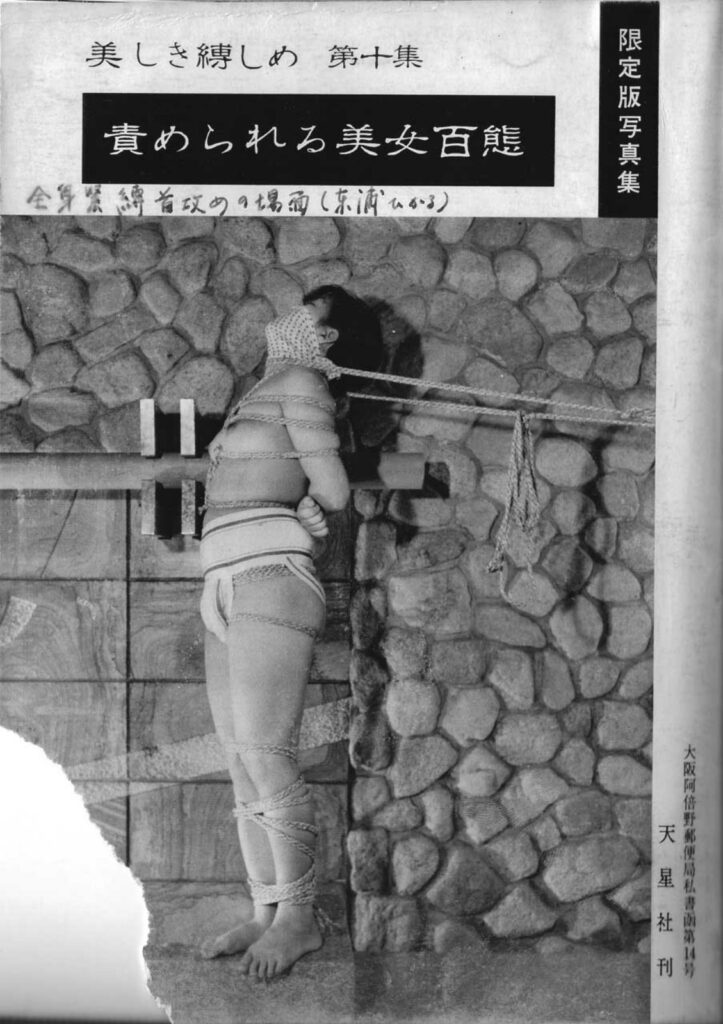
- The cover identifies the publication as the tenth Beautiful Bondage collection and presents a standing gagged model bound against a stone setting, establishing the volume's anthology of varied restraint poses. (PDF p. 1).
- The opening pages juxtapose compact floor bondage, kneeling chest restraint, rear-arm ties, gags, and several different body types, with handwritten annotations functioning as brief commentary on the photographs. (PDF pp. 2–4).
- Several early sequences emphasize suspension and environmental restraint, including an inverted outdoor hanging pose, tree bondage, and women tethered to architectural or overhead anchor points. (PDF pp. 4–5, 9, 11).
- The central portfolio repeatedly shows rear-arm and chest bondage from multiple angles, revealing the structure of the rope across the shoulders, upper arms, back, breasts, waist, and wrists. (PDF pp. 6–13).
- A tiled bath setting provides one of the issue's more unusual environments, contrasting patterned bathing-room surfaces with a model restrained in rope and a patterned garment. (PDF p. 18).
- The volume repeatedly explores the physical effects of tight torso restraint through close views of compressed flesh, arched backs, twisted shoulders, and models folded into compact floor positions. (PDF pp. 13–22).
- Several photographs incorporate the binder or an external manipulating hand, including scenes in which the model's head or face is handled and restraint is actively adjusted rather than merely displayed as a finished pose. (PDF pp. 12, 20, 23–24).
- The later pages broaden the repertoire with pulley-assisted restraint, standing and kneeling chest bondage, cloth gags, outdoor rock settings, and tightly controlled rear-arm poses. (PDF pp. 22–30).
- The final photographic tableau binds a woman spread across a rough wooden frame, using the structure as a four-point restraint apparatus and giving the volume a particularly theatrical conclusion. (PDF p. 32).
- The colophon identifies the publication with the shorthand 美10, names Tenseisya of Abeno, Osaka as publisher, states that it is not sold through bookstores, and gives the limited-edition price as 1,000 yen. (PDF p. 32).