Kitan Club
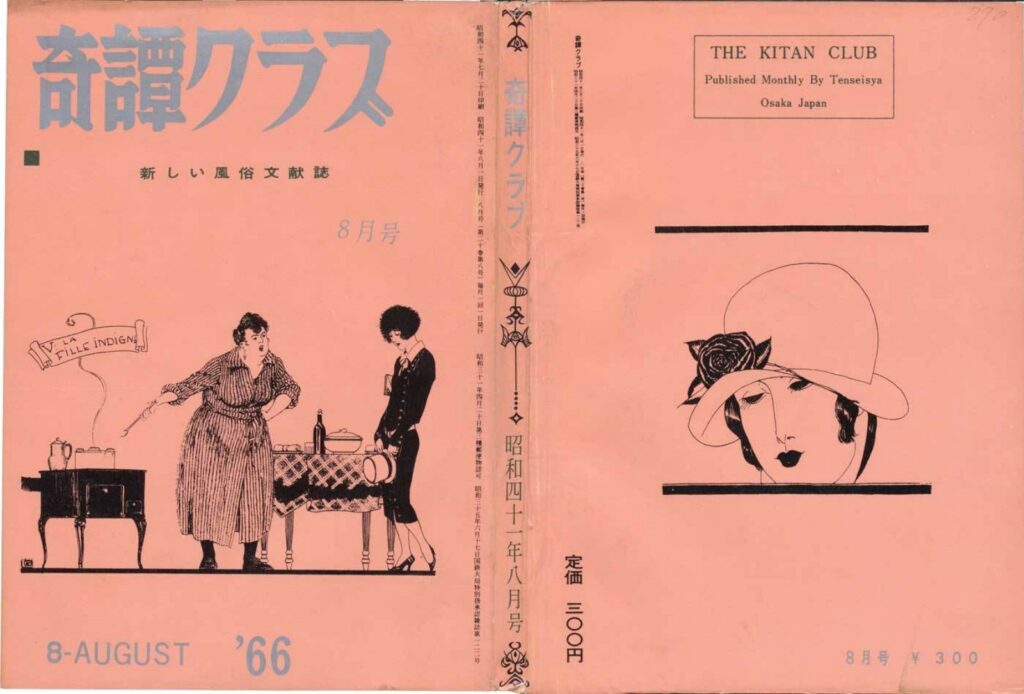
August 1966
← Back to magazine archive
Issue Details
- PDF pages
- 153
Summary
The August 1966 issue of Kitan Club presents a magazine that has changed substantially from its early-1950s form. Bondage, sadism, masochism, fetishism, queer desire, confession, and reader communication remain central, but they are now organized through a much denser network of columns, serialized fiction, letters, editorial commentary, photographic documentation, and reports on contemporary SM practice. The issue feels less like a cabinet of strange curiosities and more like an established subcultural forum with its own recurring personalities, debates, technical language, reader expectations, and commercial ecosystem.
Read full summary Close full summary
Table of Contents 32 items
-
Kiki Salon
Summary
A fictional domestic SM narrative portrays a husband introducing his initially reluctant wife to bondage, sensory restriction, and ritualized marital discipline.
-
To Our Women Readers Who Have Written, or Are Thinking of Writing
Summary
This editorial addressed to women readers encourages them to submit writing about intimate experiences and offers practical guidance on presenting sexual, psychological, and bodily material for publication.
-
Kinaku, Part Two
Summary
The second installment on gags discusses direct and indirect ways of depicting gagging and related restraint in erotic writing, accompanied by illustrations of gag apparatus and a photographic example of physical discipline.
-
How I Seek It
Summary
A visual feature by Takarazuka Mitsuo presents his approach to erotic punishment through illustrations and a photograph demonstrating a gag and its fastening, alongside reflections on depicting bodily restraint and the subject’s psychological experience.
-
Impressions of Fukuda Hisabumi
Summary
This character portrait, prompted by a letter from Fukuda Hisabumi, dwells on his feminine manner of writing, refined youthful appearance, intellectual interests, and the erotic possibilities of cross-dressing, restraint, and concealed desire.
-
Brief Correspondence
Summary
An editorial correspondence column answers several readers, acknowledging their letters and discussing their SM-related questions, impressions, and submissions as part of the magazine’s ongoing reader community.
-
A Woman’s Confession: The Lady-in-Waiting’s Bloody Duel
Summary
An erotic narrative and visual feature built around the “Lady-in-Waiting’s Bloody Duel” image, describing a woman observed, posed, and subjected to violent and bondage-themed treatment. The accompanying illustration and photograph emphasize severed-head imagery, theatrical staging, and the spectacle of the bound female body.
-
Film Correspondence: Bondage Scenes on Television
Summary
A critical column examines bondage scenes in NHK television dramas, especially the depiction of a female criminal accomplice being tied and interrogated. It discusses the conventions, camera treatment, realism, and sensational appeal of televised rope-bound scenes.
-
The Character “Rope”
Summary
A personal essay reflects on the erotic and psychological power of the Japanese character 縛 (“to bind”), including the writer’s fascination with women tied by rope and fantasies of solitary suspension. The piece invites readers to consider their own responses to rope bondage and restraint.
-
Salon Practice Record
Summary
Tsujimura Takashi’s recurring salon column recounts his efforts to find women willing to model for SM photographs, including planned outings, correspondence from fellow enthusiasts, and repeated successes and disappointments in “camera hunting.”
-
SM Photographs
Summary
This photographic feature presents staged S/M scenes involving female performers, including female domination, male submission, restraint, bodily fluids, and the elaborate posing and production of erotic photographs.
-
The Rubber Raincoat and the Wife
Summary
Tsuda Akiko’s erotic narrative follows a wife whose fascination with a rubber raincoat develops into a fetishized domestic fantasy involving its texture, shine, handling, and relationship to her husband and marriage.
-
My Encounter with Kurobuchi Eiichi
Summary
Fukuda Hisabumi offers a literary portrait of his encounter with Kurobuchi Eiichi, recalling Kurobuchi’s hospitality, distinctive personality, erudition, and creative work while praising the authenticity and imaginative force of his writing.
-
A Satirical Review of Recent Society
Summary
Kuroi Chinpei’s satirical column comments on contemporary Japanese news, taxation, policing, censorship, and social conformity, accompanied by an erotic-grotesque illustration titled “Bird-Beast Play” by Muroi Asaraji.
-
Kitan Club, Escape Vulgarization!
Summary
Hanayama Kaoru argues that erotic magazines and related mass media must resist vulgarization, reject formulaic sensationalism, and pursue more intellectually and psychologically substantial writing and editorial standards.
-
Aigan Yūko’s Bondage Poses
Summary
A photographic feature presents Aigan Yūko posed nude and bound with rope around her torso and breasts, emphasizing the visual arrangement of the restraint.
-
My Fantasy: The Torture of a Female Spy
Summary
This fictional fantasy narrates female spy Keiko’s capture, public execution by firing squad, hanging, and cremation, dwelling on her helplessness and the spectacle of punishment.
-
Women’s Sea-Fishing Course: No Need to Worry About That
Summary
A practical feature encourages women to take up sea fishing and explains suitable equipment, preparation, and techniques while addressing concerns about women’s ability to fish independently.
-
My Master
Summary
A first-person account by a devoted male servant describes life under the control of an elegant female doctor, including her rules, clothing, grooming, feeding, transportation, and disciplinary expectations.
-
Our Magazine’s Creed
Summary
The editorial department states the magazine’s publishing principles: it targets adults, excludes minors, promotes serious and peaceful social life, avoids provocative imagery, limits advertising, and gradually refines its literary and visual presentation.
-
A Spring Night Is Worth a Thousand Pieces of Gold
Summary
An extended illustrated interview with Masuda Kiyoshi and Miyuki explores a married couple’s elaborate SM practices, including bondage, nose-focused punishment, slave-machine apparatus, role play, photography, and the negotiation of shared erotic interests.
-
My Wife’s Nose Is Mine
Summary
A dark erotic narrative follows a man’s obsessive fixation on his wife’s nose as he turns marital intimacy into increasingly coercive, fetishistic control involving restraint, humiliation, and bodily threat.
-
Burlesque Biographical Sketches
Summary
This episodic burlesque fiction presents grotesque biographical sketches of men and women engaged in elaborate scenes of sexual domination, bondage, punishment, humiliation, and role reversal.
-
A Certain Spring Labor Offensive
Summary
A serialized SM fiction narrative set amid a factory labor dispute, in which Eiko is targeted by coworkers and union activists and subjected to escalating coercion, bondage, exposure, photography, and humiliating punishment.
-
A Journey of a Wounded Heart: Threads Woven Together, Part Four
Summary
The fourth installment of this serialized erotic novel follows prison guards, police, and female detainees through investigations, arrests, confinement, and shifting schemes of coercion, with extensive scenes of handcuffing, binding, gagging, interrogation, humiliation, and sexualized power. The narrative also develops the characters’ troubled histories, loyalties, and forbidden desires.
-
Scarlet Lips of Sadism
Summary
A fictional first-person sadistic narrative depicts the coercive domination, restraint, punishment, humiliation, and bodily torment of a woman by a male tormentor, escalating through repeated scenes of bondage and sexualized violence.
-
A Record of Apologizing to a Friend
Summary
A confessional literary account describes an uneasy correspondence and friendship shaped by shared interest in enema practices, fetish materials, and the author’s eventual attempt to apologize for his intrusive or excessive behavior.
-
Monkey Bird, Continued
Summary
This serialized SM fiction continuation follows Toyomura Rieko’s promotion to a managerial position at a food company, where gendered workplace authority becomes intertwined with sexualized domination, humiliation, discipline, and the use of fetish devices against male subordinates.
-
SM Camera Hunt: The Group of Cute Little Devils, Continued
Summary
A sensationalized first-person erotic reportage follows a photographer’s manipulative pursuit of Masumi and Yuriko, documenting staged encounters that escalate into rope bondage, restraint, and sexualized coercion. The accompanying photographs present the women in posed bondage scenes as part of the article’s erotic narrative.
-
Ariadne: A Reconstruction of Greek Myth
Summary
A fictional, eroticized reconstruction of the Greek Ariadne myth follows Ariadne, Theseus, and rival armies through political intrigue, warfare, captivity, punishment, and repeated rope restraint, emphasizing shifting gendered power and female martial authority.
-
Pleasurable SM Play in Disguise
Summary
A first-person account describes a married couple’s elaborately costumed SM role-play, in which staged restraint, costume changes, and reciprocal performances turn domestic sexual play into an extended theatrical scenario.
-
Bewitched by the Rope
Summary
This personal essay traces the author’s fascination with kinbaku through memories of erotic photographs, films, magazines, historical imagery, and imagined scenes of women being bound, while reflecting on the psychological appeal of rope restraint.
Highlights
- The opening reader columns reveal a mature correspondence culture in which rope, models, stories, films, and earlier issues are discussed as shared subcultural knowledge (PDF pp. 6–13).
- Several short essays consider the meaning of nawa, the written character for rope, and the distinction between ordinary restraint and erotic binding (PDF pp. 8–12).
- The “film correspondence” column examines bondage scenes in television and cinema and how mainstream media represents or distorts SM imagery (PDF p. 11).
- “A Thousand Pieces of Pure Gold in One Spring Night” presents an extended conversation with Masuda Kiyoshi and Miyuki about photography, rope, models, and SM practice (PDF pp. 23–30).
- The accompanying photographs show elaborate chair and frame bondage, revealing the increasingly technical and apparatus-based side of 1960s SM photography (PDF pp. 27–29).
- “The Wife’s Nose Is Mine” relocates fetishism into humorous domestic marriage and everyday bodily intimacy (PDF pp. 31–40).
- “The Red Candle of Abuse” is presented as a reader-submitted sadistic short story, illustrating the magazine’s continuing role as an entry point for amateur writers (PDF pp. 87–101).
- “Record of Playing with a Friend” uses first-person confession to blur lived experience, fantasy, and editorial reconstruction (PDF pp. 102–104).
- “Monkey Bird” adapts foreign enslavement and domination material for a Japanese SM readership (PDF pp. 105–110).
- “The Dramatic History of a Wounded Heart” is a long serialized psychological melodrama of desire, manipulation, crime, and emotional dependency (PDF pp. 71–86).
- “SM Camera Hunt: The Group of Cute Little Devils” presents bondage as a process involving posing, adjustment, dialogue, and photographic staging rather than only finished images (PDF pp. 111–129).
- The photo sequence includes standing bondage, floor restraint, chest harnesses, arms-behind positions, wall or doorway restraint, and extended tatami scenes (PDF pp. 112–128).
- “Pleasurable SM Play in Disguise” combines costume, masks, amateur role play, comedy, and physical domination in a domestic photographic sequence (PDF pp. 141–144).
- “Bewitched by the Rope” recounts the gradual development of a reader’s fascination with bondage through magazines, images, memory, and participation (PDF pp. 145–150).
- “Ariadne” reconstructs Greek myth through the labyrinth, sacrifice, sexuality, captivity, and the symbolic thread linking hidden worlds (PDF pp. 127–140).
Contributors
Named contributors represented in this issue:
- Chigusa Tadao
- Dorei Niro
- Editorial Department
- Fukuda Hisabumi
- Hanayama Kaoru
- Hayaki Yumeji
- Ikura Shunji
- Inagyō Yoshiko
- Katsurayama Eiji
- Kawazu Yasuharu
- Kurobuchi Eiichi
- Kuroda Hisashi
- Kuroi Chinpei
- Masuda Kiyoshi
- Masuda Kiyoshi and Miyuki
- Mihara Hiroshi
- Nitta Hideo
- Saijō Misao
- Saitō Kaneharu
- Saniwa Kazuo
- Suiura Chō
- Takahashi Kazuo
- Takarazuka Mitsuo
- Tsuda Akiko
- Tsujimura Takashi
- Yamaguchi Hiroshi
- Yanagawa Shigeo