Fuzoku Soshi
August 1954
← Back to magazine archive
Issue Details
- PDF pages
- 170
Summary
The August 1954 issue of Fūzoku Sōshi is organized around captivity, sexual crime, forensic investigation, queer correspondence, psychological abnormality, and sensational fiction. Compared with issues dominated by explicit rope portfolios or historical punishment art, this number leans heavily toward crime narratives and detective reportage. Yet its opening photographs, illustrated fiction, correspondence columns, and clinical case studies retain the magazine’s larger fascination with bodies being restrained, exposed, examined, and interpreted.
Read full summary Close full summary
Table of Contents 23 items
-
Black Cat and Bizarre Show
Summary
A visual feature pairing an illustrated scene of a frenzied banquet with a photographic stage act presented as a bizarre show. The imagery emphasizes theatrical spectacle, bodily display, and sensational entertainment.
-
Torment Picture
Summary
A color illustration titled 「踏み絵」 (fumie) depicts a kimono-clad woman kneeling over and apparently stepping on a Christian image or emblem. The composition evokes the historical persecution of Christians in Japan through a sensualized torment-picture motif.
-
Latest American Uproar Photo Special
Summary
A photographic feature presenting staged American fetish scenes, including men and women bound with ropes, suspended or restrained by furniture and vehicles, and posed in elaborate dominance scenarios. The accompanying commentary emphasizes the novelty, ingenuity, and polished presentation of these imported erotic images.
-
Women Who Abuse Men
Summary
A photographic feature depicting women physically dominating and humiliating men in staged scenes, including the use of ropes, props, and apparent striking or punishment. The images foreground female aggression and reversal of conventional gender power roles.
-
Pitiable Punishments
Summary
A photo- and illustration-based feature depicting women receiving spanking and other forms of corporal punishment in purported Western domestic and school settings. Captions emphasize forced exposure, embarrassment, and the spectators’ reaction, presenting discipline as a pitiable and humiliating spectacle.
-
The Rain Does Not Cease, Part Four
Summary
Part four of the serialized erotic melodrama follows the tangled relationships among Sayoko, Kikuchi, Yuki, and their associates. Jealousy, deception, coercion, and scenes of restraint and abuse intensify as the characters move between private rooms, theatrical circles, and everyday urban settings.
-
The Taishō-Era Villain: Kin-kei no Kame
Summary
A dramatized account of Ikeda Kamegorō, the notorious Taishō-era criminal known as “Kinkei no Kame.” The narrative follows his violent crimes, robberies, disguises and escapes, the police investigation and pursuit across western Japan, and his eventual apprehension, accompanied by sensational black-and-white illustrations.
-
Crucifixion Ship
Summary
An illustrated Edo-period erotic crime tale follows a group of men who abduct and exploit women in boats, bathhouses, and pleasure-quarter settings. The narrative dwells on coercion, bodily display, tattooing, and grotesque sexual spectacle, with recurring confrontations among gang members, victims, and intermediaries.
-
The Rainbow of the Enchantress, Part Three
Summary
The third installment of this erotic supernatural mystery follows Akaboshi Jirō and his wife as their troubled domestic and sexual relationship becomes entangled with a witch-like figure, occult manipulation, grotesque mannequins, and disturbing dream imagery. Dialogue and narrative reflection emphasize jealousy, repression, control, and the unsettling transformation of desire into psychological and physical threat.
-
The Tsukishima Driver Murder
Summary
A dramatized true-crime account of the murder of a driver in Tsukishima, tracing the discovery of the body, police inquiries, witness testimony, clues, and the pursuit and capture of the suspects. The narrative emphasizes investigative persistence, disguises and deception, and the reconstruction of the crime through interrogation and evidence.
-
Sodomia Correspondence
Summary
A correspondence and advice column addressing readers’ concerns about male same-sex attraction, romantic relationships, marriage, sexual anxiety, and social adjustment. Fujii Akira responds to individual case histories, discussing emotional and sexual development, partner-seeking, personal appearance and conduct, and the pressures of family and conventional expectations.
-
A Crime Scene with Bodily Fluids
Summary
An illustrated true-crime account follows a violent nighttime incident in a rural community and the police investigation that reconstructs what happened. Blood, bodily-fluid traces, wounds, footprints, testimony, and alibi checks gradually undermine the initial account and help expose the killer and the staged circumstances of the crime.
-
Lesbos Correspondence
Summary
A conversational salon narrative follows women meeting in cafés, beauty salons, and private settings while discussing fashion, cosmetics, travel, romance, and relationships with other women. Through lively dialogue and illustrated scenes, it depicts lesbian social networks, flirtation, jealousy, emotional uncertainty, and the search for companionship in mid-century urban nightlife.
-
Abnormal Escape
Summary
An illustrated pulp-fiction narrative follows Yoshida Senichi, a Japanese serviceman detained in postwar Saigon, as he repeatedly escapes confinement and moves through a dangerous landscape of military authorities, civilians, and clandestine shelters. His encounters with Vietnamese, Chinese, and Japanese women combine erotic fascination, coercion, violence, and psychological disorientation against the backdrop of postwar Indochina.
-
The Distorted Affair
Summary
A serialized, illustrated collection of comic and unsettling case narratives about distorted romantic and marital relationships. Through dialogues involving spouses, lovers, parents, and alleged sexual deviants, it explores abnormal desire, domestic conflict, gossip, deception, and socially disapproved behavior.
-
The Devil’s Gale
Summary
A dramatized true-crime casebook feature centered on the murder of nineteen-year-old Fumiko during a typhoon, when floodwater and chaotic conditions help conceal an assault and strangulation. The narrative follows witnesses, police investigators, documentary evidence, and forensic clues, while also presenting related crime-case vignettes involving domestic violence, concealed corpses, and criminal pursuit.
-
The Shiga Highlands Murder Case
Summary
A reconstructed murder-case investigation set in the Shiga Highlands, presented through an extended dialogue between investigators, journalists, and medical experts. The article examines witness statements, the victim’s clothing and bodily injuries, bloodstain patterns, autopsy findings, suspected sexual motives, and the competing interpretations of the evidence.
-
The Dancer’s Strange Death
Summary
An illustrated detective mystery about a dancer found dead under suspicious circumstances. Police investigate the room, physical evidence, witness statements, and conflicting alibis while readers are invited to identify the murderer from the clues.
-
Tokyo’s Bluebeard
Summary
A documentary-style true-crime account of a suspected serial wife murderer, reconstructed from police records, witness testimony, interrogations, and forensic examination of a woman’s corpse discovered in the ruins of postwar Shibuya. The narrative follows the investigation as officers identify the victim, trace the suspect’s movements and relationships, and uncover evidence of additional disappearances and killings.
-
Midsummer Tragedy
Summary
A young woman travels to Kagoshima to stay with her married sister, only to become entangled in a violent family mystery after the sister’s husband is found murdered and his body concealed. Detective questioning, conflicting testimony, and a disturbing dream gradually expose the relationships, motives, and hidden history behind the crime.
-
Autopsy of a Rape-Murder Corpse
Summary
A forensic crime report describing the examination of a woman’s corpse after rape and murder. The narrative explains how autopsy findings, bodily evidence, witness accounts, and investigative reasoning are used to reconstruct the assault and identify the perpetrator.
-
The Captured Wife
Summary
An illustrated true-crime account of a married woman who is abducted and later found dead, followed by the police investigation into her movements, associates, and killer. Physical traces, witness testimony, and interrogation gradually expose the circumstances of the murder.
-
Practice
Summary
An illustrated erotic fiction narrative set within a touring theater troupe, where rehearsals, backstage rivalries, and performances become entangled with sexual manipulation and coercive relationships. The story follows the narrator’s interactions with actress Mikiko, troupe leader Sawada, and other performers as theatrical practice blurs into private desire and power struggles.
Highlights
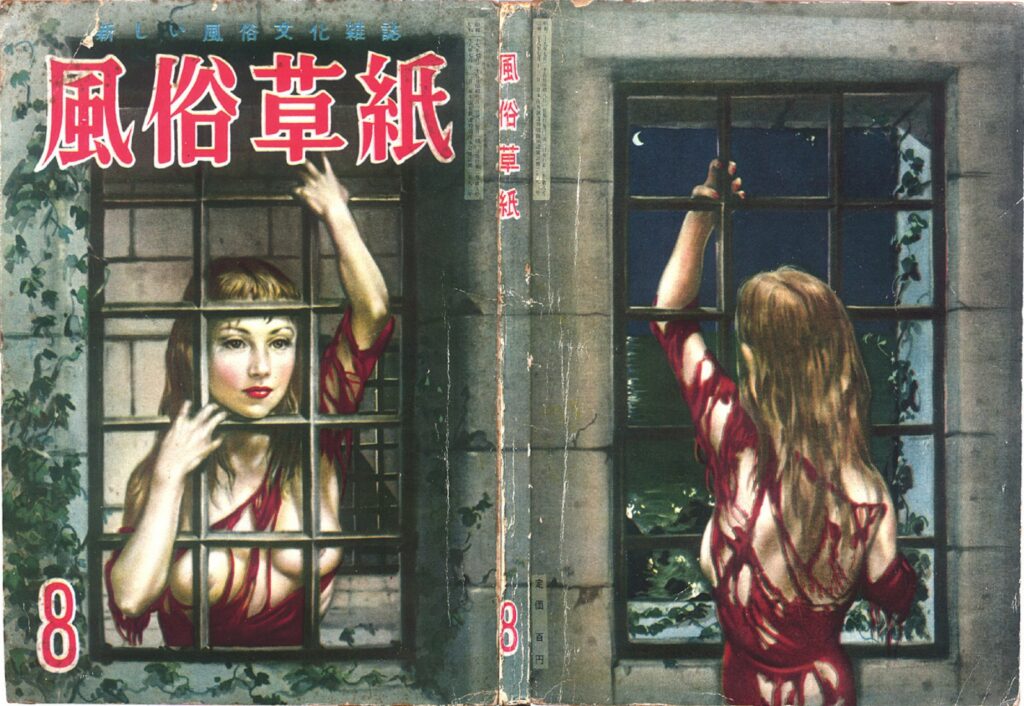
- The cover frames a partially exposed woman behind barred windows from front and rear, making captivity inseparable from visual display (PDF p. 1).
- The color “Torment Picture” uses rope, bent posture, disturbed kimono, and bare feet to present restraint as controlled movement (PDF p. 3).
- The American Uproar Photo Special surveys automobile restraint, chair bondage, inversion, whipping, and group binding (PDF pp. 4–7).
- “Women Who Abuse Men” reverses the dominant gender structure through images of whipping, trampling, and female command (PDF p. 8).
- “The Rain Does Not Cease” combines urban danger, sexual coercion, medical intervention, and unstable intimacy in a serialized abnormal novel (PDF pp. 12–22).
- “Kin-kei no Kame” reconstructs a Taishō-period criminal case through robbery, murder, pursuit, arrest, and evidence (PDF pp. 23–31).
- “Crucifixion Ship” turns cabins, decks, masts, rope, and maritime isolation into an enclosed system of coercion (PDF pp. 32–41).
- “The Rainbow of the Enchantress” uses drugs, suggestion, illness, and psychological manipulation to explain distorted desire (PDF pp. 42–53).
- “Sodomia Correspondence” lets male same-sex readers discuss loneliness, concealment, attraction, and hopes for contact (PDF pp. 63–69).
- “A Crime Scene with Bodily Fluids” transforms sexual traces, bodily evidence, and testimony into a forensic narrative (PDF pp. 70–79).
- “Lesbos Correspondence” presents women’s same-sex desire through letters about intimacy, isolation, secrecy, and recognition (PDF pp. 80–85).
- “The Shiga Highlands Murder Case” uses a remote landscape, corpse examination, witness statements, and physical clues to construct documentary suspense (PDF pp. 112–118).
- “Tokyo’s Bluebeard” relocates the serial-wife-killer archetype into modern Tokyo and treats domestic intimacy as potential predation (PDF pp. 126–134).
- “Autopsy of a Rape-Murder Corpse” turns wounds, sexual evidence, and decomposition into objects of medical and reader inspection (PDF pp. 144–149).
- “Practice” begins after the apparent 150-page boundary and continues through the true final page, concluding the issue with a story of instruction, secrecy, and asymmetrical desire (PDF pp. 156–170).
Contributors
Named contributors represented in this issue:
- Aoyama Natsuki; illustrations by Natsume Hiroshi
- Fujii Akira
- Hamada Shirō; illustrations by Kanzaki Isao
- Hoshi Hideo
- Matsui Raiko; illustrations by Muramura Reiko
- Miki Takeshi; illustrations by Kanzaki Isao
- Mitani Shōsuke
- Mitani Shōsuke; illustrations by Tsunakawa Gōji
- Muramatsu Rokurō; illustrations by Jinnō Shigeharu
- Ogihara Hideo; illustrations by Ikegawa Tomo
- Onda Ichirō; illustrations by Oda Akio
- Ryūtōji Yū
- Sekine Jun; illustrations by Tsukida Hiroshi
- Shimamoto Haruo; illustrations by Furumasa Eikichi
- Somekawa Tatsuyuki; illustrations by Oda Akio
- Sonomura Keiko
- Sunagawa Sakae
- Takenō Tōsuke