Kitan Club
August 1954
← Back to magazine archive
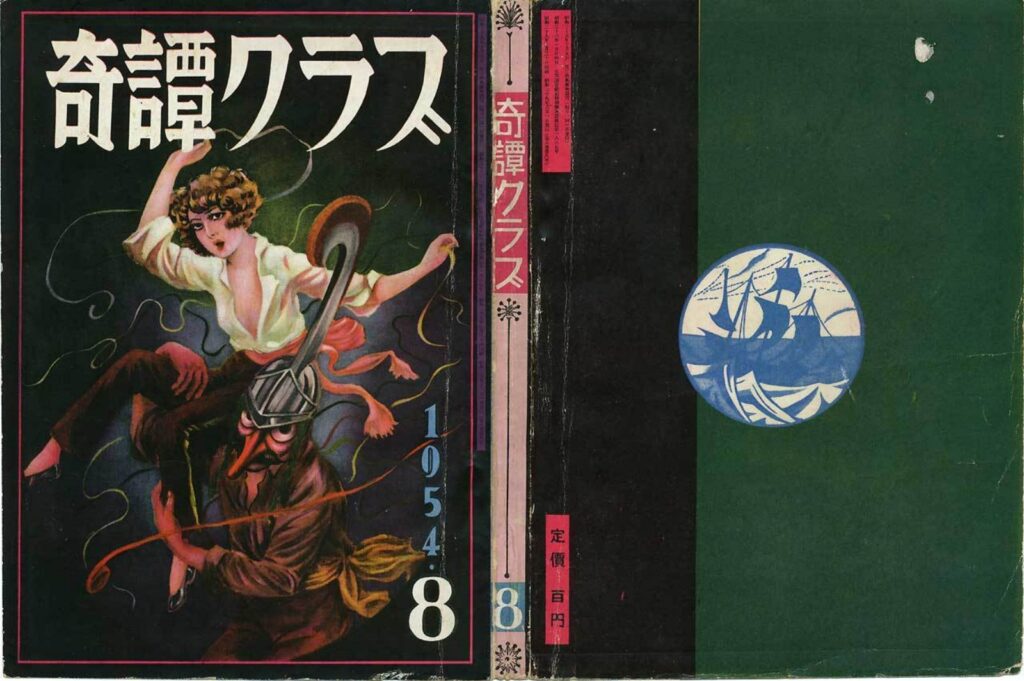
Issue Details
- PDF pages
- 220
Summary
The August 1954 issue of Kitan Club combines staged bondage photography, female-on-female domination, historical punishment imagery, fetish studies, queer testimony, seppuku research, masochistic confession, literary fiction, social commentary on female sexuality, and an extensive final section concerned with masks, correspondence, emotional education, international vice, and the representation of cruelty in contemporary art and literature.
Read full summary Close full summary
Table of Contents 54 items
-
Beauty Exercises Using Rope
Summary
A photographic feature presents beauty and flexibility exercises performed with ropes, showing several posed body positions and movements.
-
The Tragedy of Mitsumata
Summary
An illustrated historical account recounts the legendary Mitsumata tragedy, in which the courtesan Takao’s loyalty to her lover leads to her brutal execution, while situating the tale within Edo-period pleasure-district culture.
-
Water Punishment
Summary
An illustrated fantasy of seaside punishment depicts women subjected to drowning, burial, chaining, and other forms of captivity, combining a fictional beach murder narrative with classical Andromeda-like imagery.
-
Guillotine
Summary
A historical erotic illustration depicts a richly dressed woman pleading for her life at a guillotine while an executioner prepares to carry out the sentence.
-
The Woman of Iron
Summary
An eroticized historical torture scene shows a woman restrained inside an iron maiden, with the caption describing her body being pierced by needles through openings in the apparatus.
-
Cage Punishment
Summary
A dramatic illustration presents a woman confined in a suspended cage above a fire, accompanied by commentary condemning the cruelty of religious persecution in supposedly peaceful societies.
-
Firing-Squad Punishment
Summary
An erotic illustration depicts a woman bound spread-eagled to a tree while a man aims a firearm at her, framed as a fanciful vision of punishment in Japan before the Kojiki.
-
An Example of Rope Use from a French Source
Summary
A photographic feature demonstrates a breast restraint made from celluloid rings and cord, inspired by French nude imagery and presented as an application of rope and ring bondage.
-
My Lady, Is It Not Too Hot?
Summary
A staged photographic sequence presents a female-led rope punishment game involving restraint, wax-dripping heat, pinching, and the submissive partner’s pleas for leniency.
-
Beautiful Pose
Summary
A staged bondage photograph presents Rumi gagged and posed over a man, emphasizing her severe expression and forceful, dominant use of her legs.
-
Active and Passive
Summary
This staged photographic feature contrasts active and passive roles through scenes of one woman restraining, pulling the hair of, and pressing down another woman.
-
Hands-Behind Binding
Summary
A photographic demonstration shows women secured with rope in a continuous binding and hands-behind-back configuration.
-
Hands-Behind Waist Binding and Gag Harness
Summary
A photographic bondage feature demonstrates hands-behind-the-waist binding and a gag harness through two staged restraint scenes.
-
Newlywed Game: Summertime Kimono
Summary
An erotic illustration presents a newlywed dressed in a sheer summer kimono, bound with rope in a playful domestic fantasy.
-
Newlywed Game: Dawn
Summary
An erotic illustration depicts a newlywed in an Akashi-style kimono subjected to foot suspension as part of a husband’s playful bondage fantasy.
-
Overhead Wrist Restraint
Summary
A photographic feature depicts a woman with her wrists bound together and secured overhead, emphasizing an elevated restraint position.
-
Unrestrained Playfulness
Summary
A staged scene portrays a domineering woman rousing a prone male servant and threatening punishment if he refuses to perform or obey her commands.
-
Sitting on the Buttocks
Summary
A staged domestic scene shows a woman using a prone man as a seat while ordering him not to move and threatening further servile punishment, including attention to her feet.
-
Footstool
Summary
A staged photograph shows a seated woman using a prone man as a footstool, emphasizing her control and the erotic display of feet.
-
Beating
Summary
A staged photograph depicts a woman administering a beating or spanking to a kneeling man, accompanied by taunting Japanese captions.
-
The Silent Piper
Summary
An erotic illustration titled “The Silent Piper” depicts a gagged woman with her arms restrained to a horizontal bar, presenting bondage as a theatrical visual tableau.
-
Disordered Hair
Summary
A staged erotic photograph presents a woman with dramatically disordered hair in an intimate, sensual encounter, emphasizing hair as a visual fetish.
-
Single-Leg Suspension
Summary
A photographic feature demonstrates a woman secured in a single-leg suspension using rope, highlighting the pose, suspension method, and visual composition of Japanese rope bondage.
-
Shackles
Summary
An erotic illustration titled “Shackles” depicts a restrained, pearl-adorned woman accompanied by threatening animal imagery, combining bondage motifs with dramatic fantasy illustration.
-
Demonic Seduction
Summary
A serialized erotic narrative follows Shizuko after a chance train encounter draws her into a disturbing domestic world of seduction, coercion, captivity, and escalating bondage involving several women and a man.
-
Overseas Sadism Notes: Uses of Clothing
Summary
An illustrated essay on overseas sadism examines clothing as a vehicle for fetishistic attraction, bodily restriction, discipline, humiliation, theatrical display, and eroticized visual fantasy, with examples from photographs, films, and performance imagery.
-
Answering Former Military Policeman Hayashida Masaki
Summary
Minamikawa responds to former military policeman Hayashida Masaki’s confession, discussing wartime and postwar sexual violence, humiliation, voyeurism, and the disturbing eroticization of personal testimony.
-
Private Punishment
Summary
A fictional account of an escaped mistress and her lover being recaptured and subjected to escalating bondage, humiliation, physical punishment, and sadistic sexual control.
-
Seppuku Research Night Talk
Summary
An illustrated research essay examining seppuku through samurai history, historical documents, literature, journalism, and artistic representations, tracing changing ideas of honor, execution, gender, and erotic spectacle from the Edo period into modern Japan.
-
Sexual Fluids, Part Seven
Summary
The seventh installment of Itō Seiu’s serialized erotic narrative follows encounters involving a theatrical milieu, sexual violence, murder, and sensational rumor, accompanied by dramatic erotic illustrations.
-
The Complaint of the White Belly
Summary
A first-person account describes escalating abdominal self-abuse and self-binding practices, including the psychological experience of seeking pain, restraint, and bodily control.
-
Homosexual Mania and Masturbation
Summary
Murazato Eiichi presents an autobiographical account of same-sex desire and the development of self-binding fantasies and practices, linking them to adolescent experience and fetishistic compulsion.
-
The Secret of the Beautiful Boy
Summary
A fictional account of a teacher’s obsessive fascination with a handsome male student develops into an episode of pursuit, stripping, physical control, and outdoor bondage.
-
The Sorrow of a Foot Fetishist
Summary
Presented as a fetishist’s appeal to the magazine, this piece discusses foot and body-part fetishism, high-heel imagery, Western fetish publications, and the desire for more specialized reader-submitted material.
-
Until Spring Withers
Summary
An erotic melodrama follows Misako through a troubled relationship and marriage in which jealousy, coercion, humiliation, and escalating rope restraint threaten her emotional and physical autonomy.
-
From a Masochist’s Notebook
Summary
A first-person masochistic narrative depicts a servant’s erotic submission to a dominant woman, combining scenes of domestic service, humiliation, and fur-clad mistress imagery with reflections on Leopold von Sacher-Masoch’s Venus in Furs and its Japanese translation.
-
Female Sexuality
Summary
An essay and illustrated feature examines female armpits, body hair, sweat, and odor as objects of erotic fascination, interweaving sexual-psychological commentary with personal anecdotes and sensational examples.
-
Song of the Shore
Summary
This first-person erotic reminiscence recalls a rural childhood relationship with an older sister and the narrator’s developing fixation on her armpits, body odor, bathing, and bodily exposure.
-
Illustrated Mandala of Abdominal Cutting
Summary
An extensively illustrated serialized erotic narrative depicts a young woman and boy enacting ritualized abdominal cutting, bloodletting, suffering, and death in a stylized historical setting.
-
Observations of the Navel, Part Three: My Bodily-Fetish Record
Summary
This personal and reflective essay examines fascination with the navel and abdomen through bodily aesthetics, intimate experience, fetishistic imagery, and references to psychological and sexological interpretation.
-
Cruel Women
Summary
A translated and annotated selection from a 1901 German work surveys historical examples and cultural interpretations of cruel women, linking female violence and domination to changing sexual and social attitudes.
-
The Humiliation of Bengal: A Secret History of Colonial Cruelty
Summary
A sensational historical account of British colonial rule in Bengal and India, emphasizing famine, mass death, punitive violence, and the humiliation of the colonized population.
-
Interruption of Female Sexuality
Summary
An extended essay on the repression and reshaping of women’s sexuality under Japanese patriarchal family and marriage systems, connecting domestic subordination with wartime and postwar experiences and changing ideas of female autonomy.
-
Blue Firefly
Summary
A serialized erotic fiction featuring a married couple who develop increasingly elaborate nighttime bondage games, with the wife restrained, tied, and displayed in domestic settings amid fetishistic imagery and voyeuristic narration.
-
The Mask of the Sadistic Woman
Summary
An essay on the “mask” of the sadistic woman explores female dominance, sadistic self-presentation, and the erotic significance of facial features—especially the nose—through discussion, staged scenarios, photographs, and illustrations. It presents concealment, disguise, and visual transformation as ways of intensifying sadistic authority and erotic spectacle.
-
A Masochistic Man’s Secret Letter
Summary
A first-person secret letter from a masochistic man describes his long-standing fantasies of female control, rope restraint, nudity, punishment, and staged bondage, accompanied by editorial commentary and erotic illustrations. The piece frames these desires as a private confession addressed to a specialized readership.
-
Regarding a Certain Letter
Summary
This correspondence feature presents and answers a reader’s letter concerning erotic photographs, bondage fantasies, discreet meetings, and the emotional complications of exchanging intimate material. The editorial reply treats the exchange as part of the magazine’s ongoing community of readers and contributors.
-
Sentimental Education, Part Ten
Summary
This serialized erotic narrative follows the married Shōzō and Yuki as literary ambitions, financial pressures, jealousy, and encounters with the enigmatic S lead into increasingly coercive sexual games involving domination, submission, and bondage.
-
International Spy Headquarters
Summary
A sensational spy-prison narrative traces the persecution and captivity of women connected with Shanghai and wartime China, depicting interrogation, torture, sexualized humiliation, executions, and the harsh operations of an international espionage organization.
-
Seme in Contemporary Literature
Summary
A literary-critical essay examines depictions of coercion, domination, violence, and disciplinary sexuality in modern Japanese fiction, connecting these motifs to military experience, gender relations, and readers’ emotional responses.
-
In Beautiful May
Summary
An extended first-person erotic narrative presents a woman’s fantasies and experiences of sadistic and masochistic sexuality, including bondage, humiliation, marital conflict, punishment, and the tension between sexual desire and social respectability, accompanied by erotic illustrations.
-
Regarding It
Summary
A recurring personal essay or reader contribution reflects on erotic fascination with women’s noses and responds to the magazine’s earlier discussion and imagery of this body-part fetish.
-
Three Forms of the Female Nose
Summary
A nose-focused aesthetic and fetishistic essay compares three forms of the female nose, using photographic examples and discussing beauty standards, cosmetic presentation, and attempts to emphasize or alter the nose’s appearance.
-
Reader Correspondence, Editorial Material, Binding Diagrams, and Publication Notices
Summary
A mixed reader-and-editorial section presents correspondence, forthcoming issue announcements, subscription and ordering information, manuscript guidelines, and illustrated instructions for tying or binding garments.
Highlights
- Beauty Exercises Using Rope turns rope into an acrobatic drawing tool that stretches the body into four sculptural compositions (PDF p. 5).
- Itō Seiu’s The Tragedy of Mitsumata places bodily punishment within a moonlit landscape of boats, water, and public witnesses (PDF p. 6).
- The guillotine, iron woman, cage, and firing-squad plates form a compact international catalogue of punishment technology (PDF pp. 9–12).
- The early photographic sequence makes female-on-female physical control a central theme through pinning, twisting, rope pulling, trampling, and corporal punishment (PDF pp. 14–25).
- Overseas Sadism Notes: Uses of Clothing treats leather, corsets, boots, masks, uniforms, and animal costumes as devices for constructing erotic identity (PDF pp. 43–54).
- Private Punishment gives discipline and humiliation an apparently female first-person voice and links physical submission with emotional dependence (PDF pp. 59–63).
- Seppuku Research Night Talk combines bibliography, historical anecdote, legal material, and fetish imagery into an improvised field of research (PDF pp. 64–71).
- The Sorrow of a Foot Fetishist portrays fetish identity as loneliness and emotional conflict rather than a simple preference (PDF pp. 85–87).
- Until Spring Withers is the issue’s major early literary narrative, developing dependency and control across fourteen PDF pages (PDF pp. 88–101).
- Illustrated Mandala of Abdominal Cutting organizes solitary, assisted, historical, and theatrical examples into an extended visual taxonomy (PDF pp. 114–127).
- Blue Firefly continues for six pages beyond the former artificial cutoff and uses nocturnal folklore and strange light to create erotic unease (PDF pp. 150–155).
- The Mask of the Sadistic Woman examines concealment and the dominant persona, suggesting that the mask permits an alternate social identity (PDF pp. 156–163).
- Regarding a Certain Letter demonstrates that the magazine had become an active correspondence network whose contributors publicly evaluated one another’s testimony (PDF pp. 170–173).
- Sentimental Education, Part Ten occupies fourteen pages and explores power through publishing work, money, ambition, and intimate dependency (PDF pp. 174–187).
- The final nose study and correspondence pages confirm that the issue continues through PDF page 220 and ends with reader debate and editorial infrastructure rather than fiction alone (PDF pp. 212–220).
Contributors
Named contributors represented in this issue:
- Azuma Shin
- composition by Tsujimura Takashi; model Mori Chieko
- composition by Tsujimura Takashi; model Yanagimoto Setsuko
- contributor credit unclear
- Forty-Six
- Furukawa Hiroko, credit reading uncertain
- Futamata Shizuko
- Haruhi Rumi and Itabuki Makiko
- Haruhi Rumi and model A
- Haruyama Tadakazu
- Hayashi Yumio
- Hishiha Kiyoko, romanization uncertain
- Hōya Shirō
- Itabuki Makiko
- Itabuki Makiko and model B
- Itō Seiu
- Kawabata Tanako
- Kawada Susumu
- Kawano Kyōsuke
- Kazuhisa, artist credit uncertain
- Kurihara Shin; text credit reading uncertain
- Matsui Raikō
- Mimura Haruo
- Minamikawa Kazuko
- multiple contributors
- Murata Seiichi
- Murata Tamiko
- Murazato Eiichi
- Nakafuji Tamiko and Tō Mieko
- Nakayasu Hiromichi
- Nonaka Aizō
- Nozaki Jun
- Numa Shōzō
- photographed by Itō Seiu
- Saji Kōsuke
- Sudō Ritsuo
- Sugihara Nijiko
- Taki Reiko
- translated and explained by Morimoto Aizō
- Yamada Masami, romanization uncertain
- Yamaguchi Kōichi
- Yanagisaki Kenji, credit reading uncertain