Kitan Club
August 1953
← Back to magazine archive
Issue Details
- PDF pages
- 173
Summary
The August 1953 issue of Kitan Club combines illustrated punishment history, translated Western fiction, confessional writing, serialized masochistic narratives, discussions of marriage and fetish identity, queer and gender-related material, staged bondage photography, and recurring exchanges among pseudonymous contributors. Its most distinctive feature is the way it moves between social identity and bodily classification. Readers are invited to recognize not only particular acts and fantasies, but recurring types of people: the masochist, the voyeur, the reluctant spouse, the fetishist, the dominant woman, and the person whose desires resist conventional gender expectations.
Read full summary Close full summary
Table of Contents 28 items
-
Foreign Girls Being Whipped
Summary
An erotic illustration depicts several foreign women undergoing whipping or caning by a male figure, emphasizing spectacle, punishment, and apparent sexualized submission.
-
Punishment and Bondage in Prewar and Postwar Illustration
Summary
Murata Seiichi surveys prewar and postwar Japanese erotic illustrations depicting punishment, bondage, restraint, and sexual coercion. The article compares works by named artists and discusses how historical picture traditions and modern magazine imagery represent these motifs.
-
The Lustful Wolf
Summary
A serialized erotic-grotesque tale follows the entanglements of circus and sideshow figures, including a snake woman, a monkey boy, and the dwarf performer Gen-san. The narrative combines obsessive desire, bodily difference, violence, humiliation, and theatrical spectacle as its characters pursue one another through performances and private encounters.
-
My Confession: The Severed Chapter, Part Three
Summary
In this third installment of a personal confession, the narrator recounts the development of his erotic fixation on women’s bodies, bathing and swimwear, voyeuristic observation, and compulsive sexual behavior. The piece reflects on fetishistic desire, secrecy, self-control, and the tension between private impulses and social morality.
-
A Meiji-Era Artist of Bound Women
Summary
An art-historical essay on Itō Seiu’s interest in depictions of bound women, tracing bondage imagery from Edo-period ukiyo-e and popular prints into Meiji-era illustrated media. It discusses representative artists, works, techniques, and the relationship between erotic restraint imagery and commercial publishing.
-
In Praise of the Anus
Summary
An essay that treats the anus as an object of erotic appreciation, combining personal reflection, sexual psychology, aesthetic description, and discussion of anal stimulation. Accompanying imagery and commentary emphasize close visual and sensory attention to the buttocks and anus.
-
Fire, Part Eight
Summary
Part eight of Matsui Kōko’s serialized erotic novel follows Sayuri as marital betrayal and emotional injury drive her to reverse the power relationship with her husband. The installment depicts revenge through binding, physical discipline, humiliation, and a subsequent attempt to escape into a new life, while also setting up the next episode.
-
Portraits of Women
Summary
A social-realist portrait of women employed in a small printing factory, describing poverty, low wages, harsh working conditions, sexual exploitation, and the limited prospects available to working-class women in postwar Japan. The article also follows several women’s relationships, family circumstances, and attempts to survive within a deeply unequal social environment.
-
Abnormal Play
Summary
A first-person fetish autobiography recounting the author’s discovery and practice of masochistic play with a male partner, including negotiated imprisonment fantasies, rope bondage, gagging, whipping, and other forms of physical restraint. The narrative emphasizes alternating dominance and submission and presents detailed scenes of private bondage experimentation.
-
The Agonized Nude
Summary
An erotic horror narrative about Noda Saburō’s obsessive fascination with an agonized nude female figure. His voyeuristic fixation develops into pursuit, restraint, and lethal violence, blending sadistic fantasy with imagery of bodily suffering and death.
-
Female Seppuku and Examples of Women’s Ritual Suicide
Summary
A historical and forensic study of women’s ritual suicide by abdominal cutting, examining four cases alongside male seppuku. The article compares wounds, weapons, clothing, body positions, blood loss, and contemporary accounts to assess gendered differences in the practice and its representation.
-
Nudity and Tight Binding as an Expression of Marital Love
Summary
Nishizawa Yoshizō discusses nude rope binding as a possible expression of marital intimacy, combining psychological reflections on mutual arousal, trust, and sexual roles with descriptions of a husband binding his wife. The article also offers practical observations on tying methods, including waist, chest, and limb restraints, while presenting the practice within postwar domestic sexuality.
-
From a Masochist’s Notebook, Part Three
Summary
A first-person notebook-style narrative recounts the narrator’s masochistic fantasies and humiliating encounters with dominant women, including scenes of public and domestic submission, foot and shoe fixation, and enforced service. The later sections extend these themes through literary, racialized, colonial, and childhood imagery while reflecting on the psychology of obedience, degradation, and eroticized authority.
-
Secret Notes of Cruel Pleasure
Summary
A first-person erotic confession by Shida Yōko exploring her fascination with bodily exposure, voyeuristic spectatorship, sadistic and masochistic fantasies, and the emotional intensity of being observed or physically controlled. The piece blends autobiographical reflection with elaborate fantasies of bondage, bodily sensation, violence, and sexualized danger.
-
The Sufferings of Christine, Part Two
Summary
The concluding installment of a translated serialized SM narrative follows Christine as she is captured, repeatedly bound, whipped, humiliated, and subjected to escalating punishments by her husband and Jules. After sustained captivity, coercion, and psychological distress, the narrative reaches its resolution with Christine’s ordeal and the perpetrators’ actions brought to a close.
-
Reader Correspondence and Notices
Summary
A contents and notices page listing recent and forthcoming issue features, including reader-oriented material and publication announcements.
-
A Study of the Bound Female Body
Summary
A photographic study of model Namiko Murata bound with rope in staged domestic settings. The accompanying essay discusses the visual appeal, composition, and constraints of photographing the bound female body, while the images emphasize rope placement and cramped positional restraint.
-
Reader Exchange and Notices
Summary
A contents and notices page listing recent and forthcoming magazine material, including reader-oriented features and publication information. It reflects the magazine’s role in organizing an ongoing readership and circulating specialist content.
-
The Duchess’s Revenge
Summary
A serialized historical erotic narrative, translated and adapted by Numa Shōzō, recounting Princess Olga’s revenge after the murder of her husband Igor by the Drevlyans. The story combines courtly marriage, female authority, captivity, punitive violence, executions, and sensational historical spectacle, followed by commentary on its historical and literary sources.
-
Masochistic Affection
Summary
An autobiographical erotic confession recounting a woman’s difficult upbringing, her work in entertainment, and her obsessive relationship with Ōmura, who repeatedly binds, beats, humiliates, and sexually dominates her. Although she attempts to resist and escape, she comes to experience his violence and rope restraint as expressions of love, later reflecting on marriage and the persistence of her masochistic desire.
-
On Women’s Trousers
Summary
An essay tracing women’s adoption of trousers from European fashion and wartime utility to modern Japanese society. It examines trousers as practical clothing, a sign of changing gender roles and women’s independence, and an object of erotic fascination shaped by fashion, body display, and cultural convention.
-
From the Notebook of a Masochistic Lover
Summary
A first-person masochistic account centered on encounters with an authoritative woman in military or riding attire who subjects the narrator to commands, restraint, exposure, and corporal punishment. The narrative combines confession-like testimony with highly stylized fantasies of female control, humiliation, and bodily discipline.
-
The One-Eared Legend, Part Two
Summary
The second installment of an Edo-period erotic adventure tale in which conflicts among samurai, entertainers, and women escalate into pursuit, abduction, coercion, torture, and mutilation. The recurring one-eared figure, violence directed at the body, and strange insect imagery give the narrative a sensational mystery-and-revenge atmosphere.
-
To Hamura Kyōko
Summary
A reader letter addressed to Furukawa Yuko reflects on her published bondage-themed stories, especially the relationship between physical sensation, psychological masochism, and the reader’s imaginative response. It also comments on the expectations created by erotic fiction and invites further literary exchange.
-
Love Slave, Part Eight
Summary
Part eight of a serialized erotic novel in which Harumi’s husband, Otsuki, and the sadistic Noro engage in escalating coercion, beating, restraint, and humiliation while Harumi is forced into degrading spectacles and physical submission. The episode also shifts into voyeuristic and retaliatory scenes involving bondage, domestic violence, and the manipulation of marital and sexual power.
-
My Wife Will Not Let Me Tie Her, Part Two
Summary
In this first-person confession, Okada Keisuke describes his obsessive pursuit of the beauty of the bound female body and the increasingly elaborate ways he ropes his wife, Yasuko, including domestic scenes involving nudity, rear binding, and confinement in a bath. The account ultimately centers on the marital conflict between his fetishistic desire to bind her and her need for affection and reciprocal intimacy beyond restraint.
-
The Sweet Surrender of Alice, Part One
Summary
The first installment of a translated erotic serial follows Alice as she engineers a calculated revenge and draws her target into an elaborately equipped private room. The narrative emphasizes psychological manipulation, female control, captivity, and increasingly elaborate mechanical and rope restraints.
-
Publication Notices and Advertisements
Summary
A closing notices and advertising section promotes Kitan Club subscriptions, back issues, direct sales, illustrated books, and related publications. It also solicits manuscripts and reader participation while outlining editorial and submission policies.
Highlights
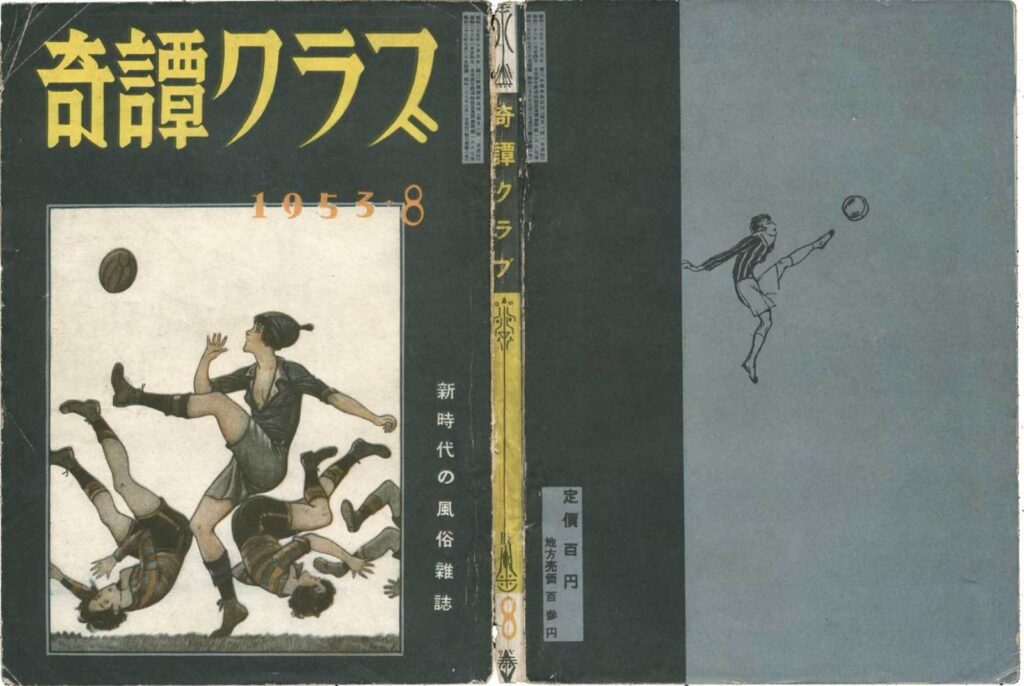
- The cover establishes female authority through vertical posture and movement, placing two disordered figures beneath the standing woman (PDF p. 1).
- The opening illustration of foreign girls being whipped uses European punishment imagery to frame suffering through historical and cultural distance (PDF p. 5).
- Punishment and Bondage in Prewar and Postwar Illustration gathers images of tied, abandoned, and assaulted women into a comparative archive of Japanese visual motifs (PDF pp. 6–9).
- The Lustful Wolf uses animal metaphor to represent predatory male desire, relying on fictional coercion rather than negotiated participation (PDF pp. 11–20).
- My Confession: The Severed Chapter, Part Three continues the magazine’s use of serialized first-person testimony to create durable erotic identities (PDF pp. 21–22).
- Itō Seiu’s A Meiji-Era Artist of Bound Women gives modern Japanese restraint imagery an art-historical genealogy and connects the magazine to earlier visual traditions (PDF pp. 23–27).
- In Praise of the Anus surrounds a specific bodily fixation with literary and psychological references, turning fetishism into a form of specialized connoisseurship (PDF pp. 28–30).
- Portraits of Women treats femininity as a set of contrasting erotic and psychological types rather than a single role (PDF pp. 43–47).
- The female-seppuku study uses historical ritual and the exposed abdomen to merge antiquarian inquiry with erotic spectatorship (PDF pp. 55–62).
- Nudity and Tight Binding as an Expression of Marital Love attempts to relocate rope within emotional domestic life, though its consent framework remains undeveloped (PDF pp. 63–64).
- From a Masochist’s Notebook, Part Three provides masochism with a sustained first-person language that readers could recognize across issues (PDF pp. 65–84).
- A Study of the Bound Female Body compares curled and compressed floor positions, treating rope as an instrument for producing controlled visual form (PDF pp. 106–109).
- On Women’s Trousers reveals how clothing and gender presentation were incorporated into the magazine’s expanding taxonomy of erotic perception (PDF pp. 127–132).
- My Wife Will Not Let Me Tie Her, Part Two explicitly acknowledges refusal and incompatibility between private fantasy and marital reality (PDF pp. 160–162).
- The Sweet Surrender of Alice, Part One closes the issue by introducing another serialized foreign heroine, extending the magazine’s network of recurring submissive identities (PDF pp. 163–172).
Contributors
Named contributors represented in this issue:
- Amadore Seiei
- Azuma Minoru
- composition by Tsujimura Takashi; photography by Tsukamoto Tetsuzō
- Fujiyasu Setsuko
- Fukuda Eiichi
- Goku Osamu
- Hamura Hiroshi
- Itō Seiu
- Kawabata Tanako
- Kitō Kōichirō
- Kojima Mitsuhiko; illustrations by Mijō Haruhiko
- Matsui Kōko
- Murata Seiichi
- Nishizawa Yoshizō
- Numa Shōzō
- Okada Keisuke
- Shida Yōko
- Sudō Tsuneo
- Sumida Hiroshi
- Taya Takao
- translated and adapted by Numa Shōzō
- translated by Azuma Minoru
- translated by Samukawa Midori
- Wakabayashi Keiko