Uramado
April 1959
← Back to magazine archive
Issue Details
- Volume
- 4
- Issue
- 4
- PDF pages
- 289
Summary
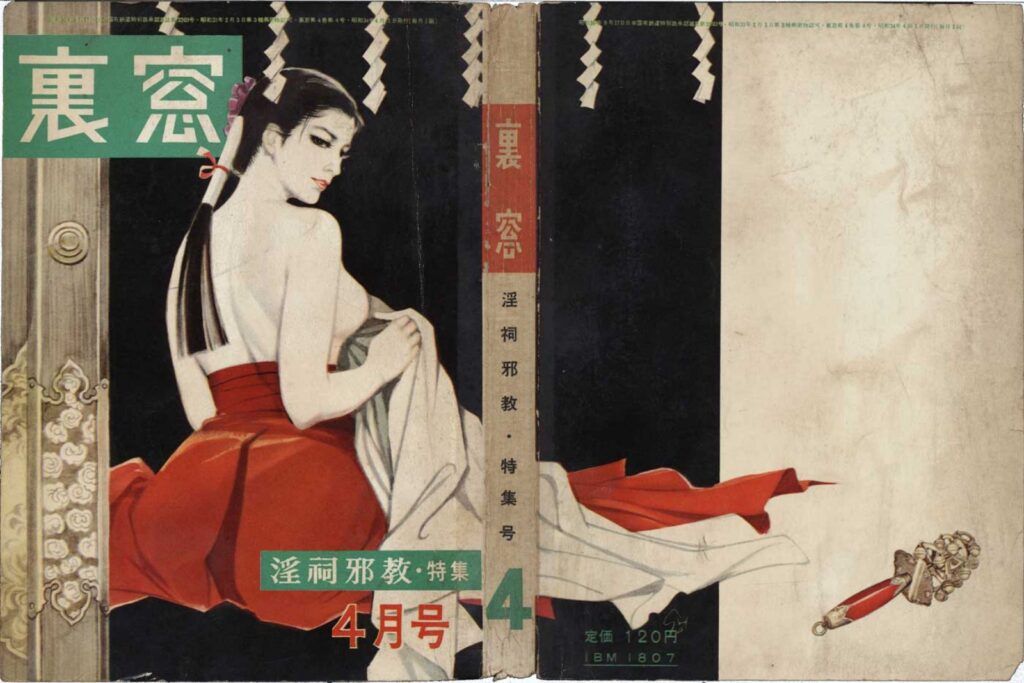
The April 1959 issue of Uramado is organized around a special feature on 淫祠邪教, imagined obscene, heretical, and sexually charged religious cults. Its contents combine illustrated crime and suspense, supernatural and historical fiction, pseudo-ethnographic accounts of secret rites, photographic nude studies, and recurring columns on actresses and popular visual culture. The issue repeatedly uses temples, shrines, hidden chambers, mountain settlements, occult societies, and charismatic religious figures as settings in which desire, coercion, punishment, and ritual become intertwined.
Read full summary Close full summary
Table of Contents 22 items
-
The Vanished Tattooed Nude
Summary
An illustrated sensational account follows the disappearance of a tattooed nude woman and the police investigation, mixing eroticized scenes of captivity, coercion, and interrogation with lurid reportage.
-
Nude Masterpieces
Summary
A photographic portfolio presents staged black-and-white nude studies emphasizing sculptural poses, bodily form, concealment, and visual spectatorship.
-
Secret Tales of Obscene Cults Abroad
Summary
This purportedly foreign-sourced dossier surveys obscene cults, occult religions, sexual rituals, secret societies, and sensational cases involving fetishistic or coercive practices.
-
Tickling Kannon
Summary
An Edo-period serialized erotic adventure follows the schemes of the physician Kōan and other villains as they pursue money, abduct O-Shizu, and subject her to elaborate rope restraints and relentless tickling. The illustrated narrative combines criminal intrigue, captivity, coercion, and the threatened exchange of a young woman’s body for religious-fund funds.
-
The Burning Women’s Cave
Summary
This serialized erotic fantasy follows travelers and local men who are lured toward a hot-spring mountain and an uncanny women’s cave, where seductive, grotesque female figures subject them to captivity, humiliation, and bizarre supernatural encounters.
-
Wheel of Vengeance Hell
Summary
This illustrated Edo-period erotic revenge serial follows shifting confrontations among townspeople, courtesans, and criminals as abduction, confinement, deception, and violent punishment drive the characters toward reciprocal vengeance.
-
The Goddess’s Jar
Summary
This serialized erotic fantasy follows investigators and other victims into a murderous occult cult centered on a seductive goddess, whose rituals involve coercion, bondage, bodily transformation, and supernatural violence.
-
Selections from a Heretical Temple of Lust
Summary
A historical survey of alleged heretical lust cults in the Edo period, describing their beliefs, sexualized rituals, sensational incidents, official investigations, arrests, executions, and related illustrated scenes. It presents these accounts through archival documents and crime-oriented historical commentary.
-
The Riding Immortal Woman
Summary
An erotic fictional dialogue about a young man visiting a beautiful female fortune-teller whose predictions and seductive authority lead to a coercive, physically dominant sexual encounter, accompanied by erotic illustrations.
-
The Magic of the Waist Cord
Summary
A serialized erotic-occult tale in which practitioners use waist cords, binding rites, curses, and other magical techniques to control women and summon frightening supernatural experiences. The narrative combines ritualized restraint, violent fantasy, and dramatic illustrated scenes of encounters between men, women, and uncanny forces.
-
The Strange Cult of Loving Spirits
Summary
This serialized erotic fantasy follows characters drawn into a sinister spirit-worship cult whose schemes involve abduction, coercion, captivity, ritualized bondage, and attempts at rescue and revenge. Its illustrated narrative combines supernatural menace with sensational scenes of restraint and sexual domination.
-
The Cult of Female Bodily Suffering
Summary
An illustrated sensational account of a secretive heretical cult in which women are subjected to ritualized humiliation, forced nudity, bodily punishment, restraint, and sacrifice-like suffering.
-
Nude Benten
Summary
An erotic occult narrative depicting the manipulation and coercion of women through religious ritual, hypnotic suggestion, nudity, binding, sexualized humiliation, and staged scenes of submission.
-
The Sin of Falling
Summary
A suspenseful erotic crime narrative follows Kasai as he schemes to obtain money through fraud, murder, staged alibis, and drugging, while investigators and associates gradually expose the plan.
-
The Golden-Cat Cult of Female Desire
Summary
This serialized occult crime fantasy follows the Golden-Cat cult, its female mediums and male devotees, and a series of ritualistic manipulations, assaults, murders, and supernatural threats surrounding its secret teachings.
-
That Scene, That Actress
Summary
A critical survey of bondage and erotic scenes in Japanese and foreign films, discussing actresses, direction, staging, visual impact, and the conventions of sensational and SM cinema.
-
The Sorceress of Yasaka
Summary
A serialized historical erotic narrative set in Edo-period Japan, in which a mysterious sorceress and her associates become entangled in religious intrigue, pursuit, captivity, interrogation, and ritualized bondage.
-
Sacrifice to the God of Love
Summary
A serialized erotic-sadistic narrative follows Hartley, Marie, and others through abduction, restraint, violence, murder, and ritualized sacrifice within a sinister cult-like setting. Illustrated scenes emphasize captivity, coercion, female figures, police investigation, and the recurring imagery of the “god of love.”
-
Black-Hair Binding
Summary
A serialized erotic historical-fantasy thriller follows doll maker Izumi Megichi and other Edo-period figures through abduction, rope binding, hair-cutting rituals, grotesque dolls, curses, and violent pursuit, accompanied by dramatic bondage illustrations.
-
Hair Lantern
Summary
A serialized narrative follows a boy’s fascination with women’s long hair through encounters at a bathhouse, hair salon, cinema, and domestic settings, blending sensual fantasy with crime, femme-fatale imagery, and occult or supernatural motifs. The later sections discuss literary, cinematic, and folkloric representations of seductive, dangerous women and magical practices.
-
Her Mass
Summary
A serialized erotic-crime narrative follows Shuwaru and Merii as they investigate a clandestine obscene cult, encountering abduction, coercive restraint, ritualized violence, and a deadly confrontation. The story is accompanied by dramatic black-and-white illustrations.
-
Phantom Samurai: The Gecko Spell of Exorcism
Summary
An illustrated historical erotic fantasy follows a mysterious samurai and an exorcist through seduction, deception, violent captivity, murder, and supernatural rituals involving a gecko spell. The serialized narrative combines occult menace with elaborate scenes of restraint, punishment, and forbidden desire in an Edo-period setting.
Highlights
- “The Vanished Tattooed Nude” opens the issue with a densely illustrated crime narrative involving pursuit, captivity, tattooing, and the circulation of sensational images. (PDF pp. 6–11).
- Fujisawa Osamu’s “Nude Masterpieces” presents a sustained monochrome studio portfolio built around dramatic shadow, isolated bodies, and sculptural posing. (PDF pp. 12–17).
- “Secret Tales of Obscene Cults Abroad” surveys devil worship, secret rites, ritual sexuality, and Western occult fiction, establishing the intellectual and sensational framework of the special issue. (PDF pp. 18–25).
- “Tickling Kannon” is an extended Edo-period narrative in which family debt, deception, religious imagery, and the exploitation of a young woman converge. (PDF pp. 27–40).
- “The Burning Women’s Cave” follows travelers into a mysterious mountain and hot-spring community, gradually revealing a concealed female society and underground chambers. (PDF pp. 41–52).
- “The Cult of Female Bodily Suffering” develops one of the issue’s most explicit invented religious systems, organizing female suffering and bodily discipline as doctrine and ritual. (PDF pp. 141–153).
- “The Golden-Cat Cult of Female Desire” combines animal symbolism, occult authority, sexuality, and religious secrecy within the issue’s central cult motif. (PDF pp. 173–184).
- “The Sorceress of Yasaka” draws on shrine and folk-magical imagery to depict a dangerous female ritual specialist and a world governed by secrecy and supernatural power. (PDF pp. 193–204).
- “Black-Hair Binding” and “Hair Lantern” form a late pairing centered on hair as fetish, magical instrument, bodily trace, and source of supernatural danger. (PDF pp. 219–252).
- “Her Mass” adapts Christian ceremonial vocabulary and imagery to a transgressive narrative immediately before the issue’s closing samurai fantasy. (PDF pp. 253–266).
Contributors
Named contributors represented in this issue:
- Akitsu Kyōta
- Enjōji Tatsu
- Fujimi Iku
- Fujisawa Osamu
- Hashizume Hikoshichi
- Iida Toyokichi
- Kitaba Okunao
- Kurobane Shin
- Kuroki Shinobu
- Minamimura Ran
- Mizorogi Shukuko
- Nakabayashi Setsuzō
- Nakajima Yoshimi
- Odagiri Sō
- Setani Tomohachi
- Shiba Toshiyasu
- Shima Fuji
- Shimamoto Haruo
- Suzuki Kazuo
- Tōge Kōsuke
- Ushioi Taku
- Yagiri Jūhachi