The opening page is dominated by correspondence and a short reflective column titled “Idle Man’s Ramblings” (Kanjin Mangwa). The letters respond to earlier issues and discuss bodily attraction, fantasy, rope, photographs, and the difficulty of communicating abnormal desires. Several writers address the newsletter as a place where interests concealed in ordinary life can be stated without immediately being dismissed as illness or criminality.
The letters also demonstrate that readers had developed standards for SM representation. They criticize stories that seem psychologically implausible, complain about repetitive scenarios, praise images that convey convincing bodily tension, and ask for greater attention to the experience of the person subjected to seme. The newsletter therefore functions as a workshop in which the readership collectively evaluates the emerging genre.
A short column on the first page, roughly titled “A Beautiful Woman’s Essential Point Lies in Her Feet,” reflects the publication’s continuing interest in narrowly focused fetishes. Rather than treating attraction as general, the writer isolates the leg or foot as the decisive erotic feature. Such pieces helped turn individual preferences into recognizable subcategories that other readers could affirm or contest.
The serialized story “The Red Room,” Part Three, continues on PDF page 2. The narrative remains centered on confinement, threat, bodily control, and psychological pressure. Its position beside letters and editorial comments is historically important. Readers are not merely given a coercive fantasy; they are invited to judge its credibility and intensity within an ongoing public discussion.
The bottom of page 2 contains further reader correspondence, including comments on recent issues and editorial choices. These short notices reveal the practical rhythm of the newsletter: an article appears, readers respond, editors summarize or correct, and the conversation is carried into the next number. The magazine’s monthly publication schedule becomes a continuing exchange rather than a series of isolated products.
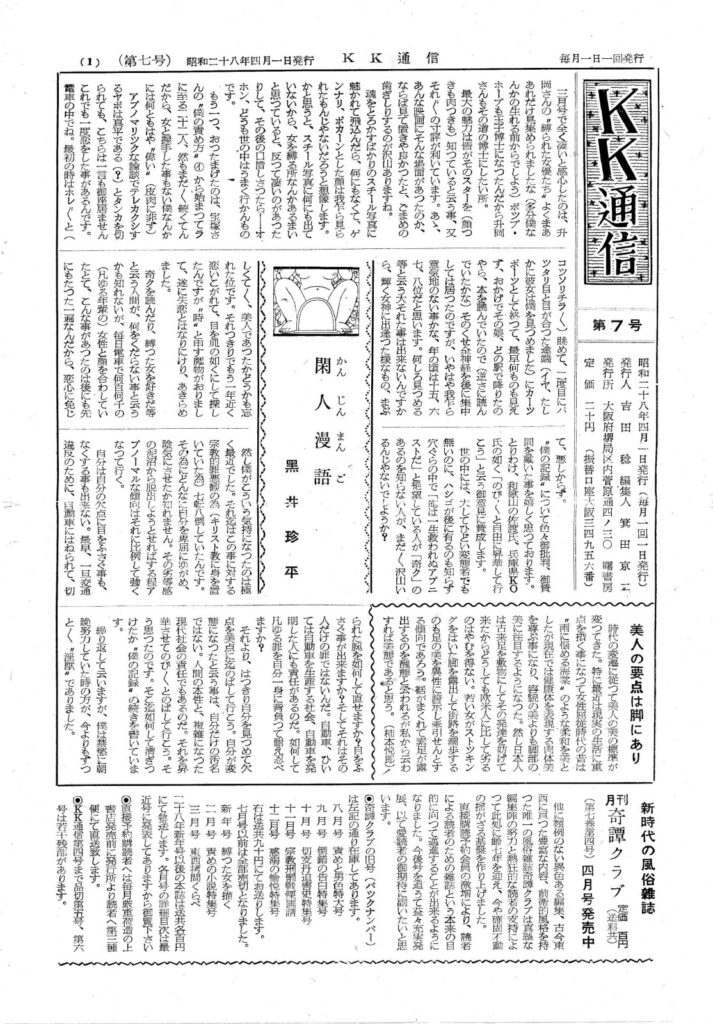
PDF page 3 introduces a new illustrated serial, “The Chair of Sin,” Part One, with the subtitle approximately “Guided by an Evil Demon.” The central drawing shows a woman draped over an ornate chair or pedestal, her body arranged as an object of display and vulnerability. The story uses supernatural or psychological corruption as an explanation for erotic transgression. The “evil demon” supplies an alibi through which forbidden desire can appear as an external influence.
The surrounding discussion on page 3 examines the relation among bodily beauty, restraint, humiliation, and the spectator’s imagination. The article appears concerned with why certain poses or conditions become erotic rather than merely painful. It treats seme as a problem of interpretation: the physical event alone does not determine its meaning; context, fantasy, expression, and the viewer’s disposition complete the scene.
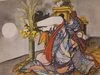
PDF page 4 contains the second installment of “My Way of Tormenting” or “How I Apply Seme.” The reader-author divides preferred methods according to body parts, implements, and sensory effects. The accompanying illustration depicts a kneeling woman with her arms restrained behind her, emphasizing compression of the torso and the exposure produced by posture.
The feature is notable for its taxonomic form. Personal desire is reorganized into numbered categories, allowing readers to compare methods and preferences. This is one of the ways the newsletter converts fantasy into shared knowledge. A technique becomes something that can be named, described, debated, and potentially reproduced.
The lower section of page 4 contains Short Correspondence, where readers ask questions, respond to one another, and comment on earlier pieces. Some messages concern accuracy and terminology, while others appear to seek connection with people who share particular desires. These brief exchanges function much like notices pinned to a private bulletin board.
PDF page 5 is largely devoted to editorial commentary. The editors discuss reader reactions, accepted and rejected manuscripts, the quality of recent submissions, photographic material, and the practical limits of publication. The tone is candid and occasionally critical. Readers are encouraged to contribute, but they are also told that vague fantasy, repetition, and careless writing are insufficient.
This editorial page provides strong evidence that the newsletter imagined its readers as collaborators. It asks them to improve descriptions, report experiences carefully, and avoid merely copying familiar scenarios. The culture being formed depends upon circulation: experience becomes writing, writing becomes editorial material, and publication produces further experience and response.
PDF page 6 presents “From the Confessions of a Sadist: Continued, The Ethics of Confusion”, by Kondō Kikuya. The essay is one of the issue’s more conceptually ambitious pieces. It considers the sadist’s self-understanding, the relationship between fantasy and action, and the moral confusion produced when erotic pleasure resembles cruelty.
The title’s reference to “ethics” is significant. The writer does not simply celebrate torment. He asks how sadistic desire should be understood when it crosses from imagination into relations with another person. Although the argument does not employ a modern consent framework, it shows readers attempting to distinguish erotic seme from uncontrolled violence.
The lower part of page 6 contains an editorial apology or notice. It addresses errors, delays, and the difficulty of managing reader submissions. Such material may appear mundane, but it reveals the infrastructure behind the publication: handwritten manuscripts, photographs, pseudonyms, postal exchanges, and a small editorial office trying to coordinate a geographically dispersed readership.
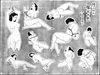
PDF page 7 includes an agency or editorial notice featuring a bondage photograph captioned “The Assaulted Woman.” The image shows a woman restrained with her arms raised or extended overhead. It is presented alongside advertisements for photographic sets, including collections centered on suspended women and tightly tied female bodies.
These advertisements reveal how reader culture and commercial culture reinforced one another. The newsletter encouraged discussion of images while simultaneously making additional images available for purchase. Readers could move from public debate to private collecting, creating personal archives that extended beyond the monthly magazine.
The page also includes corrections and supplementary material for the March issue. Readers point out errors, ask about missing passages, and comment on the accuracy of titles or illustrations. Editorial correction becomes another form of participation, reinforcing the idea that the publication belongs partly to the readers who scrutinize it.
The final page continues “Hell Picture,” Part Five, by Yukita Kazuko. The illustrated story depicts a restrained woman and a threatening hand or implement. The narrative remains within the older pulp grammar of captivity and female peril, but its placement inside a correspondence newsletter gives it a different role. It becomes one item in a broader circuit of criticism, fantasy, technique, and reader response.
The issue ends with information about special membership and the publication’s subscription system. Membership promises access to special materials, photographic collections, and other benefits. This demonstrates that KK Communication was not only a newsletter but the administrative center of a developing subculture, managing circulation, participation, commerce, and identity.
For readers of Kinbaku Today, the April 1953 issue is valuable because it shows early Japanese SM culture thinking aloud. Its readers are not yet using a standardized language of consent, safety, or negotiated practice, but they are already asking difficult questions. What makes suffering erotic? How should the recipient’s feelings be understood? When does fantasy become dangerous? What distinguishes convincing bondage from empty spectacle? Who has the authority to interpret the bound body?
The issue does not answer these questions conclusively. Its importance lies in making them collective. Through letters, criticism, confession, serialized fiction, practical taxonomy, and editorial mediation, private abnormality becomes a shared intellectual and social problem.