Article Summary
A first-person confession by a poor woman painter in Kyoto who describes how her private drawings of bound women became the center of an informal circle of SM enthusiasts. A pawnbroker friend creates an anonymous "exhibition" of her torment pictures inside the house's toilet, where visitors may take a picture and leave one-hundred-yen notes according to its value. Observing how viewers respond to the pictures causes the narrator to reconsider her own erotic psychology and to distinguish what she calls "etsugyaku," an ideal of mutually experienced erotic cruelty, from sadism based solely on the unilateral suffering of an unwilling woman. The essay culminates when she burns the money left for her pictures and, aroused by the reaction of the landlady's twenty-year-old daughter Taga, binds the young woman herself. Historically, the piece is notable for presenting an explicitly female first-person theory of reciprocal sadomasochistic pleasure in an early-1950s Japanese erotic magazine, while also linking bondage imagery, artistic production, spectatorship, and lived erotic experimentation.
Translation
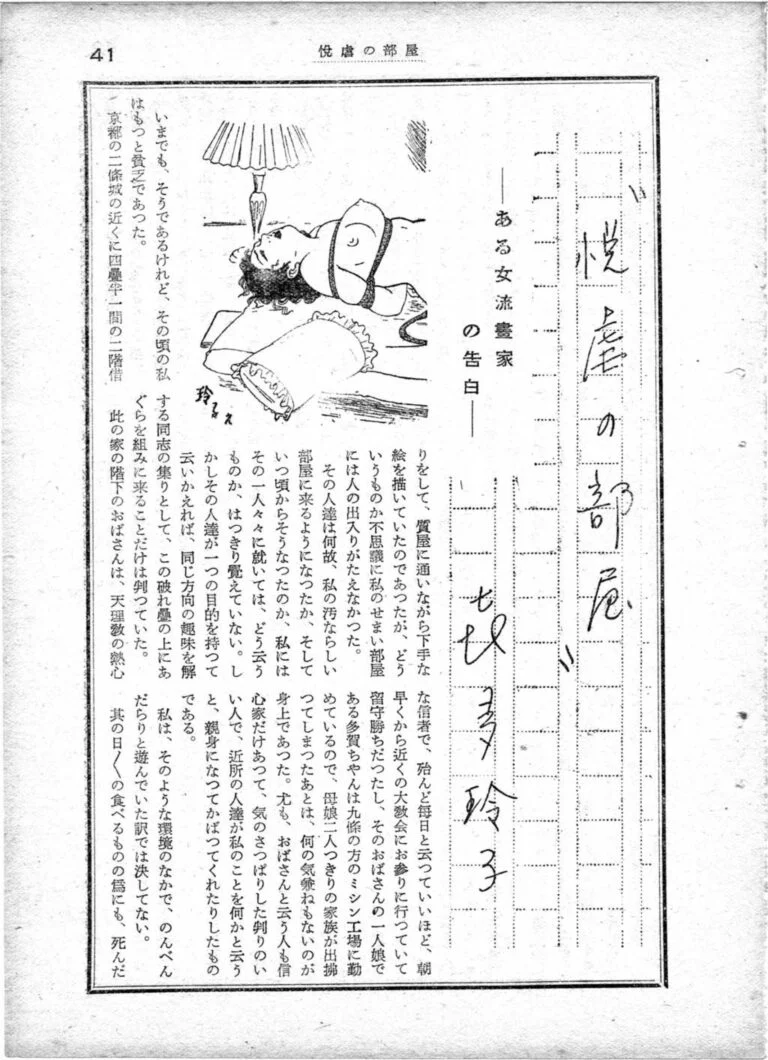
The Room of Ecstatic Cruelty
A Woman Painter’s Confession
Even now I am poor, but in those days I was poorer still.
I rented a single four-and-a-half-tatami room on the second floor of a house near Nijo Castle in Kyoto. I made the rounds of pawnshops and somehow kept myself going while painting my clumsy pictures. For some strange reason, however, people were constantly coming and going through my cramped room.
Why they had begun coming to my shabby room, and exactly when it had started, I can no longer remember clearly in the case of each individual. But I did understand one thing: they all came with a common purpose. To put it another way, they understood the same sort of taste, and they came to sit down together and share it.
The woman downstairs was a devout believer in Tenrikyo. Nearly every day she went out early in the morning to worship at a nearby grand church, so she was often away. Her only daughter, Taga-chan, worked at a sewing-machine factory around Kujo. Once the mother and daughter had both gone out, I could behave without worrying about anyone. The landlady herself, being deeply religious, was straightforward and understanding. Whenever the neighbors said something about me, she would even defend me as though I were one of her own.
I was not simply idling my life away in those surroundings. I had to eat. Like my late husband, I painted faces on clay dolls and painted Kyoto sights on pieces of plywood cut into decorative shapes. But such work came only seasonally. When there was nothing, I could search everywhere and still find no work. Life was difficult even when I had a job, and when I did not, there were times when nearly three days passed without my eating anything.
It was not that the people who came to my room abandoned me or refused to help. They came because they enjoyed looking at my awkward pictures of bound women. Here, among others who shared their tastes, they could set aside the calculating motives and wariness that ordinarily govern people in society. Inside this room alone, they could become completely naked with one another. They knew how desperate my circumstances were. But I was frightened by my own temptation to depend upon them, and so I did everything I could not to show it.
A pawnbroker named Endo came up with the idea for that peculiar “exhibition.” No doubt he had two aims: to give me at least temporary relief from my poverty, and to provide a new kind of stimulation to the group that gathered in my room. For me, the mistress of this Room of Ecstatic Cruelty, it became a strange experience as well.
Until then, people who took my pictures home had never paid me for them, nor had it occurred to me to ask. It was enough to make me happy that even this small group understood the pictures of “bound women” that I painted out of both personal obsession and longing.
The odd thing about the pawnbroker’s “exhibition” was its venue. It was held in the large toilet of the house.
A sheet of plywood about two shaku five sun wide was fixed where it would stand directly before anyone squatting there. I carefully prepared three “torment pictures” and pinned them to it with thumbtacks. Anyone who visited me could examine them. If someone wanted one of the pictures, he could take it away. In exchange, however, there was an unwritten rule: he was to leave behind, pinned to the same board, as many one-hundred-yen notes as he thought the picture was worth.
The clever part was that no one knew who had taken which picture, though if one watched carefully it was sometimes possible to tell. I did not pry into such matters. One student from Ryukoku University, for example, would occasionally remain in the toilet for an extraordinarily long time. He later confessed that the atmosphere of that secret place had drawn him in so strongly that he had found it difficult to stand up and leave.
What should one call this? It was a peculiar, inverted psychology. I too looked at my own pictures inside the toilet and felt something I had never felt before. Pinned to the plywood there, they no longer seemed like the familiar pictures I myself had drawn. They had become murals decorating the wall before the toilet.
Once I began looking objectively at my own pictures as “a mural in a solitary room,” I felt my eyes gradually opening outward through that wall toward the broader phenomenon called “torment.” That had never happened to me before.
Until then I had understood only myself. Perhaps that was inevitable. My dead husband had been the only person to lead me into such experiences, and in reality I had known only what took place between him and me. After his death, I had sought satisfaction by pursuing the image of my former self. Just as my husband had once sketched me while I was bound, I painted those images of myself and, through them, aroused the body and heart of a woman alone.
But now, as I stood in the toilet and regarded my own work objectively while being struck by its strangely transformed quality, I began to understand with frightening clarity the people in the group who stood in this same place, within this same atmosphere of solitude, and stared at a “torment picture” on the wall.
I did not consider the student’s confession filthy.
For the sake of this peculiar “exhibition,” I studied very hard. There was no fixed number of one-hundred-yen notes that had to be left. Sometimes five or six were pinned to the plywood. Naturally, I began to discover which pictures appealed to the group and which did not.
Each of these people was, in ordinary life, a perfectly respectable member of society. I found no one among them who was so much a person of action that he would forget the limits of morality. Yet that did not prove that every one of them was good.
They liked images of “torment” resembling rape or torture. From my point of view, such things were tragic. Yet they said that it was precisely this tragic beauty that appealed to them.
One day I found a scrap of paper pinned up in the toilet. It said:
“Reiko’s pictures are just play.”
“Too lukewarm.”
These people judged from nothing but their own subjective perspective. They criticized me in this way while refusing to recognize that the person who creates a picture has a subjective vision of her own.
When I listened to them talk, it seemed that in every case a woman was to be sacrificed solely for the man’s desire, and that the woman undergoing the torment was to experience no pleasure whatsoever. They were not talking about masochists. They spoke of wanting to subject ordinary young women to such treatment. Hearing them reach this conclusion made me shudder.
Perhaps these were the true sadists. But I can feel nothing but contempt for a sadist without love.
What I call “etsugyaku,” ecstatic cruelty, means that if the man who torments another experiences pleasure through tormenting her, then the woman on the receiving side must likewise experience pleasure through being tormented.
I had believed these people to be sympathetic and understanding. Yet perhaps they did not understand me at all. Or perhaps they merely pretended to understand me while slyly trying to drag me back down into the same old demonic abyss.
If the sadism of a new generation could become what I imagined it to be, if a refined ideal could embrace us at its deepest level, then I would be the first to raise the banner of “ecstatic cruelty” and receive upon my naked body the joyful marks of rope.
But I had no partner.
Amid confusion, anguish, and searching, my passion for the murals of my “solitary room” was gradually disappearing.
Then the landlady downstairs noticed that some of the one-hundred-yen notes were still pinned to the plywood. Late one evening Taga-chan brought them upstairs to me. They had apparently been hanging there untouched for three days.
The landlady must already have realized that the woman painter upstairs was rather strange, but she probably had no idea what the money meant.
The several one-hundred-yen notes Taga-chan brought me, each punctured by the thumbtacks, suddenly seemed unbearably filthy.
Laughing in a hollow cackle like a madwoman, I set fire to the notes. Taga-chan simply stood there, unable to do anything, staring at me with her beautiful eyes opened wide.
As the flames rose and their light glittered like stars in those wide-open eyes, the torrent of sexual feeling for which I had found no outlet suddenly surged upward from somewhere inside my body.
That night, for the first time, I put rope on Taga-chan.
In the deep silence of the late night, a young pleasure was beginning to awaken within her.
For me, this was my first experiment in “ecstatic cruelty” with another person, apart from the acts I had shared with my husband. I became completely possessed by something like a man’s emotion and poured my sadism into this fresh, twenty-year-old body that had become its object.
She did not call downstairs to her sleeping mother for help. At the same time, she offered a certain amount of resistance while gradually surrendering herself to my freedom.
What a beautiful body it was.
Dizzy with feeling, I looked down upon the naked body of this young woman of my own sex. Her arms had been twisted behind her and bound. Two or three lengths of waist cord had been joined together, and their flowing bondage constricted the twin swelling curves of her dreaming breasts. Her abdomen sloped gently toward her adorable navel before falling away sharply, while her hips, almost provoking in their plump softness, traced a curve into long, slender thighs bent into the shape of the character ku. There, amid my cold bedding, she waited for the expression of my love.
Ah.
Neither quite a sob nor quite a moan, something like a sigh escaped from those fragrant lips. Beneath the dim light of the electric lamp, she kept her long-lashed eyes closed.
Watching the flower of the night gradually open, I felt an immeasurable ecstasy in the knowledge that the expression of my love was beginning to conquer this lovely young generation.
Translation Notes
The printed title is 悦虐の部屋. 悦虐 is an unusual compound combining 悦, pleasure or ecstasy, with 虐, cruelty or torment. "The Room of Ecstatic Cruelty" preserves this deliberate paradox. The subtitle reads ある女流画家の告白, literally "A Woman Painter's Confession." The byline appears as 北多玲子 and is rendered here as Kita Reiko in accordance with the supplied article identification. The narrator repeatedly uses 責め and 責め絵. In this context, 責め refers broadly to erotic torment, punishment, or SM treatment rather than simply verbal blame; 責め絵 is translated as "torment picture." サヂスト and サヂズム are period spellings of "sadist" and "sadism." マゾヒスト is "masochist." The phrase 悦びの縄目 refers literally to the marks or lines of rope experienced as pleasure. The essay's distinction between sadism without affection and 悦虐 based on reciprocal pleasure is central to its argument. 二尺五寸 is approximately 76 centimeters. 四畳半 describes a four-and-a-half-tatami room. The reference to 龍大 most plausibly means Ryukoku University in Kyoto. The text after the end of the article on PDF viewer page 46, headed 愛読者通信 and ending with a reader's location/signature, is a separate reader-correspondence item and has been excluded.
Uncertain readings:
- The author's printed name appears as 北多玲子. The supplied metadata identifies the author as Kita Reiko, but the scan itself does not provide a romanization.
- On PDF viewer page 43, the wording describing visitors setting aside ordinary social calculation and caution is slightly blurred; the transcription "打算目的も警戒心をもすてて" reflects the most plausible visible reading.
- On PDF viewer page 45, the phrase describing the narrator's attachment to the murals is read as "パッションは消え失せてゆきつつあった"; the katakana word is somewhat degraded but appears to be パッション.
- On PDF viewer page 46, the phrase describing the banknotes is read as "ゾッとするほどきたならしいもの". The first expression is faint and could warrant comparison against a higher-quality scan.
- The anatomical word in the description of Taga-chan's abdomen is read as 臍, "navel," although the printed character is small.