Uramado
February 1962
← Back to magazine archive
Issue Details
- PDF pages
- 20
Summary
The February 1962 issue of Uramado is a compact photographic publication devoted almost entirely to staged bondage imagery. Rather than following the article-heavy structure of a conventional magazine issue, it is organized as a succession of black-and-white photographic sequences with brief titles and production credits. The photographs emphasize pose, framing, costume, rope placement, and the use of domestic interiors as theatrical environments, creating short visual narratives without accompanying prose articles or fiction.
Read full summary Close full summary
Loading PDF…
Highlights
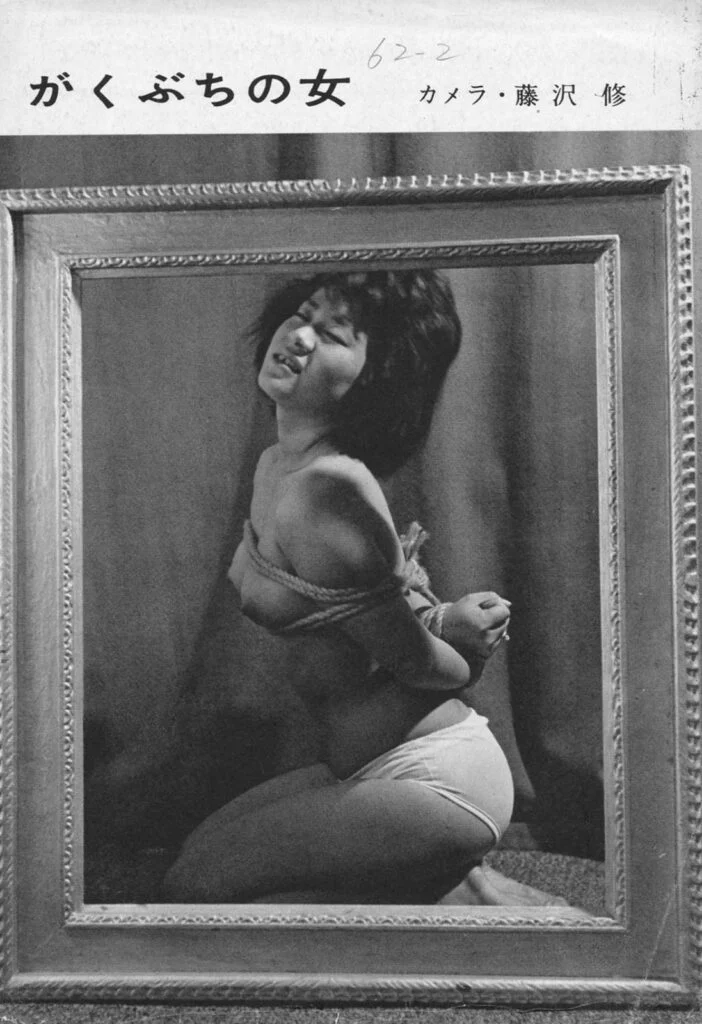
- Woman in a Picture Frame opens the issue by literally surrounding the bound model with ornamental frames, creating a distinctive visual conceit in which the photographed body becomes an exhibited image within the image. (PDF pp. 1–3).
- The opening portfolio is credited to photographer Fujisawa Osamu and develops from formally framed poses into increasingly varied rope-bound compositions. (PDF pp. 1–14).
- Suspended shifts attention to overhead wrist restraint, using a sequence of close and medium views to emphasize the model's raised arms, knots, and tension through the upper body. (PDF pp. 4–5).
- Shining Hills uses an unusually tight torso close-up followed by detailed views of rope and knots, foregrounding the material presence of the rope rather than treating it only as part of a full-body pose. (PDF pp. 6–7).
- The middle of the Fujisawa sequence alternates standing and kneeling poses with close attention to wrists bound behind the back, translucent costume, and rope crossing the shoulders and chest. (PDF pp. 8–9).
- White Abduction gives the photographic portfolio a stronger captivity scenario, placing the bound woman within a recognizable domestic room and presenting her in standing, kneeling, and floor-level poses. (PDF pp. 10–14).
- The Room You Cannot Escape, photographed by Yoshida Hisashi, introduces a second major portfolio in which long ropes visually connect the restrained model to the bedroom environment. (PDF pp. 15–20).
- The closing images progressively move the second model from an upright bedroom scene to the bed and finally the floor, using the room itself as part of the restraint scenario. (PDF pp. 17–20).