Translator’s Note: When we explore the history of Kinbaku and Japanese SM (the two are inseparable, in reality), we have a tendency to focus on the legends of bondage themselves. Names like Minomura Ko, Nureki Chimuo, Akechi Denki and many others.
But equally important are the models, both amateur and professional, that help shaped the content and the shape of the culture of Japanese SM. From Kitan Club to Roman videos, and to the modern era of Japanese AVs, each model provides a unique canvas in expression and feeling, and without them, Japanese SM may have never evolved out of primarily reader submission magazines.
Hiromi Saotome is a legendary model in the Japanese SM world. First staring in adult films in 1983, she participated in one of her first magazine shoots in the same year, for a magazine called SM Mania. The production involved herself, Nureki Chimuo, and Sugiura Norio.
These are the translations of her blog, located here (https://note.com/saotome6) talking about her history with Nureki. It is my honor to have them published on Kinbaku Today.
By Hiromi Saotome
October 24, 2020
With the shoot for Tomoshibi Planning’s first photo book, “The Sunset Room,” now complete, the four of us, Nureki Sensei, Nakahara Rutsu-san, photographer Sachi Yamanouchi-san, and I, felt a real sense of fulfillment. This, we thought, must be what true bondage is all about. I, too, felt a thrill from being bound in a way I’d never experienced before. It was a wonderful shoot, I really enjoyed it. It was completely different from a typical gravure shoot. I felt like I was able to respond with my true self. However, as I wrote in a previous entry, I felt a sense of sadness, thinking, “Is this really the end?” I’d love to be cast again, but I can’t say that out loud. That’s because there’s a fixed notion that this kind of work maintains its freshness precisely because the models are always changing.
After the wrap party, the thoughts that crossed Nureki Sensei’s mind as he headed home are recounted in the 167th chapter of Talking Theater. “The atmosphere of the Yamanouchi residence, Saotome’s masochistic sensibility, given this situation, we can still shoot more. No, we must shoot more,” he thought. The Yamanouchi residence is what you’d call a typical Showa-era single-family home. It’s packed with the charm of a house built about 40 years ago. It reminds me of my own childhood home. No, this is exactly what a very ordinary Showa-era home looked like (two tatami-mat rooms, a kitchen, a bathroom, and a toilet). And right next to the entrance, there was a thicket of horsetail, a plant that used to grow everywhere. Nureki Sensei seemed to take a liking to this horsetail. “All right, let’s drag the action all the way over here,” he said. And there’s also a veranda. “Let’s use this, too,” he decided. The story of Hiromi, the wife of a husband in debt, and Tamaru, the local moneylender, continues.
In the next chapter of Talking Theater that follows, discussions about the story continue. In situations like this, I remain an observer. I want to play the role of “someone else.” Even when things aren’t happening exactly as I intend, or when they’re real events occurring within my own body, placing a “transparent panel” (meaning I’m aware of the intent behind the action) allows me to immerse myself more deeply and feel more excitement. It’s a slightly complicated quirk of mine. The focus of the story was on “Why must Hiromi be dragged out at this point?” Honestly, I was surprised by the depth of this obsession. This isn’t a movie or a video shoot. It’s a photo shoot. “We must absolutely avoid cliched, casual situations,” said Director Nakahara, who was determined to enforce this policy. That’s because she knew full well that Nureki Sensei was prone to falling back on cliches. For better or worse, Nureki Sensei and I have been practicing bondage professionally. As a result, we tend to act instinctively, following a “do this in this situation” kind of mindset. Director Nakahara wanted to eliminate that.
August 26, 2011. The day of the shoot. To make the most of the engawa, Nureki Sensei had brought a “teru teru bozu” made of bleached cotton with a face painted on it. “So cute!!” The three of us girls squealed with delight. It was a peaceful moment. I’m also a fan of stuffed animals, so I have a strong reaction to things like this (of course, I took it home with me). Apparently, this “teru teru bozu” idea had been proposed earlier by Yamanouchi-san, the photographer. Well, this shoot also turned out to be tougher than expected. Let’s take a look at Talking Theater chapter 172 here.
The highlight of the shoot was the scene where Hiromi Saotome, playing the character Hiromi (a married woman), and I, playing the role of Tamaru, a ruthless loan shark, forcefully made her bite down on a hand towel tied into a gag.
For me, it was a scene I’d done a thousand , two thousand, no, three thousand times before. I was well-practiced at it.
So, I instinctively set the staging quickly and went through the motions smoothly.
However, Nakahara-san would not allow it.
“No, no, no, Sensei. That won’t do. That kind of half-hearted monkey’s fist won’t cut it!”
At Nakahara-san’s earnest rebuke, my heart skipped a beat, and I instinctively stopped tying the monkey’s fist. (My heart skipped a beat because I had a premonition that she was going to say that.)
“There’s no strength in your fingertips, Sensei. This is supposed to be a very thrilling scene for Tamaru and Hiromi, isn’t it? The cloth isn’t just for show, it serves the crucial purpose of ‘preventing Hiromi from making a sound.’ Tamaru shouldn’t let his guard down for even a single moment until he’s finished tying the rope. We don’t want to take a portrait of a face with the cloth tied neatly, do we? We want to see that thrilling process described in your script. Sense, put yourself in Tamaru’s shoes and show us those powerful movements of your fingertips.
To make sure the cloth you’ve wedged behind Hiromi’s teeth doesn’t come out, press down harder with your fingertips, and push it deep into her mouth, then use a narrow strip of cloth to cut across the top in a straight line, clamp it firmly between her upper and lower teeth. First tie it tightly at the back of her head, then, using another hand towel, cover Hiromi’s entire mouth with a large gag, pulling it tight… harder, harder, harder!”
Since this is not a film, Director Nakahara’s voice is not recorded here.
“Is this right? Is this good enough?”
At this point, I am nothing more than a performer, moving exactly as the director instructs.
Of course, what this director says is correct, so I move earnestly, just as I am told.
Actually, at this moment, I am more concerned with the reaction of Hiromi Saotome, who plays the married woman Hiromi.
Saotome has a small face, and proportionally, her mouth is small as well. When I force the rolled-up white cloth deep into her mouth, it immediately reaches her throat, making it difficult for her to breathe.
Watching Saotome’s changing expression, I put my strength into my fingertips and performed the harsh gag scene as Director Nakahara intended.
When I tied the first hand towel, which I had wedged between her teeth, at the back of her neck, Saotome’s cheeks made a gurgling sound.
Whistling breaths escaped her, and I heard a low, gasping voice.
If a gag enthusiast were here, the sheer intensity of the scene would be mind-boggling.
Hiromi remains in this intense bondage position as the loan shark grabs the end of her rope and drags her around the room.
Along with the harsh movements of her entire body, agonized moans escaped from with the gag, making it an even more stimulating, sadistic scene.
Nakahara-san, this time acting as the videographer, filmed a portion of this scene.
(I didn’t know at the time that she was filming with a video camera.)
From Talking Theater Chapter 174
“A scene where a woman bound with her hands behind her back is being dragged around pitifully, that doesn’t exist in any footage or photograph to date. Even if the binding method is the same, there’s nothing that captures that kind of scene. That’s exactly why we have to act it out and film it properly,” Director Nakahara said, still glaring at me with those wide eyes.
“But it’s going to hurt Saotome-san a lot, with her whole body scraping against the tatami mats,” I said. After all, I am a feminist.
“Saotome-san, please do your best. This is a scene filled with a deeply masochistic emotion, symbolizing the fate of an unfortunate and pitiful married woman. So even if it hurts a little, please endure it, don’t fake it, and let’s shoot this thoroughly.” Director Nakahara was unusually fired up.
Saotome is a seasoned veteran actress, so she simply nods in silence.
I lower my center of gravity slightly, brace my feet, take a deep breath, and begin dragging her around. I grip the rope tightly.
Saotome’s body is petite, but because she is bound and deprived of her freedom, she feels heavy. Moreover, she tries to strike a defiant pose whenever she sees an opening.
I have to put some real effort into it if I’m going to move this woman’s body lying on the tatami mats. But even if I drag her with all my might, it won’t result in a sensual pose full of SM appeal.
Naturally, grabbing the rope and dragging her is an act, and turning her body on the tatami mats is an art.
(I wrote about this in quite some detail last time.)
I must move her rope-bound body while consciously aiming for an alluring, sensual pose worthy of SM appreciation, and furthermore, I must repeat the dragging motion as if timing my breath, all while taking into account the position of the photographer Yamanouchi and the angles she is aiming for.
I must not rush, and of course, I must not rely on brute force. Yet, I must remain Tamaru through and through.
Saotome also fully embodies the married woman Hiromi, writhing her entire body and expressing the eroticism of a masochistic woman through movements of agony. Agony and hatred toward the loan shark.
A heart-wrenching gaze, a realistic sense of pain that makes her chest and throat tremble. She has really studied the script well.
What deserves special mention in Saotome’s passionate performance in this intense scene is that not only the pitiable nature of the unfortunate woman, but also the resentment and hatred toward the ruthless loan shark are expressed in a tantalizing way through the eyes of the married woman, Hiromi, as a form of sensual allure.
Her frustration, resentment, hatred toward the man, anger, and resignation, as she attempts to flee only to be caught again, bound with her hands behind her back, and even gagged, are rendered with a mysterious intensity and added sensuality, thanks to Saotome’s natural talent. It is this mix of resentment and hatred that brings the married woman to life.
Feeling compelled to mercilessly torment this vulnerable married woman, the man’s movements continue to assault her body, yet at this moment, half of my consciousness is constantly observing the breathing and expressions of photographer Yamanouchi.
The moment the photographer shows that “I want to shoot this!” in her breathing and makes her decision, I must stop my own movements and adjust the subject’s pose to match the photographer’s intent.
Thanks to the flawless cooperation of everyone involved (or rather, a clash of passions), this scene also turned out exceptionally well.
“Amazing, amazing, that’s it, that’s it, I’m so glad we pushed through, ah, that’s it!” Both Nakahara-san and Photographer Yamanouchi let out heartfelt cheers.
Saotome, the heroine, is smiling while resting a short distance away.
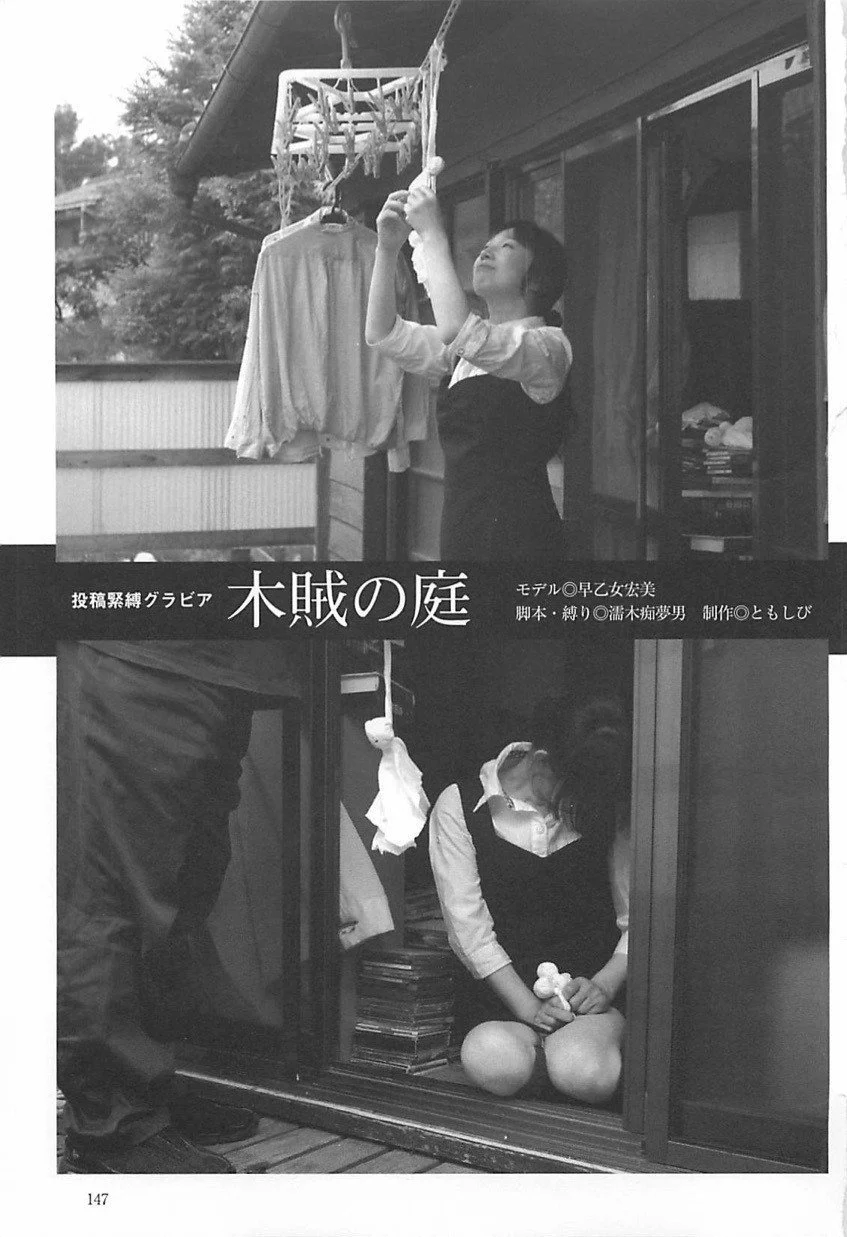
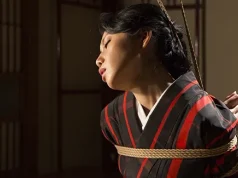
私はこの文を読み、感動して感想文を書いた。それはまた次回に。(写真はマニア倶楽部/三和出版に掲載されたもの)