Uramado
October 1958
← Back to magazine archive
Issue Details
- Volume
- 3
- Issue
- 13
- PDF pages
- 291
Summary
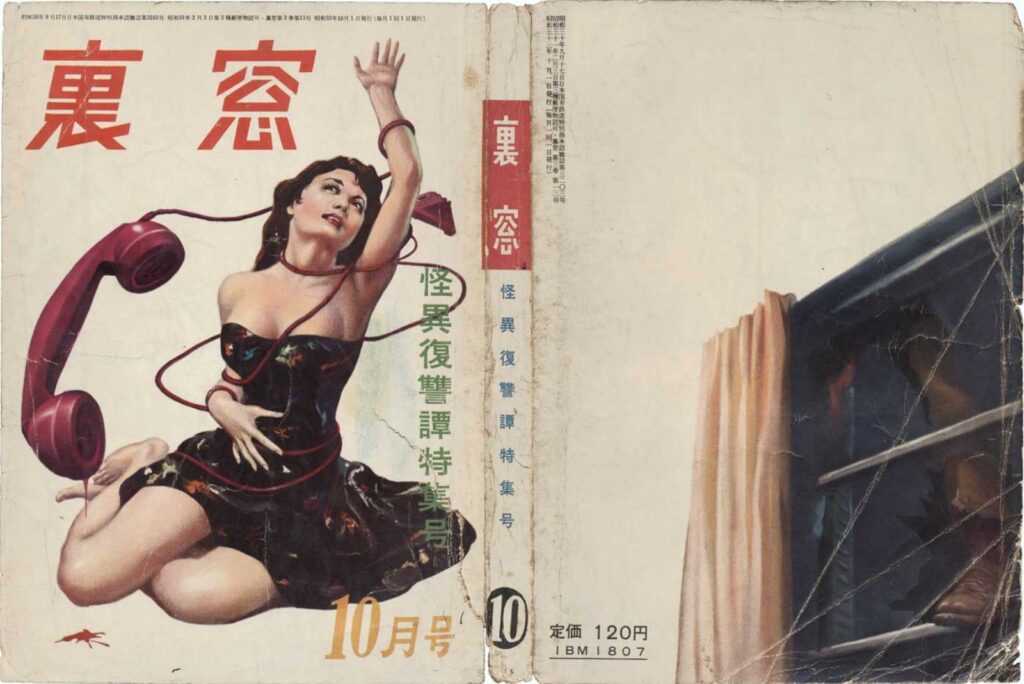
The October 1958 issue of Uramado is an unusually large anthology organized around a special feature of supernatural revenge tales. Its editorial identity combines historical melodrama, contemporary crime fiction, grotesque fantasy, erotic suspense, illustrated serials, photography, and popular occultism. The cover’s telephone-cord bondage image establishes a modern erotic menace, while the formal contents spread presents a densely packed program of stories about curses, ghosts, vengeance, confinement, murder, mysterious women, and bodies placed under threat.
Read full summary Close full summary
Table of Contents 25 items
-
The Female Water Entertainer
Summary
An illustrated historical erotic revenge tale set in Edo-period pleasure quarters, following a female water entertainer, a samurai, and a chain of murders, pursuits, coercive encounters, and uncanny events.
-
Light and Skin
Summary
A photographic study of nude bodies that explores how lighting models skin, emphasizing tone, contour, texture, and sensual form through a sequence of studio images.
-
The Secret of the Bat Theater
Summary
An illustrated erotic crime-suspense narrative about a glamorous actress’s abduction, secret performances at the Bat Theater, fetishistic coercion, pursuit, and the revelation of concealed motives and identities.
-
Breast Chamber of Hell
Summary
A serialized erotic crime thriller follows drug traffickers, fugitives, and hired killers through a cycle of kidnapping, pursuit, revenge, and violent torture involving Feng Mei, Minghai, and their associates. The narrative repeatedly depicts women being restrained, beaten, gagged, threatened with weapons, and subjected to sadistic captivity, accompanied by dramatic illustrations.
-
The Damask-Skin Curse
Summary
Takagi Ryūji’s illustrated Edo-period revenge tale follows a household and its visitors as supernatural curses, erotic coercion, violence, and successive deaths unfold around a mysterious woman and occult inscriptions. The serialized narrative combines grotesque haunting with scenes of bondage, domination, and punishment.
-
The Demon Lurking in the Feet
Summary
A grotesque supernatural erotic tale follows Rumie as an uncanny black-cat presence and strange encounters expose an obsessive fixation on women’s feet, bodily difference, and forbidden desire.
-
Hatamoto Bedchamber Chronicle
Summary
A historical erotic chronicle set among a hatamoto household and its retainers unfolds through secret intrigues, sexual coercion, captivity, violence, and revenge in a feudal domestic world.
-
The Monster of the Stock Hotel
Summary
A reporter investigates the Stock Hotel after hearing a woman’s cries from a locked room, uncovering a grotesque supernatural mystery involving captivity, hidden identities, and the hotel’s violent past.
-
Oshima’s Vendetta Journey
Summary
Set in the Edo period, this revenge tale follows Oshima on a vendetta journey that brings her into encounters with violent men, eroticized restraint, deception, and retaliatory justice.
-
The Inn of the Poison Butterfly
Summary
A dark erotic tale follows Takemi, a beautiful bar hostess whose financial vulnerability and forbidden desires draw her into manipulation, captivity, and escalating bondage and abuse by men around her. Illustrated scenes emphasize rope restraint, coercive sexual power, humiliation, and the transformation of her identity under exploitation.
-
The Beauty Mound’s Karmic Consequence
Summary
A historical erotic revenge tale follows violent entanglements among warriors, merchants, and women, linking sexual coercion, captivity, betrayal, and eventual karmic retribution. Its illustrations emphasize bondage, bodily exposure, torture, and grotesque punishment within an Edo-period setting.
-
The House That Invites an Eerie Presence
Summary
A grotesque supernatural story centers on a mysterious house and the unsettling encounters, erotic propositions, and violent fantasies associated with it. The accompanying illustrations reinforce the narrative’s atmosphere of eerie voyeurism, bodily transformation, and menace.
-
The Transformed Young Samurai
Summary
A historical erotic revenge tale follows a young samurai whose forbidden relationship, family conflict, and encounters with supernatural transformation lead to violence, pursuit, and retribution, accompanied by dramatic narrative illustrations.
-
Will-o’-the-Wisp Riverbank
Summary
An illustrated supernatural erotic narrative set around a riverbank follows lovers, servants, ghosts, and deceptive apparitions through pursuit, captivity, escape, and revenge, presented in serialized scene panels with dialogue.
-
The Supernatural Death-God Hatamoto
Summary
Set in Edo-period Japan, this lurid revenge tale follows a mysterious headless corpse and an investigation that uncovers sexual betrayal, murder, coercive bondage, and the supernatural return of a wronged woman to punish those responsible.
-
Disappearance Underwater
Summary
A suspenseful erotic crime story follows police investigators as they pursue a resourceful female suspect through disguises, surveillance, a bathhouse, and an underwater escape.
-
The Man Who Walks About Selling Death
Summary
A serialized crime-and-revenge thriller follows Saburō, Mari, and other conspirators through schemes involving deception, captivity, murder, drugging, and an underground room, while their shifting motives and betrayals drive the narrative toward further violence.
-
Strange Transformation Sketches
Summary
Suzuki Kazuo presents an illustrated anthology of Edo-period strange tales involving supernatural transformations, ghosts, sexual intrigue, violence, murder, and revenge, accompanied by discussion of historical sources and reported testimony.
-
Almost the Anniversary of Your Death
Summary
Serialized revenge fiction follows a destructive family conflict involving inheritance, coercion, sexualized domination, murder, suicide, and elaborate retaliation among the protagonists.
-
Men Who Toy with Women’s Bodies
Summary
An illustrated essay surveys theatrical and staged erotic representations of cruel, dominant women who restrain, humiliate, punish, and physically overpower men, while considering the appeal of these gender reversals to spectators.
-
Hell Ship
Summary
A serialized erotic fantasy follows Ōtaki, who is abducted and transported aboard a hell ship, where captors subject her to confinement, forced nudity, sexual violence, and sadistic punishment before further dangers unfold.
-
Autumn Wind at Kikyo Field
Summary
Set amid a turbulent historical battle, this erotic adventure depicts women and travelers caught up in warfare, abduction, pursuit, coercive sexual encounters, and violent domination around Kikyo Field.
-
The Ageless Maiden
Summary
This erotic fantasy centers on the enigmatic young woman Hanako and the fascination she arouses in a rural household, presenting youthful beauty, intimate observation, romantic intrigue, and fetishized bodily detail.
-
The Hot-Spring Inn Murder Case
Summary
A serialized sensational mystery follows the investigation into the death of a young woman associated with a hot-spring inn, whose body is discovered after heavy rain and whose final movements implicate two male guests. Interrogations, conflicting accounts, and eroticized descriptions of the victim gradually intensify suspicion around the case.
-
Death-Coffin Komachi
Summary
A historical supernatural revenge tale follows the ninja善四郎 and other figures through curses, apparitions, pursuit, abduction, and violent confrontations surrounding the mysterious “death coffin” and the fate of Komachi. The illustrated narrative repeatedly depicts women and men bound, restrained, threatened, or subjected to occult punishment.
Highlights
- The formal contents spread announces a “Strange Tales of Revenge” special and organizes a remarkably extensive mixture of period fiction, modern thrillers, supernatural stories, photography, and illustrated serials. (PDF p. 4).
- “The Female Water Entertainer” opens the issue with richly colored period illustrations and a tale of murder, mutilation, pursuit, and a performer linked to a mysterious crime. (PDF pp. 6–13).
- Osamu Fujisawa’s “Light and Skin” uses stark lighting and tightly composed nude studies to transform limbs, torsos, and bodily curves into abstract sculptural forms. (PDF pp. 14–19).
- “The Secret of the Bat Theater” is a modern noir narrative involving a nightclub actress, a dwarf performer, abduction, narcotics, captivity, public spectacle, and pursuit through the city. (PDF pp. 20–28).
- “Breast Chamber of Hell” combines gangster intrigue, stolen narcotics, erotic coercion, imprisonment, revenge, and gun violence in an extended illustrated thriller. (PDF pp. 29–42).
- “The Damask-Skin Curse” inaugurates the main revenge feature with a haunted mansion, coded writings, secret rooms, missing women, and a chain of inherited grievance. (PDF pp. 43–58).
- “Hatamoto Bedchamber Chronicle” is one of the issue’s longest period narratives, using household intrigue, sexual secrecy, status, and violence to explore the hidden life of a warrior residence. (PDF pp. 71–82).
- “The Inn of the Poison Butterfly” and “The Beauty Mound’s Karmic Consequence” form a substantial middle sequence of poison, fatal attraction, supernatural suggestion, and karmic retribution. (PDF pp. 107–134).
- The later sequence from “The Man Who Walks About Selling Death” through “Hell Ship” intensifies the issue’s mixture of assassination, disguise, haunted travel, waterfront danger, and violent revenge. (PDF pp. 196–248).
- The concluding “Death-Coffin Komachi” installment combines ornate period illustration, serial adventure, female peril, violence, and historical spectacle before the editorial and publication back matter. (PDF pp. 271–290).
Contributors
Named contributors represented in this issue:
- Fujii Kenji
- Fujisawa Osamu
- Hada Hikaru
- Hashizume Hikoshichi
- Hattori Gen
- Iida Toyokichi
- Inumon Masato
- Kawano Kyōsuke
- Matsui Yoriko
- Mikunizawa Takashi
- Mizorogi Jakushi
- Nakajima Yoshimi
- Natsumoto Keinosuke
- Odagiri Sō
- Ojima Shin
- Saruwaka Tonpei
- Sasamoto Tōru
- Shimamoto Haruo
- Suzuki Kazuo
- Takagi Ryūji
- Takeya Jūzō
- Ujigawa Ryū
- Utagawa Taiga
- Yagiri Jūhachi
- Yanagitsutsu Jūzaburō