Kitan Club
December 1953
← Back to magazine archive
Issue Details
- PDF pages
- 201
Summary
The December 1953 issue of Kitan Club is an unusually expansive year-end number that combines rope photography, illustrated restraint systems, fetish and masochism essays, literary fiction, serialized narratives, film criticism, autobiographical writing, female-dominance fantasy, and historical discussions of punishment. Its editorial center is no longer simply the spectacle of a restrained woman. The issue repeatedly analyzes how bondage is constructed through rope materials, frames, posts, pulleys, clothing, photography, expression, and narrative role.
Read full summary Close full summary
Table of Contents 38 items
-
Binding Methods Using Posts and Leverage
Summary
An illustrated instructional feature by Itō Seiu presenting multiple Japanese rope-binding methods that use posts, beams, and leverage to secure the body in varied positions. Captions explain the placement and tightening of ropes around the limbs and torso.
-
A Certain Pose Produced by Tight Binding
Summary
A photographic feature showing a model placed in a tightly bound, folded seated pose, with rope arranged around the torso and legs. The single staged image emphasizes the visual form and bodily posture produced by intensive restraint.
-
Illustrated Female-Prisoner Punishments
Summary
An illustrated feature presenting scenes of female prisoners subjected to various punishments and restraint arrangements, including public display, dragging, burning, and splitting or stretching forms of punishment. The accompanying prose frames these scenes through masochistic fantasy and the spectatorship of punishment.
-
Three Expressions
Summary
An illustrated feature titled “Three Expressions,” combining portraits of women’s faces with staged scenes of bondage, exposure, and severe punishment or death. The work emphasizes changing facial expressions within stylized erotic and punitive tableaux.
-
An Album of Punishment Photographs: The Use of Vinyl Cord and Rope
Summary
A photographic feature demonstrates the use of vinyl cord and rope in elaborate punishment and restraint scenes. The accompanying text discusses cord flexibility, knotting, tension, color, and the use of hardware to vary the arrangements.
-
Forced Undressing
Summary
An illustrated erotic scene depicts a woman being forcibly undressed and restrained by a man, with accompanying dialogue emphasizing coercion, resistance, and control. The feature presents forced disrobing as a stylized fantasy of domination and humiliation.
-
Two Forms
Summary
A photographic feature titled “Two Forms” presents a bound figure in a contorted, forward-bent posture, with ropes securing the body to a supporting frame or pole. The image emphasizes contrasting bodily configurations produced through rope restraint.
-
Rod Punishment
Summary
“Rod Punishment” is a photographic depiction of a restrained figure positioned on a horizontal bar and secured with ropes while a rod is used as the central punishment device. The scene combines staged bondage with corporal punishment imagery.
-
A New Pleasure Game
Summary
An illustrated feature presenting a “new pleasure game” involving a nude woman and a partner in a rope-based restraint scene. The visual emphasizes staged erotic play and physical immobilization.
-
Brother and Sister
Summary
An illustrated erotic scene titled “Brother and Sister,” depicting a clothed man and a nude woman in an intimate encounter accompanied by dialogue expressing embarrassment and reluctance. The piece centers on forbidden, incestuous fantasy.
-
Three-Woman Bondage Show
Summary
A photographic feature depicting three women bound together in elaborate rope configurations, including suspended and group arrangements. The staged scenes emphasize visual display of restraint and coordinated bondage.
-
Illustrations of Beautiful Women in Suspension
Summary
An illustrated portfolio by Minamikawa Kazuko showing nude women placed in various suspension and restraint configurations, including swing suspension, torso suspension, reverse-hand suspension, and dragonfly-style suspension. The accompanying labels present the images as scenes of punishment and bondage display.
-
Women’s Seppuku
Summary
A photographic feature titled “Women’s Seppuku” juxtaposes a nude woman lying outdoors with a traditionally dressed woman holding a sword. The imagery invokes ritual suicide, abdominal cutting, and stylized female violence.
-
The Bush Warbler’s Valley Crossing
Summary
A first-person account describes a young woman’s experiences in a female-controlled sexual environment, including coercion, rope restraint, forced postures, beatings, and other forms of punishment. Framed as a testimony of “lynching among women,” the narrative combines personal confession with an eroticized account of female domination and abuse.
-
The Sword-Bead Woman
Summary
A dark erotic narrative centered on a woman associated with the sword-bead motif and a sadistic male imagination. The story moves through fantasies of violence, restraint, bodily vulnerability, and forbidden sexual desire, blending fictional scenes with reflections on sadism and masochism.
-
The Intermingling of Three Colors
Summary
A surreal erotic story of a precocious boy whose fantasies become entangled with encounters involving an older woman, a young woman, and dreamlike figures in forests, rooms, and urban settings. The narrative emphasizes voyeuristic discovery, sexual initiation, coercive desire, and recurring visual contrasts of white, red, and black.
-
Wild Thistle
Summary
An erotic narrative in which a married couple reenact a famous tragic woman-and-lover scenario, escalating theatrical play into elaborate restraint, needle play, and violent struggle. The story combines historical stage imagery with sadistic and bondage-oriented fantasy.
-
The Attraction of the Navel
Summary
A personal essay tracing the author’s intense fascination with navels and the erotic appeal of the female body. It reflects on navel imagery encountered in photographs, stage and screen entertainment, striptease, wrestling, and popular erotic culture.
-
A Perverse Geisha
Summary
A diary-style account attributed to a geisha working in the pleasure quarters, describing encounters with customers and the pressures, negotiations, and humiliations of her sexual labor. The narrative repeatedly depicts eroticized rope restraint, forced nudity, whipping, and bodily discipline in encounters with clients.
-
Rope and Masochism
Summary
Kurihara Shōzō presents an extended study of rope bondage and masochism, combining reflections on the psychological appeal of restraint with historical discussion of Japanese practices. Illustrated diagrams explain multiple traditional and contemporary tying methods, including wrist, arm, torso, suspension, and complex multi-rope forms, while also considering their use in erotic imagery, fiction, punishment, and captivity.
-
Illustrations of the Punishment Ground
Summary
Itō Seiu discusses the history and artistic treatment of “punishment grounds” in Japanese imagery, contrasting older depictions with modern illustrated and sculptural representations. The essay considers artists, models, exhibition culture, and the changing relationship between eroticized punishment, realism, and popular visual media, accompanied by illustrative examples.
-
Fire, Part Twelve
Summary
The twelfth installment of Matsui Kōko’s serialized SM fiction continues a melodramatic captivity plot involving a married couple, abductors, deception, and shifting loyalties. The narrative depicts elaborate rope bondage, gagging, forced exposure, humiliation, and emotional coercion before reaching a tragic confrontation and apparent resolution.
-
Gags as Depicted in Motion Pictures
Summary
An illustrated survey of gagging scenes in Japanese motion pictures, discussing actresses, actors, and representative films in which characters are silenced or restrained with cloth gags, handkerchiefs, and related devices. The article treats these scenes as recurring visual and dramatic motifs, with attention to staging, performers, and changing cinematic conventions.
-
The Autumn Journey of the Shunpūza
Summary
A serialized erotic novel follows the Shunpūza theatrical troupe on an autumn tour, where backstage rivalries, secret plans, and performances increasingly merge with scenes of coercive sexual domination. The narrative centers on women being tied, gagged, restrained, and displayed in elaborate rope-bound tableaux, blurring staged spectacle and real captivity.
-
Cruel Women
Summary
A translated and adapted 1901 German work surveying allegedly cruel and sexually dominant women in history, including female rulers associated with corporal punishment, torture, execution, and the subjugation of men. The article combines historical anecdotes with eroticized illustrations and discussion of sadistic and masochistic imagery.
-
Sentimental Education, Part Two
Summary
The second installment of this translated erotic narrative follows Tatsuo and Yuki as their marriage develops through increasingly elaborate experiments in restraint, gagging, role-play, and controlled punishment. The story presents these scenes as a gradual exploration of sexual psychology, trust, submission, and domestic intimacy.
-
MS Band
Summary
A detailed illustrated guide to the “MS Band” (Masochism Band), explaining its construction, measurements, fittings, and use with ropes, handcuffs, and other restraints. The article emphasizes controlled self-binding and describes restrictive positions and procedures intended to produce masochistic sensation while warning about safety and release arrangements.
-
Strange Mandala
Summary
A grotesque supernatural crime narrative about an occult “Mandala” cult, its charismatic teacher, and the violent fate of investigators and followers. The story features murdered and mutilated women, captivity, ritualistic menace, and the eventual exposure and downfall of the cult leader, accompanied by sensational erotic illustrations.
-
Spiders and Butterflies
Summary
A serialized SM story about actress Rie, whose promised film opportunity leads to coercion, escape, recapture, and increasingly severe punishment by a director and his associates. The narrative depicts elaborate rope restraint, suspension, gagging, humiliation, and forced submission within a film-studio setting.
-
Perversion in Modern Literature
Summary
A literary-critical essay examining how sexual “torment” and perverse desire appear in modern Japanese fiction. It discusses works and characters associated with coercion, humiliation, nudity, physical control, and unequal sexual power, with particular attention to Funahashi Seiichi’s fiction and the psychological dynamics of its scenes.
-
Love Slave, Part Twelve
Summary
The concluding installment of Kitō Kōichirō’s serialized SM novel follows Harumi as she manipulates several men through money, jealousy, erotic display, and demands for obedience. Hospital visits, foot- and shoe-centered humiliation, kneeling submission, and negotiations over love and possession culminate in a renewed but unequal relationship between Harumi and the male narrator.
-
The Sweet Surrender of Alice
Summary
A translated serialized SM story in which Alice is physically overpowered, restrained, stripped, and subjected to escalating discipline and sexual domination. Across chapters seven through ten, her resistance gives way to coerced submission, while the narrative emphasizes bondage, corporal punishment, humiliation, and the captor’s control.
-
Fantasy and Expectation of Humiliation
Summary
A first-person confession by Furukawa Yūko explores a woman’s fantasies and expectations of humiliation through imagined and recounted scenes of captivity, restraint, gagging, blindfolding, and sexual submission. The narrative moves between domestic life, travel, memory, and erotic fantasy, presenting bondage and degradation as sources of masochistic excitement and psychological escape.
-
A Woman’s Path
Summary
A historical erotic samurai tale centered on O-Chika, whose relationships with rival warriors become entangled with coercion, revenge, sexual domination, and betrayal. The narrative culminates in an intensely violent confrontation involving restraint, bodily exposure, and death.
-
Memoirs of a Female Slave
Summary
A first-person memoir recounts a woman’s transformation into a household slave through confinement, forced service, sexual coercion, and repeated physical punishment. The narrative emphasizes the routines and psychology of domestic enslavement, including binding, surveillance, humiliation, and submission to male authority.
-
Records from Manchuria and Mongolia
Summary
A memoir by a Japanese returnee describes life and labor in Manchuria and Mongolia, including travel, harsh working conditions, encounters with Japanese expatriates, and erotic relationships shaped by the colonial wartime environment. The account combines personal confession with reflections on male same-sex desire, sexual coercion, and culturally unfamiliar practices in northeast Asia.
-
From a Masochist’s Notebook
Summary
A serialized case narrative presented as material from a masochist’s notebook, recounting Karo’s relationship with his wife and their increasingly elaborate dog-training and disciplinary role-play. Framed through letters and psychological commentary, it explores male sexual incapacity, masochistic desire, domestic power exchange, and the fetishistic use of a dog, collar, leash, commands, and bodily discipline.
-
Publication Notices and Advertisements
Summary
A page of publishing notices and advertisements promoting new and forthcoming erotic books, illustrated collections, fetish-oriented materials, subscriptions, and a special Sadism-literature supplement. It also solicits original manuscripts and contributions, presenting the magazine’s commercial and participatory publishing network.
Highlights
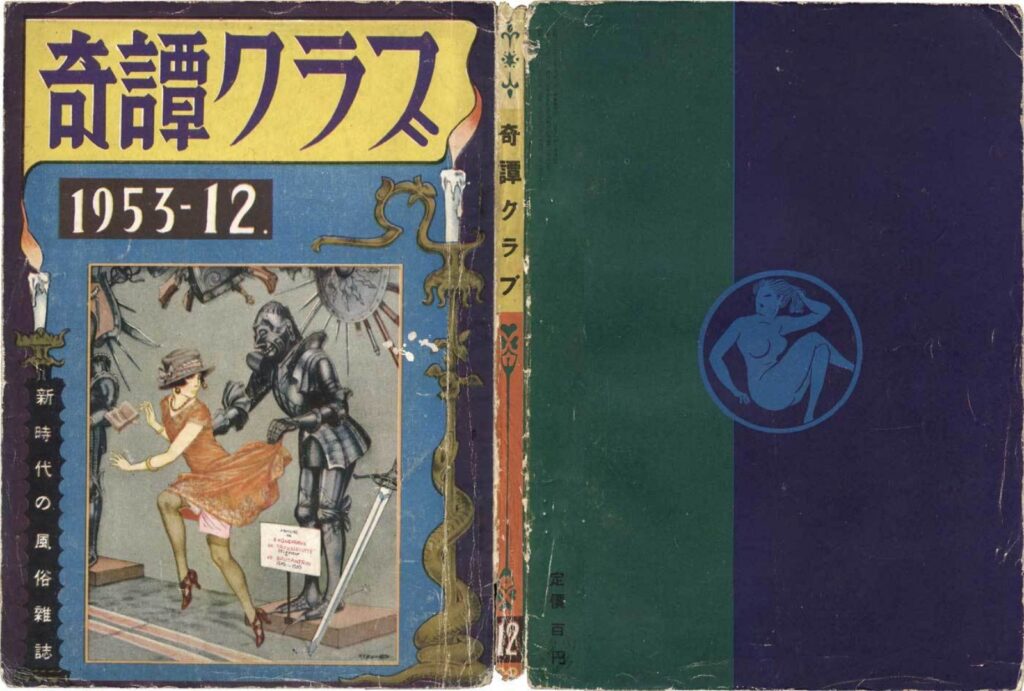
- The cover frames erotic hierarchy through European costume, armor, exposed leg, and theatrical confrontation rather than explicit rope (PDF p. 1).
- Binding Methods Using Posts and Leverage treats the rigid frame as an active partner in restraint, shaping inversion, elevation, and bodily exposure (PDF p. 5).
- A Certain Pose Produced by Tight Binding isolates a kneeling model against a simple background, making silhouette and upper-body compression the principal subject (PDF p. 6).
- The illustrated female-prisoner sequence compares posts, poles, crosspieces, suspension lines, and body angles as elements of an engineered bondage apparatus (PDF pp. 7–10).
- Three Expressions uses hair, facial direction, collapse, and line quality to construct visual states of exhaustion and distress (PDF pp. 11–12).
- An Album of Punishment Photographs treats vinyl cord and conventional rope as distinct visual materials, marking a growing interest in the physical medium of bondage (PDF pp. 13–14).
- Rope and Masochism reduces chair bondage to diagrams and repeatable arrangements, making rope legible as a technical system rather than a generic sign of captivity (PDF pp. 52–60).
- Itō Seiu’s Illustrations of the Punishment Ground connects technical restraint with architecture, historical punishment, and the deliberate construction of scenery (PDF pp. 61–64).
- Gags as Depicted in Motion Pictures invites readers to analyze cinema as an archive of silencing, restraint, and dramatic visual convention (PDF pp. 78–82).
- Cruel Women identifies female dominance as a recurring erotic type rather than merely an exceptional act of villainy (PDF pp. 99–104).
- MS Band combines fetish garment and restraint device, showing how costume can shape posture and function as bodily control (PDF pp. 115–119).
- Spiders and Butterflies uses predator-and-prey symbolism to represent entrapment, beauty, fragility, and controlled movement (PDF pp. 131–138).
- Perversion in Modern Literature encourages readers to become critics and collectors of nonnormative themes across contemporary writing (PDF pp. 139–144).
- Love Slave, Part Twelve completes a year-long recurring submissive identity, demonstrating how serialization helped stabilize the magazine’s erotic community (PDF pp. 145–155).
- Memoirs of a Female Slave and From a Masochist’s Notebook close the issue with apparently first-person voices, transforming submission and masochism from externally described categories into recurring narrative identities (PDF pp. 183–200).
Contributors
Named contributors represented in this issue:
- Aoyama Mieko
- composition by Itō Seiu; illustrations by Chikami Reiko
- composition by Tsujimura Takashi; photography by Tsukamoto Tetsuzō
- Furukawa Yūko
- Itō Seiu
- Itō Seiu; illustrations by Chikami Reiko
- Kameoka Ryokushichirō, credit uncertain
- Kawai Itsuko
- Kimi Tenzan, credit uncertain
- Kitayama Kaoru
- Kitō Kōichirō
- Kiyama Sakugo, credit uncertain
- Kurihara Shōzō
- Kuriyama Sakugo, credit uncertain
- Matsui Kōko
- Minamikawa Kazuko
- Morimoto Aizō
- Murata Seiichi
- Nanji Kōji
- Naruyama Kumahira
- Numa Shōzō
- Numata Fujise
- Sumida Hiroshi
- Taki Reiko
- Tayama Akira
- translated by Kurihara Azuma
- translated by Samukawa Midori
- Tsuzuki Mineko
- Yoshino Mayumi