Kitan Club
April 1953
← Back to magazine archive
Issue Details
- PDF pages
- 173
Summary
The April 1953 issue of Kitan Club brings rope more decisively into the realms of technique, bodily analysis, staged photography, domestic fantasy, and reader discussion. Historical punishment and coercive fiction remain prominent, but the issue repeatedly asks how restraint works: how different arm positions alter the body, how fetish objects acquire meaning, how domination is represented in art and literature, and how people who identify with these desires might understand one another.
Read full summary Close full summary
Table of Contents 29 items
-
A Study of the Beauty of Tight Binding with the Hands Behind and the Arms Raised
Summary
A photographic study of tight rope binding with the hands secured behind the body and raised, presenting several postures and variations using ropes and a bamboo pole. The accompanying text discusses the visual beauty, tension, and practical arrangement of these restraints.
-
Confessions of a Reformed Delinquent
Summary
A first-person confession by a former delinquent describing detention in a juvenile correctional institution, including institutional discipline, confinement, punishment, and degrading treatment. The narrative reflects on the physical and psychological effects of custodial correction and eventual reform.
-
How to Obtain the Wine of the Gods
Summary
A first-person erotic account presents the pursuit and consumption of a woman’s urine as the “wine of the gods.” Framed partly as practical advice, it describes arranging a toilet and collecting vessel to obtain the urine discreetly, along with the narrator’s fantasies and sensory responses.
-
Longing for the Obese Body
Summary
An autobiographical confession traces the author’s longstanding attraction to obese bodies, recalling childhood impressions, encounters with nude male bodies, and later fantasies involving exhibitionism, medical observation, and masochistic exposure. The piece presents this fixation as a distinctive sexual psychology and fetishistic desire.
-
Riding Clothes, High Boots, and the Whip
Summary
A first-person erotic account of a fascination with riding clothes, high boots, and whips, developing through encounters with women and riding-related scenes into episodes of bondage, whipping, and female control. The narrative emphasizes the narrator’s fetishistic and masochistic responses to clothing, equipment, and disciplinary treatment.
-
A Mysterious Interrogation
Summary
A first-person erotic narrative set partly in a coeducational high-school milieu, in which female students subject a male figure to an elaborate interrogation and punishment involving ropes, forced positions, whipping, gagging, and humiliation. The account escalates from staged restraint to intense coercive and masochistic fantasy, accompanied by suggestive illustrations.
-
My Newlywed Life
Summary
A first-person account of married life describing escalating erotic tensions between a wife and husband, including marital bondage, role reversals, sexual experimentation, and the wife’s conflicted responses to domestic intimacy. The narrative combines autobiographical confession with reflections on sexual psychology and changing marital expectations.
-
The Occasion for Blooming
Summary
A confessional narrative about a woman whose masochistic and exhibitionistic impulses develop through fantasies of bodily exposure, abdominal injury, knives, and violent erotic scenarios. The account links private sexual imagination with the thrill of being watched and with sensationalized images of female vulnerability and bodily violation.
-
The Shadow of Jealousy
Summary
A first-person erotic narrative centered on jealousy, illicit intimacy, and an escalating encounter in which a woman is subjected to elaborate rope bondage and punitive domination. The story emphasizes possessiveness, humiliation, and the psychological interplay between desire and resentment.
-
The Dream I Saw Last Night
Summary
A dream-diary-style account of a frightening yet erotically charged nightmare in which the narrator is led into a secluded house, captured, gagged, and bound with rope by others. The piece dwells on helplessness, sensory confinement, fear, and the lingering intensity of the dream after waking.
-
Lament of a Young Bride
Summary
A multi-part erotic narrative set in Osaka’s Tobita pleasure district, following a male visitor’s encounters and conversations with prostitutes and other women. Across successive episodes, the story explores commercial sex, marital tensions, sexual bargaining, and the contrasting emotional lives of women working in the district.
-
Confession of a Cultured Animal
Summary
A first-person confession by a private tutor describing his voyeuristic observations of an employer’s household and his subsequent sexual involvement with a young woman. The narrative centers on peeping, secrecy, fetishized clothing and bodies, and coercive erotic power relations.
-
New Nude Rhapsody
Summary
An essay arguing for a more expansive appreciation of nude bodies in art, contrasting conventional representations of male and female bodies and discussing photography, sculpture, painting, and the aesthetics of bodily form. It also reflects on changing standards of beauty, gendered spectatorship, and the place of nude imagery in modern Japanese visual culture.
-
Sexual Intercourse
Summary
A first-person erotic confession tracing the author’s childhood attachment to animals, developing sensory and sexual interests, family influences, relationships, and later encounters with erotic desire. The narrative blends autobiographical memory with reflections on animal affection, bodily sensation, secrecy, and unconventional sexuality.
-
Love Slave, Part Four
Summary
Part four of Kitō Kōichirō’s serialized first-person SM fiction follows a husband whose idealized new-marriage fantasies develop into encounters involving female authority, humiliation, punishment, and elaborate restraint. The narrative moves between domestic and theatrical scenarios, emphasizing the narrator’s masochistic submission and fascination with powerful women.
-
The Woman on a Sheet of Paper
Summary
A first-person erotic encounter in and around a public lavatory develops around a woman’s display of herself, colored newspapers or toilet paper, and fantasies of being bound. The narrator describes the woman’s appearance, behavior, and the voyeuristic fascination generated by her staged restraint and fetishized paper objects.
-
Pilgrimage Through Pictures of Hell
Summary
This essay traces images of bound women and related eroticized restraint across hell paintings, Japanese prints, illustrations, photographs, films, and popular magazines. It compares historical and postwar visual culture, discussing changing conventions of kinbaku, cinematic staging, censorship, spectatorship, and the preservation or rediscovery of older erotic materials.
-
The Death of a Beautiful Boy
Summary
A tragic erotic narrative about the relationship between two men, centered on the beauty, vulnerability, and changing circumstances of a young man named Ryōsuke. Their intimate encounters and conversations about desire, masculinity, and same-sex love culminate in illness, emotional crisis, and the beautiful boy’s death.
-
Ecstasy and Religious Rapture
Summary
Takatori Nagaharu compares sexual passion with religious ecstasy, arguing that both involve intense affect, altered consciousness, and devotion to an idealized object. Drawing on psychological theory, Christian and Buddhist traditions, saints’ visions, and other historical examples, the essay examines how erotic impulses may be sublimated into mystical rapture and how religious experience can retain sensual dimensions.
-
Camera Lovers’ Society
Summary
A serialized erotic fiction narrative follows reporter Hirobi as she becomes involved with a secretive camera-lovers’ society. What begins as an investigation develops into a coercive staged photography session involving nudity, rope bondage, restraint, humiliation, and voyeuristic spectatorship.
-
Rulers and the Ruled
Summary
An extended essay examines the psychological relationship between rulers and subjects through sadistic and masochistic impulses, coercion, obedience, humiliation, and the pursuit of pleasure through domination or submission. It illustrates these ideas with historical anecdotes, literary and ethnographic examples, and accompanying scenes of punishment, servitude, and ritualized power.
-
Torture in Aesthetic Expression: Torture in Film, Theater, and Fiction
Summary
An essay examines how torture and eroticized restraint are represented aesthetically across cinema, theater, and fiction. It discusses staged scenes of captivity, rope bondage, humiliation, and gendered domination, comparing Japanese and Western examples and the effects of visual presentation on spectators.
-
Continued: Prison Garb
Summary
A continuation of Furukawa Yūko’s serialized erotic narrative, in which a female protagonist is subjected to elaborate scenes of arrest, confinement, interrogation, punishment, and restraint. The story moves between prison-like fantasy, correspondence, marital and forbidden desire, and the protagonist’s conflicted psychological responses to coercion and submission.
-
Historical Notes on Seppuku, Part Two
Summary
A historical survey of Japanese seppuku, examining its formal procedures, terminology, social meanings, and notable examples from the samurai era through modern times. The article also considers distinctions between ritual seppuku, punishment, battlefield death, and suicide, with detailed discussion of the implements and bodily techniques involved.
-
Bound Actresses, Part Two
Summary
A continuation of the magazine’s catalogue of actresses depicted in bondage, describing staged scenes of women being tied, restrained, punished, abducted, or displayed in films and illustrated erotic settings. The feature combines performer names, narrative scenario descriptions, and visual representations of rope bondage and captivity.
-
A Refined Form of Torture
Summary
Azuma Minoru presents sadistic pleasure as a refined form of torture, discussing pain, restraint, gagging, blindfolding, sensory deprivation, and the psychological effects of carefully controlled confinement. The article also offers practical observations on materials, techniques, and the manipulation of sight, sound, smell, and bodily discomfort.
-
Selections from Heresy
Summary
A literary selection of strange-marriage and human-animal encounter tales, drawing on Japanese legend and folklore. Stories involving snakes, horses, dogs, monkeys, and other uncanny figures combine erotic desire, transformation, abduction, sacrifice, and supernatural or grotesque imagery.
-
Fire, Part Four
Summary
The fourth installment of Matsui Kōko’s serialized erotic fiction follows a married couple through a tense encounter involving jealousy, coercive intimacy, and elaborate rope restraint. The woman is repeatedly bound, immobilized, and humiliated while the man directs the scene through alternating threats, commands, and possessive affection.
-
Publication Notices and Advertisements
Summary
A miscellany of Kitan Club publication notices, including calls for manuscript submissions, editorial policies, back-issue availability, subscription and direct-order information, and details of the forthcoming April issue. The page also promotes the magazine’s reader and contributor network and lists publication and pricing details.
Highlights
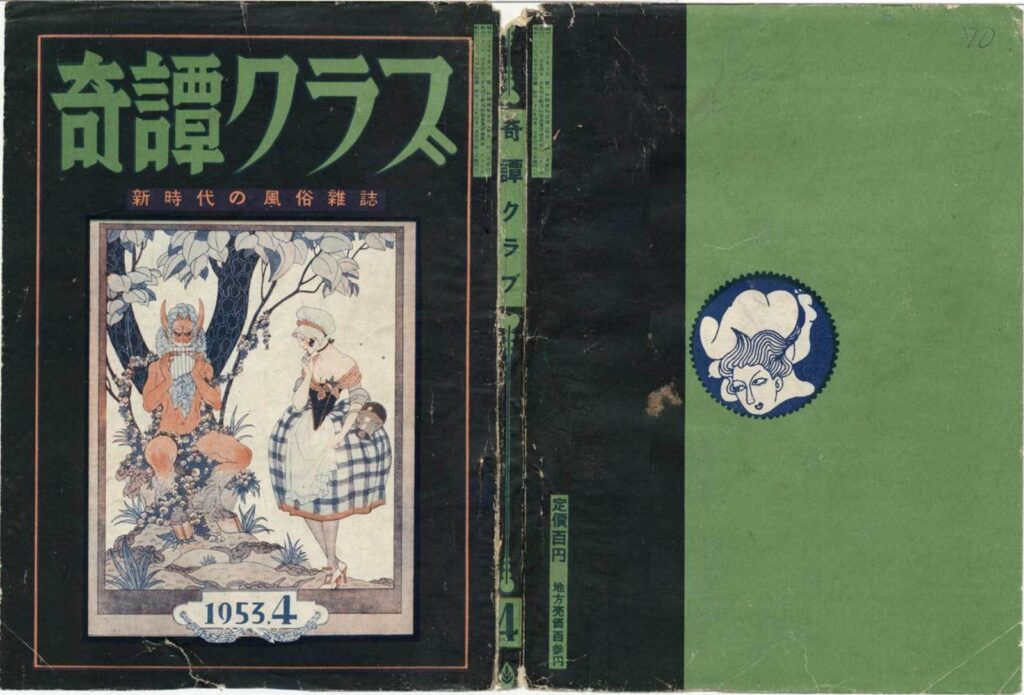
- The cover’s theatrical European fantasy places domination within costume, performance, and decorative spectacle rather than documentary realism (PDF p. 1).
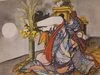
- A Woman Being Toyed With introduces the issue’s concern with the restrained female body as a composed visual object (PDF p. 3).
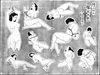
- The illustrated plate on PDF page 5 arranges several restraint positions as a comparative taxonomy, encouraging the reader to distinguish posture and bodily effect (PDF p. 5).
- A Study of the Beauty of Tight Binding with the Hands Behind and the Arms Raised compares how different arm positions compress the shoulders, back, and torso (PDF pp. 6–13).
- The opening photo feature treats rope as an instrument of visual composition, marking a movement away from punishment alone and toward a specialized kinbaku aesthetic (PDF pp. 6–13).
- How to Obtain the Wine of the Gods adopts an explanatory or quasi-technical tone, showing how erotic practice was being surrounded by claims of specialized knowledge (PDF pp. 18–20).
- Longing for the Obese Body gives a specific body preference sustained treatment, helping readers recognize fetish identity through print (PDF pp. 21–24).
- Riding Clothes, High Boots, and the Whip demonstrates how costume and objects can establish authority before physical restraint begins (PDF pp. 25–27).
- A Mysterious Interrogation uses institutional coercion as a fictional device, with the subjected person’s experience interpreted externally rather than through negotiated participation (PDF pp. 28–31).
- My Newlywed Life and The Occasion for Blooming bring specialized erotic desire into marriage and domestic life rather than restricting it to criminal or historical fantasy (PDF pp. 32–40).
- Love Slave, Part Four continues a recurring diary identity whose serialization binds private fantasy to a continuing magazine readership (PDF pp. 73–82).
- Pilgrimage Through Pictures of Hell treats punishment imagery as historical and artistic evidence while preserving its value as erotic spectacle (PDF pp. 87–94).
- Camera Lovers’ Society makes photographic spectatorship itself a subject, revealing the emerging social world surrounding erotic image production and exchange (PDF pp. 109–118).
- Rulers and the Ruled begins to describe domination and submission as durable relational positions, even though the issue lacks a modern vocabulary of negotiated power exchange (PDF pp. 119–128).
- Blame in Aesthetic Expression compares punishment and seme across film, theater, and fiction, showing the emergence of a self-conscious critical vocabulary around erotic representation (PDF pp. 129–132).
Contributors
Named contributors represented in this issue:
- Arima Inaho
- Asō Tsuwako
- Azuma Minoru
- composition by Tsujimura Takashi; photography by Tsukamoto Tetsuzō
- Fujiyasu Setsuko
- Furukawa Yūko
- Goku Osamu
- Hanamura Tsuruji
- Iioka Kinkichi
- Izumi Tatsunosuke
- Kawabata Tanako
- Kitō Kōichirō
- Matsui Kōko
- Morimoto Aizō
- Nagaoka Aiichirō
- Nakayasu Kōdō
- Nanajō Miki
- Nibiyama Hitoshi
- Numa Shōzō
- Okada Mashirō
- Okada Sakiko
- Sasaki Tadashi
- Shida Yōko
- Shimamura Yasuo
- Takatori Nagaharu
- Tsunoda Heihachi
- Watanabe Shinji