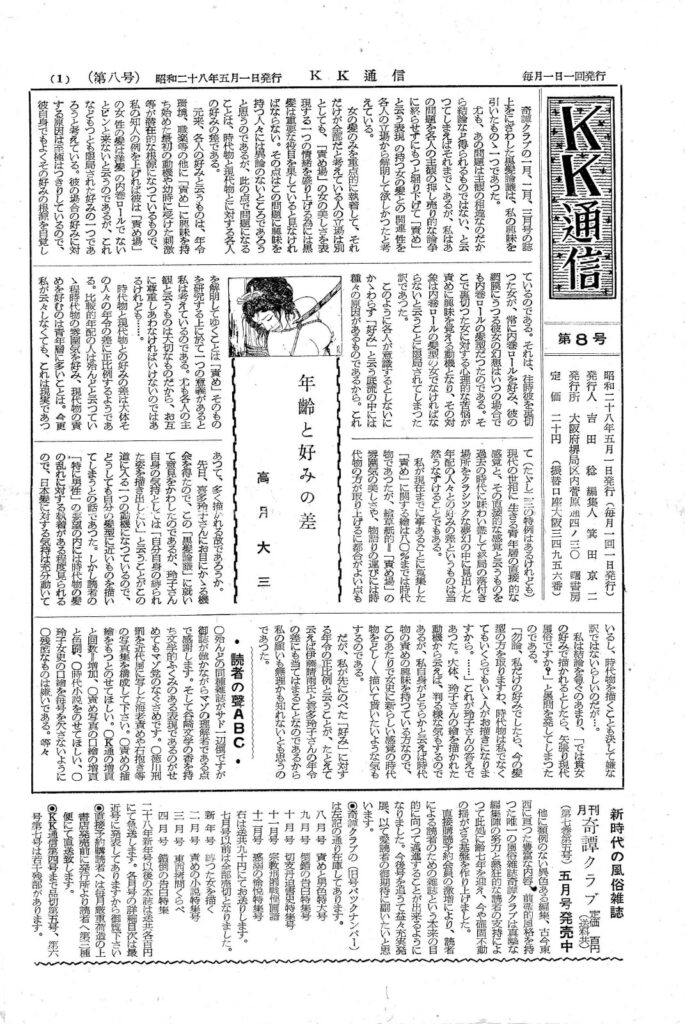
The opening page is dominated by letters concerning women, age differences, bodily preference, and the uneasy relation between attraction and social convention. The central essay, “The Difference Between Age and Taste” (Nenrei to Konomi no Sa), considers why an individual may be attracted to partners significantly older or younger than themself. The article treats erotic preference as something neither fully chosen nor easily explained by ordinary standards of beauty. Its importance lies in the newsletter’s willingness to make highly personal inclinations into subjects for collective analysis.
The surrounding letters repeatedly return to recognition. Readers describe desires that seem incomprehensible to family members or ordinary acquaintances, then ask whether other subscribers have experienced something similar. This pattern transforms confession into a relational gesture. The writer is not merely revealing a secret but testing whether an answering public exists.
The issue also contains the regular “Reader ABC” column, which criticizes stories, illustrations, and editorial decisions. Readers question whether particular scenes are convincing, whether depictions of women rely too heavily on formula, and whether the magazine should publish more varied material. This criticism shows that the readership no longer accepted any bondage or sadistic image merely because it belonged to the genre. They expected psychological plausibility, visual quality, and editorial distinction.
PDF page 2 opens with “Correspondence from Readers,” an editorially organized discussion of recent reactions. Several letters address the public reputation of Kitan Club, the social isolation of its readers, and the possibility that correspondence might help people whose desires cannot be discussed elsewhere. The column makes visible the magazine’s dual status: it is both a commercial publication and a possible refuge.
The same page includes an announcement for a proposed correspondence or communication section. Readers appear to ask how introductions might be handled, what information should be printed, and how privacy might be protected. The discussion reveals both enthusiasm and anxiety. Contact promises relief from isolation, but it also creates risks involving deception, exposure, and exploitation.
A short item titled approximately “On the Opening Mechanism” considers a device, arrangement, or bodily technique. Although brief, it reflects the newsletter’s continuing movement from fantasy toward practical inquiry. Readers want to know not only what a scene means but how it might physically work.
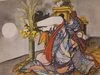
The serialized “Chair of Sin,” Part Two, occupies the center of PDF page 3. The accompanying illustration shows a woman bent over or arranged around an ornate chair, her body exposed and partially immobilized. The story continues its fusion of supernatural temptation, bodily display, and coercive fantasy. Furniture is not merely background. It determines the pose and turns the woman into part of an erotic composition.
The surrounding discussion considers the appeal of bound or constrained women and the role played by facial expression, posture, and the viewer’s imagination. Several passages question whether apparent suffering can be interpreted as pleasure. This is one of the newsletter’s recurrent problems: readers seek evidence of reciprocity, but often attempt to locate it in visual signs rather than explicit communication.
PDF page 4 contains the third installment of “How I Torment” or “My Method of Seme.” The illustration depicts a kneeling woman with her arms pulled behind her and the upper body compressed. The writer classifies preferred methods according to bodily area, position, intensity, and psychological effect.
The piece is valuable because it shows seme becoming a comparative vocabulary. One reader’s private method is presented as something others might evaluate, reject, modify, or recognize. Desire becomes procedural knowledge through enumeration and print.
The upper part of page 4 also includes a table or register of readers using roman letters and abbreviated identifiers. This appears to organize participants, submissions, or correspondence categories. Even where the exact purpose is not entirely clear from the scan, the layout demonstrates the increasingly administrative character of the newsletter. A dispersed erotic public requires indexes, codes, pseudonyms, and procedures.
PDF page 5 is largely editorial. The editors discuss the responsibilities of contributors, the quality of submissions, and the danger of confusing fantasy with careless claims of experience. They call for clearer descriptions, greater originality, and material grounded either in credible observation or openly acknowledged imagination.
The editorial commentary also discusses women contributors and the problem of authenticity. Because female names could be adopted by male writers, readers and editors had to decide how much weight to place on an apparently female voice. This uncertainty would become central to the history of figures such as Kita Reiko. Feminine authorship could confer special authority, but the gender behind a pseudonym remained unstable.
Another section on page 5 deals with jealousy, rivalry, and women’s emotional responses within relationships. Rather than presenting women only as anonymous victims, the discussion attempts to classify emotional motives such as possessiveness, resentment, attraction, and revenge. The analysis is crude by modern standards, but it shows an effort to give erotic conflict psychological structure.
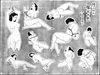
PDF page 6 contains advertisements and editorial notices for photographic series. The principal photograph shows a woman tightly restrained in a compact, inverted or folded position, with rope around the torso and limbs. Nearby advertisements offer sets centered on tied women, suspended women, and women subjected to particular forms of restraint.
These advertisements reveal a specialized visual market. Bondage images are no longer incidental illustrations inside a magazine. They are numbered, grouped, priced, and sold as thematic collections. Readers can become collectors of specific positions, techniques, or models.
The same page contains editorial commentary about the visual quality of these photographs. The editors discuss pose, realism, bodily strain, and the difference between technically accomplished restraint and an image that communicates emotional intensity. Rope photography is being treated as a developing aesthetic field.
PDF page 7 contains “The Drama of Sadism,” by Azuma Shin. The article or story considers how sadism can be constructed dramatically rather than presented as a static act. It discusses anticipation, command, hesitation, resistance, climax, and aftermath. This approach understands seme as temporal composition. The scene must develop through changing emotional states.
The central feature on page 7, “Critical Review of the April Issue,” evaluates recent fiction, illustrations, essays, and reader material. The reviewer praises some contributions while criticizing repetition and shallow sensationalism in others. Monthly criticism creates continuity across issues and makes the readership part of the magazine’s editorial memory.
The page also contains a proposal concerning the special-membership system. The writer appears to suggest changes in access, benefits, or communication among members. Such proposals demonstrate that readers were not passive recipients of the publication’s structure. They attempted to redesign the institutions through which their community operated.
The final page continues “From the Confessions of a Sadist: The Ethics of Confusion,” by Kondō Kikuya. This installment reflects on bodily desire, shame, fantasy, and the writer’s attempt to understand his own sadistic inclinations. The essay repeatedly confronts the fact that erotic pleasure may attach itself to images or impulses that appear morally disturbing.
Its importance lies in the refusal to treat sadism as self-explanatory. The writer asks how private fantasy relates to action, whether a person can accept desire without surrendering moral responsibility, and why the apparent passivity or suffering of another body becomes erotically compelling. The argument remains incomplete, but it records an early effort to formulate an ethics from within sadistic subjectivity.
For readers of Kinbaku Today, the May 1953 issue is particularly useful because it shows the community becoming self-critical. Readers are not only seeking recognition. They are evaluating the quality of fantasies, questioning claims of authenticity, discussing the risks of correspondence, distinguishing visual composition from practical restraint, and asking whether sadistic desire can be ethically understood.
The issue therefore captures a transitional moment. The language of modern consent is not yet available, and the bound person’s experience is still too often inferred from appearance. Yet the newsletter’s readers are beginning to recognize that erotic cruelty requires interpretation, responsibility, and some account of the other person. Private abnormality is becoming a public argument.