KK Correspondence
February 1953
← Back to magazine archive
Issue Details
- PDF pages
- 4
Summary
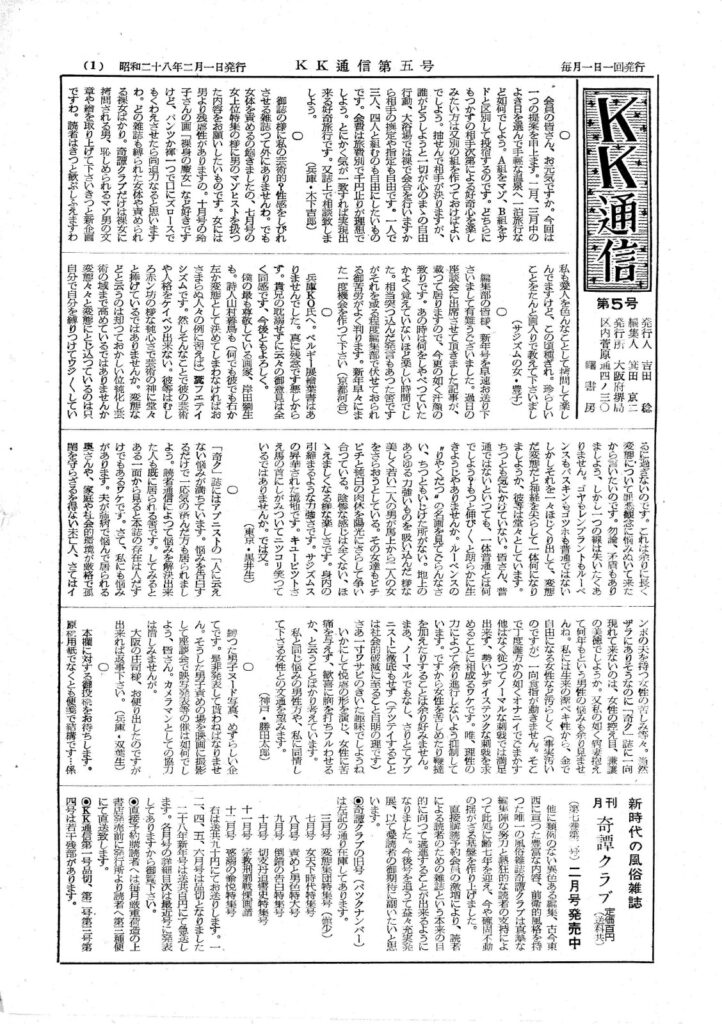
KK Correspondence No. 5 continues the newsletter’s monthly role as a communication network for readers whose interests are difficult to express publicly. The opening page contains letters about group meetings, address exchange, the publication schedule, editorial changes, reactions to No. 4, and hopes for more consistent fiction and illustration. Several correspondents describe not only what they want from the publication but the loneliness and secrecy that make it important. One reader treats the newsletter as a place where people with socially isolated desires can recognize one another; another critiques the balance of fiction, art, and editorial judgment. A notice for the February issue of Kitan Club underscores the newsletter’s relationship to the larger magazine.
Read full summary Close full summary
Highlights
- Opening letters discuss the monthly schedule, proposed meetings, address exchange, submissions, and the practical maintenance of a reader network. (PDF p. 1).
- Readers evaluate No. 4, criticizing or praising its serials, illustrations, editorial choices, and production quality. (PDF p. 1).
- Several correspondents describe the newsletter as relief from the secrecy and loneliness surrounding their erotic interests. (PDF p. 1).
- The opening page repeatedly invites continued contributions and treats reader participation as essential to the publication's survival. (PDF p. 1).
- A notice for the February Kitan Club issue shows the institutional and commercial connection between KK Correspondence and its parent magazine. (PDF p. 1).
- "The Red Room (2)" by Yamashiro Kazuo follows a married man in his fifties who maintains a concealed, specially furnished room for private erotic activity. (PDF p. 2).
- The story uses red drapery, mirrors, clothing, and ritualized preparation to contrast public domestic normality with a secret sexual identity. (PDF p. 2).
- The woman Michiko becomes central to the staged encounter in the red room, where clothing, observation, and control shape the scene. (PDF p. 2).
- A reader letter on the same page discusses bondage imagery and asks the editorial office for guidance and response. (PDF p. 2).
- The reader-forum essay "From a Supporter" argues that a fragile specialized publication needs active support as well as informed criticism. (PDF p. 3).
- The supporter distinguishes constructive criticism from attacks that weaken the publication without helping it improve. (PDF p. 3).
- Editorial notices ask readers to submit clearer manuscripts, personal confessions, drawings, photographs, and other original material. (PDF p. 3).
- Advertisements offer bound-woman photographs, hanging and restraint poses, and other specialized image sets by mail order. (PDF p. 3).
- "Hell Picture (3)" by Gyōda Kazuko continues a captivity narrative involving a demonic tormentor, binding, pain, humiliation, and threatened assault. (PDF p. 4).
- The closing "Brief Correspondence" section returns to access to older erotic books and images, reader requests, praise, and the circulation of scarce material. (PDF p. 4).