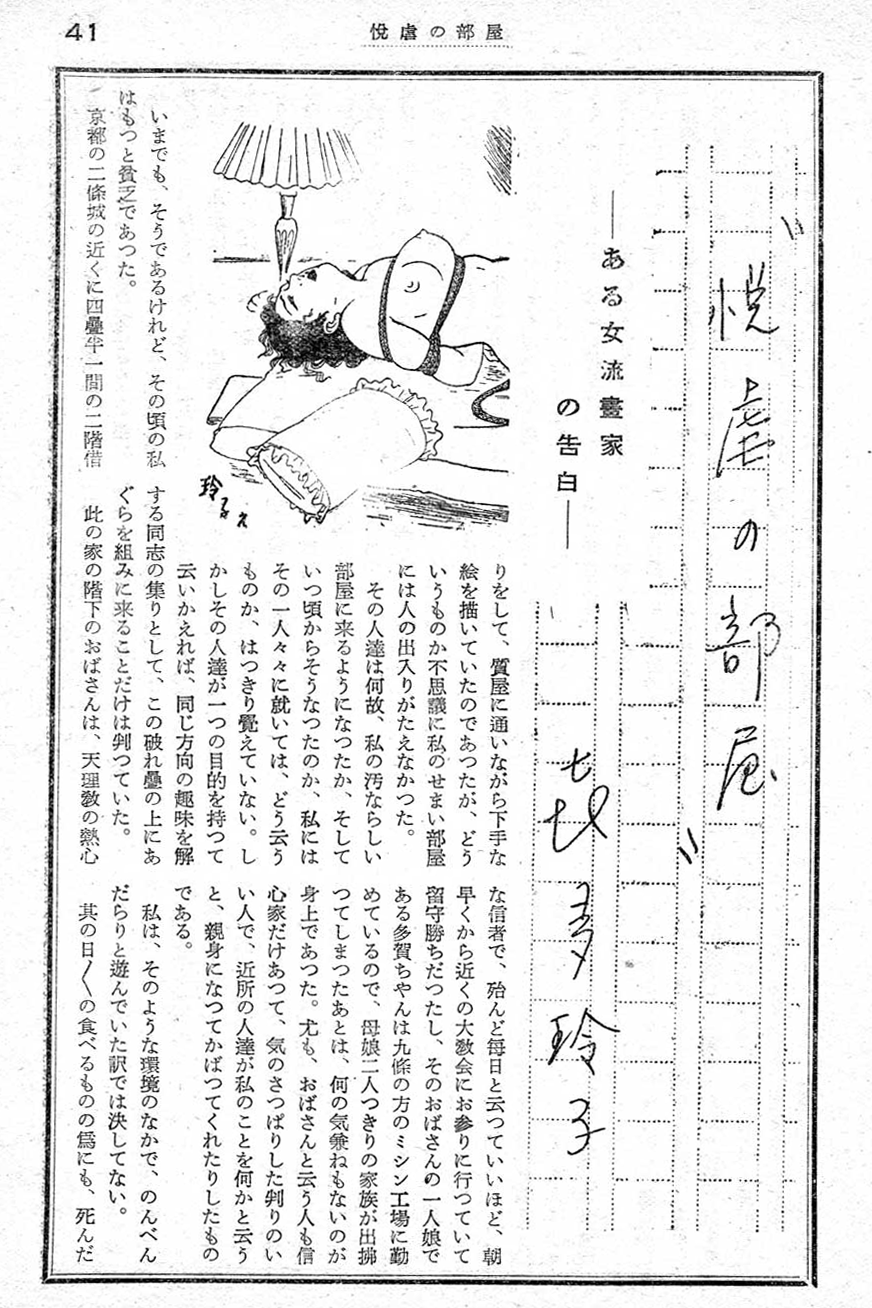
In early SM publishing, a woman’s voice could do what a man’s voice could not. It could make seme appear not merely as male fantasy, but as feminine recognition. This is why Toshiyuki Suma’s use of the name Kita Reiko matters. The name did not simply conceal the male author behind a female pseudonym; it created a position from which male-authored desire could speak as if it were a woman’s confession.
The early SM magazines emerged from a postwar print culture in which Occupation censorship restricted political criticism and representations of Allied personnel, but often left Japanese-language erotic material to be regulated by Japanese obscenity law, creating space for the rapid expansion of kasutori, sex-journalism, and “perverse” publications (McLelland, 2012).
In the earliest days of SM publishing, it was common for illustrators and authors to adopt a range of pen names. In part, this created an illusion that there were far more producers of erotica than actually existed (Kawahara, 2024). But pseudonymity did more than multiply contributors. It also created distinct authorial positions from which desire could be narrated, legitimized, and authenticated.
The Gendered Masks of Suma Toshiyuki
Toshiyuki Suma was one of the important figures in the early SM publishing world, especially through his work around Kitan Club, Fūzoku Sōshi, and later Uramado.
Throughout his career, Suma adopted many names, but two of the best known were Minomura Kō and Kita Reiko. Minomura Kō followed a more conventional masculine authorial function, but Kita Reiko was more unusual because the name was unmistakably feminine.
Male writers using female pseudonyms was not in itself unusual. What made Kita Reiko distinctive was the specific work the name performed within early SM publishing. It did not simply soften authorship or conceal identity; it allowed seme-e and writing about female masochism to appear as if they emerged from a woman’s own aesthetic and erotic interiority.
As Minomura Kō, Suma constructed male desire through memoir, history, and the figure of the male artist-technician. As Kita Reiko, Suma pursued the opposite strategy, transforming male desire into a feminine voice. Minomura’s writings worked to give seme a genealogy; Kita Reiko worked to give it an interior feminine witness. Together, they reveal how Suma’s authorial masks could both historicize male desire and make male fantasy sound like a woman’s confession.
Kawahara Azumi’s caution about Iida Toyokazu/Nureki Chimuo’s retrospective accounts is important here. Iida’s writings opened the study of magazines such as Kitan Club, Fūzoku Sōshi, and Uramado, but Kawahara warns that they also shaped a seductive “Iida historical view” in which memory, inference, loyalty, and narrative craft often blur into testimony (Kawahara, 2021).
The Kita Reiko problem is not only a question of one man using a woman’s name. It is part of a broader media environment in which authorship, memory, gender, and desire were repeatedly stabilized after the fact through names, anecdotes, captions, and editorial frames. Suma’s masks, Minomura Kō and Kita Reiko, should therefore be read not merely as biographical clues but as technologies of publication: one historicizing seme, the other feminizing it.
My aim here is not to reconstruct Suma’s private intention, which remains partly inaccessible, but to examine what the Kita Reiko persona made possible on the page. I am interested in how names, captions, story frames, reader letters, and exhibition-like layouts produced a fantasy of feminine recognition. The question is not simply whether Kita Reiko was “really” a woman, but how the magazine used that possibility to make seme appear authored, witnessed, and confirmed from the feminine side.
Creating Kita Reiko
The name Kita Reiko was drawn from a personal connection, as Suma explained in a 1980 article for SM Collector: “My pen name for my paintings was ‘Kita Reiko’, which is my wife’s maiden name. I just used it as it is. One might wonder why I would use my wife’s name as a pen name, but there are many reasons for it and I can’t possibly write about all of it without this becoming too long.” He goes on to describe it as an “editorial decision” made by Minoru-san, the editor of Kitan Club, who “thought it would be best” (Minomura, 1980/2018).
Kita Reiko was not a one-time disguise. SMpedia identifies the name as a pseudonym Suma Toshiyuki used for illustrations from around mid-1949 and notes that, during the Fūzoku Sōshi period, the magazine was structured with Kita Reiko’s work at its visual core. Most of the works from this period were bondage images and seme-e published under the Kita Reiko name. This makes Kita Reiko less a hidden author than a recurring publication device: a feminine signature through which seme could be seen, named, and aestheticized (SMpedia, n.d.).
Suma himself was quite aware of the deception and the reasons behind it. He wrote, “To tell the truth, the publishing company wanted the readers to believe that Kita Reiko was a woman and slowly it had become like this” (Minomura, 1980/2018).
In recounting his relationship with seme-e master Itoh Seiu, Suma details how Itoh was also under the impression that Suma was a woman named Kita Reiko and, without ever meeting, offered to take her on as his deshi.
The other aspect of the Kita Reiko persona that made it unique was related to the kind of work that was published under that name. In the materials surrounding early SM publishing, women’s voices often appear through models’ commentary, reader letters, or editorially framed testimony rather than through clearly recognized women artists or writers.
The use of a female pseudonym was not simply an act of hiding the author’s and artist’s identity, it was an act of framing his work in order to construct and legitimize a particular feminized form of male desire.
Fūzoku Sōshi also differed sharply from Kitan Club in tone and visual strategy. Alexandre Rodrigues da Costa describes Kitan Club as comparatively serious and investigative, framing SM through confession, psychology, literature, and quasi-academic reflection, while Fūzoku Sōshi embraced a more direct, visual, and provocative mode of erotic spectacle. This matters because “The Room of Ecstatic Cruelty” appears not in a neutral container, but in a magazine whose identity was built around the force of images, especially those associated with Kita Reiko (Rodrigues da Costa, 2026).
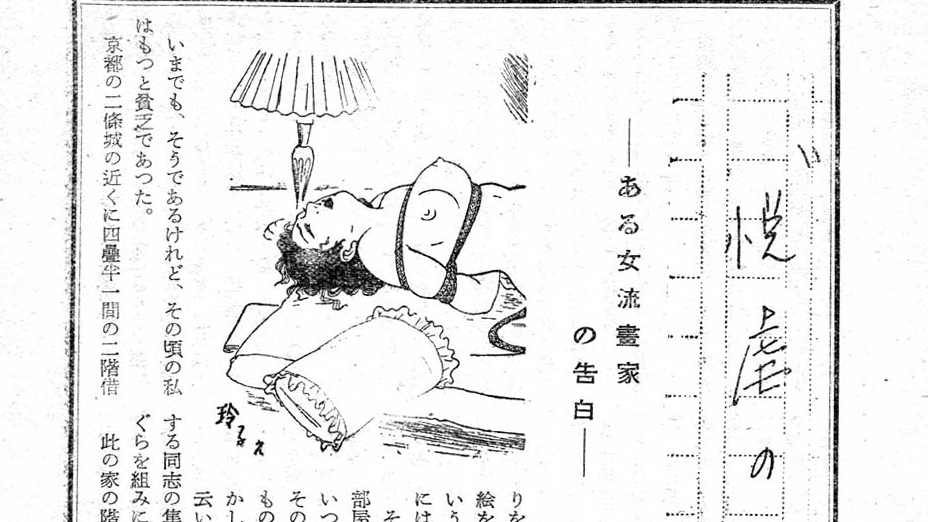
Reading “The Room of Ecstatic Cruelty” (悦虐の部屋)
In one of the early issues of Fūzoku Sōshi (July, 1953), an essay titled “The Room of Ecstatic Cruelty: Confession of a Woman Painter,” was published under the name Kita Reiko. It tells the story of a young woman balancing what she calls “a woman’s masochism” which “is held deep within the general psychology of women” with the cruelty and violence of the sadistic male imagination, “an unknown new generation of sadism.”
I leave seme untranslated because no single English term carries its range here: punishment, torment, erotic pressure, accusation, and aestheticized cruelty all hover around it. That instability is part of the story’s argument.
“The Room of Ecstatic Cruelty” can be read against the 1950s Kitan Club discourse that Kawahara identifies as the “modernization of sadism,” in which sadism was distinguished from crude violence and reimagined as affective, intimate, and even ethical (Kawahara, 2021b).
Kawahara’s account of postwar Japanese SM discourse helps explain why feminine testimony matters so much in this magazine environment. In the 1950s, Kitan Club and related magazines did not merely publish erotic fantasy; they helped create a reader community in which stigmatized desires could be shared as relational and meaningful. If the “modernization of sadism” debate worked to distinguish “true” sadism from crude violence, recasting SM as trust, intimacy, and even love, then women’s apparent recognition of seme became an especially powerful element in legitimizing it.
But the story does not merely illustrate this modernization. It also exposes one of its contradictions. In order to make seme appear affective, intimate, and ethical, the story must route it through a feminine confession; yet when Reiko moves from imagining seme to acting on Taga-chan’s body, she describes herself as becoming “completely like a man in feeling.” The result is not a stable feminization of seme, but a more unstable articulation in which female interiority authorizes desire while masculine feeling still marks the position of erotic agency.
This tension is not a flaw in the story’s logic but a condition of its appeal: the feminine voice supplies intimacy and interiority while masculine feeling retains erotic agency, and it is precisely that combination that the Kita Reiko persona was designed to produce.
In “The Room of Ecstatic Cruelty,” female desire is not yet presented as direct testimony from women participants, but as a male-authored feminine confession: a ventriloquized interiority that makes seme appear to arise from women themselves. By “ventriloquized interiority,” I mean a male-authored feminine voice that presents male fantasy as if it were emerging from within women’s own desire.
The story is set in a small room in Kyoto where its narrator, a poor and isolated woman painter, makes strange seme-e. The room is on the second floor of a rented house, the home of the landlady and her daughter Taga. Her poverty is marked by her frequent trips to a local pawnshop where the owner of the shop, Endō, becomes aware of her plight as well as the small gatherings of people visiting her to see her seme-e.
To help her out financially, Endō creates a “strange exhibition” for her work in the large toilet of the house where she lives, creating a unique and anonymous system of exchange. Three pictures were tacked on the wall in front of the toilet at eye level, held in place with pushpins. Customers were free to take any of the pictures home with them, provided they followed an unwritten rule, “using one hundred-yen bills as the unit, they were to fasten to the same place, with pushpins, as many bills as they thought the picture was worth.”
The pawnshop owner does not host the exhibition in his own shop. Rather, he devises a system that turns the large toilet of Reiko’s rented house into a makeshift exhibition space. This matters because the story’s economy of seme-e begins not in a formal gallery or marketplace, but in a degraded domestic side-space where private fantasy, bodily shame, and commercial exchange overlap.
This room becomes a private salon for people with abnormal or hidden desires. Visitors come not because Reiko is a recognized artist, but because they are curious about her drawings of women being tormented or bound. The room becomes an exhibition space, a marketplace where she hopes to find patrons, and a kind of secret meeting place for people who recognize something in her images.
The demands of male patrons, however, become increasingly violent and vulgar and contrast with the artist’s fantasy, as she writes, “I wanted, even within the ‘seme pictures,’ something that could be called ideal or romantic,” while her customers wanted, as one man would write on a note left behind, “more blood.”
The narrator rejects the demand for more violent forms of torture, writing, “Even in my “torment pictures,” I wanted something more normal, something one might call romance. I believed that such a thing surely existed. But it was not blood. Blood may be beautiful as color, but it was far removed from what I wanted my pictures to express.”
As the story unfolds, the narrator’s reaction to her customers changes. What started as a desire to understand her customers’ desires and respond to them, becomes increasingly hostile, as she laments, “But toward sadists who have no affection, I can feel only contempt. What I call 悦虐, “ecstatic cruelty,” means this: if the man who torments feels pleasure through tormenting, then, in the same sense, the woman on the side being tormented must also feel pleasure through being tormented. Otherwise it is not what I mean.”
The narrator’s perspective changes when Taga-chan, the landlady’s daughter, delivers the money from the toilet display downstairs to her. When the narrator receives the money, she extends her contempt for her customers to the money itself, “The several hundred-yen bills that Taga-chan brought with her, pierced with holes from the pushpins, looked so filthy to me that I could hardly stand it.”
She sets fire to the hundred-yen bills and as she does, she exhibits a kind of release “Laughing in a hollow, cackling voice like a madwoman, I set fire to the hundred-yen bills. Taga-chan watched my actions with her beautiful eyes opened wide, staring at me without looking away.”
The burning of the money ignites a passion in the narrator as well: “That night, I put rope on Taga-chan for the first time. In the deep stillness of the late night, Taga-chan’s young pleasure was beginning to bud. For me, this was the first experiment in 悦虐 (ecstatic cruelty) directed toward another person, apart from the acts I had known with my husband. I became completely like a man in feeling, and poured the sadism that was my object onto this fresh, twenty-year-old body.”
The sentence is revealing: even within this staged feminine confession, active seme is imagined as a movement into masculine feeling.
Rather than painting it as a picture, the narrator visualizes, for the reader, the blending of image and affect. Here we see the embodiment of ecstatic cruelty and the emergence of the female-coded eroticism attached to it.
“Dizzied, I looked down at the naked body of this young woman of my own sex. Her arms were twisted up behind her and bound. Two, three lines of waist-cord-thick rope flowed across her body like a spell, tightening around the twin swellings of her dreaming chest. Her abdomen, showing a gentle slope down toward the region of her lovely eyes, suddenly traced a soft curve and cast a shadow into the thicket below. Her hips, full and soft with flesh almost to the point of insolence, bent the line down toward her long thighs into the shape of the character く, waiting in my cold bedding for the expression of affection.”
If Reiko supplies the feminine voice, Taga-chan supplies the feminine body that appears to confirm it.
Taga-chan is not given enough interiority to be called a collaborator, a masochist, or an artist in any stable sense. That is precisely why she is useful to the story. She functions as an idealized alternative to the male patron: a feminine presence whose body appears to confirm Reiko’s aesthetic fantasy without reducing it to the patrons’ demand for blood and spectacle. Yet because Taga-chan’s own desire is never fully articulated, she remains less an autonomous subject than a screen onto which the story projects the possibility of female erotic recognition.
The story does not simply describe that desire; it manufactures a gendered theory of seme in which feminine recognition and masculine agency remain inseparable. By placing that theory in the mouth of a woman painter, the magazine converts male-authored fantasy into what appears to be feminine self-knowledge.
The Feminization of Male Desire
Early SM magazines often used women’s voices, whether through model commentary, reader letters, or editorially framed testimony, to normalize and eroticize female desire for seme and SM.
Perhaps the most direct evidence for the claim is not in the text itself, but in the addendum that accompanies it. At the end of the story there is a small section titled “Reader Correspondence” written as a letter from a woman (S-ko) from Kanagawa.
It is impossible to tell whether the letter was authentic or if it was the creation of the magazine’s editorial staff, but its inclusion is a clear indication of the ways in which the magazine repeatedly staged male-authored desire as feminine erotic recognition. McLelland makes a similar caution about women’s reader letters in the postwar “perverse press. Some appear genuine, while others remain impossible to separate from male-authored fantasy, but in either case they reveal how magazines imagined and cultivated female readership (McLelland, 2004).
The letter attached to the story reads “When I look at Kita Reiko’s “seme” pictures, I become so excited that I cannot sleep all night. In other people’s pictures I never feel any excitement, but especially with Reiko’s paintings, I feel an abnormal illusion, as if the woman in the picture and I were somehow being made to enjoy the same thing.”
The message to the readership is that these desires for seme, much like the ones the painter feels in the story, are latent. The desire for seme is presented not as male fantasy, which the story marks as vulgar and excessive, but as unfulfilled female desire.
“I imagine myself being added onto the woman in the picture. But no partner around me responds to such desires. So far, I have had no experience whatsoever. Please introduce me to someone who would guide such a person.”
The uncertainty is itself revealing. Whether S-ko was an actual reader, an edited submission, or an entirely fabricated device, the letter performs the same function: it stages feminine recognition as evidence. Its value lies less in proving that a woman reader existed than in showing that the magazine wanted such a readerly position to exist.
The S-ko letter presents Kita Reiko’s fantasy as confirmed feminine experience. This is the feminization of male desire: not the replacement of male fantasy by female testimony, but the production of female testimony as the most persuasive form of male fantasy.
SM Magazines as Rooms of Ecstatic Cruelty
The structure of “The Room of Ecstatic Cruelty” mirrors the structure of early SM magazine culture itself. In the story, Reiko’s room begins as a private space of poverty, isolation, and fantasy, but it becomes something else once visitors arrive. Her images attract patrons, patrons impose interpretations, and the room becomes a salon, marketplace, exhibition space, and fantasy community. Early SM magazines worked in much the same way. They gathered private fantasies, framed them through pseudonyms, reader letters, model commentary, illustrations, and editorial notes, and then returned them to readers as evidence of a shared erotic world.
Endō also mirrors the editorial function that Suma and others performed in early SM magazines. He is not the primary erotic voice of the story, but he builds the apparatus through which Reiko’s images can circulate. By turning the large toilet into an exhibition space, establishing an anonymous payment system, and allowing viewers to select and value the pictures, he transforms private fantasy into a structured economy of display. In this sense, Endō does not merely make desire accessible; he helps determine the conditions under which it can be seen, priced, and recognized.
This parallel is not only structural, but thematic. Reiko’s conflict with her male patrons dramatizes the problem that postwar SM magazines had to solve: how to distinguish seme from mere violence, vulgar appetite, or crude spectacle. The patrons want more blood, more obvious cruelty, more consumable sensation. Reiko wants something ideal, romantic, and internally meaningful. The magazine performs the same transformation at the level of publication. It takes fantasies that might otherwise appear violent, pathological, or shamefully private and reframes them as aesthetic, relational, and even feminine.
Kita Reiko is the crucial figure in this transformation. Within the fiction, she is the woman painter whose private fantasy becomes public image. Within the magazine, however, she is also a male-authored feminine persona, a mask through which Suma can make seme speak as female interiority. Taga-chan then intensifies that structure: she appears to move desire away from crude male consumption and into a scene of female-to-female erotic imagination. But because this scene is itself written under a constructed feminine name, it does not escape male fantasy so much as refine it. The story stages and embodies the very operation the magazine performs.
The reader correspondence completes the cycle. S-ko’s letter does for Kita Reiko what the visitors do for Reiko’s pictures inside the story: it confirms that the image has found its proper viewer. The letter presents female desire as awakened by Kita Reiko’s seme-e, turning the fiction’s claim into apparent reader testimony. A male author writes as a woman; that woman imagines seme as feminine interior experience; another feminine voice then confirms that experience as real.
The placement of the reader correspondence matters. It appears not as a separate theoretical claim, but as an attached response, a small documentary afterimage following the fiction. This layout makes the letter behave like corroboration. The story offers Kita Reiko as the woman artist who understands seme; the letter then appears to show the effect of that understanding on an actual woman reader.
In this sense, “The Room of Ecstatic Cruelty” is not simply a story published in an early SM magazine. It is a miniature model of how such magazines worked. Private fantasy becomes image. Image creates spectators. Spectators become correspondents. Correspondence becomes evidence. Evidence becomes community. And through that process, male-authored seme is transformed into something that appears to arise from women themselves. The story’s room and the magazine’s pages are therefore versions of the same chamber: a constructed space where desire is displayed, interpreted, authenticated, and finally returned to readers as if it had been discovered rather than made.
References
Kawahara, A. (2021). 飯田豊一(濡木痴夢男)氏の軌跡とその仕事:新出インタビュー原稿によせて [The trajectory and work of Iida Toyokazu (Nureki Chimuo): On newly discovered interview manuscripts]. 立命館文學 / The Journal of Cultural Sciences, (674), 243–204.
Kawahara, A. (2021b). 現代日本のSMクラブにおける「暴力的」な実践:女王様とマゾヒストの完全奴隷プレイをめぐって [“Violent” practices in contemporary Japanese SM clubs: On complete-slave play between queens and masochists]. 臨床哲学ニューズレター / Clinical Philosophy Newsletter, 3, 148–171. https://doi.org/10.18910/79260
Kawahara, A. (2024). 沼正三・倉田卓次・天野哲夫:『家畜人ヤプー』騒動解読 [Numa Shōzō, Kurata Takuji, and Amano Tetsuo: Decoding the Kachikujin Yapū controversy]. JunCture: 超域的日本文化研究, 15, 107–124.
McLelland, M. (2004). From sailor-suits to sadists: “Lesbos love” as reflected in Japan’s postwar “perverse press.” U.S.-Japan Women’s Journal, 27, 27–50. https://www.jstor.org/stable/42771918
McLelland, M. (2012, September 9). Sex and censorship during the occupation of Japan. The Asia-Pacific Journal: Japan Focus, 10(37), Article 6. https://apjjf.org/2012/10/37/Mark-McLelland/3827/article.html
Minomura, K. (1980/2018, September 25). Minomura Kō: A great man has fallen (1980) (Shiba, Trans.; Bergborg/KinbakuBooks, Ed.). Kinbaku Books. https://kokoro-kinbaku.com/2018/09/25/minomura-kou-a-great-man-has-fallen-1980/ Originally published in SM Collector.
Rodrigues da Costa, A. (2026, March 18). Fūzoku Sōshi: A short-lived magazine and its lasting impact on postwar Japanese eroticism. Shunga Gallery. https://shungagallery.com/fuzoku-soshi/
SMpedia. (n.d.). 喜多玲子. Retrieved May 4, 2026, from https://smpedia.com/index.php?title=%E5%96%9C%E5%A4%9A%E7%8E%B2%E5%AD%90