Kinbaku history is often told as a history of people, styles, and techniques, but it is also a history of magazines, masks, and ghosts. In 1974 and 1975, SM King published a series of photo-stories written under the name Fujimi Iku with photographs attributed to Kanai Yukio.
At first glance, these pieces appear to be lurid bondage melodramas. But A Woman in Torment Beneath the Moonlight is more usefully read as a kaidan-adjacent revenge melodrama at two levels: first, as a narrative of debt, grievance, moonlight, and revenge; and second, as an archival object haunted by pseudonymous authorship, uncertain photographic provenance, and the reanimation of older bondage images.
Although A Woman in Torment Beneath the Moonlight is not a kaidan in the strict sense, it borrows kaidan’s emotional machinery: moonlight, late-autumn atmosphere, unresolved injury, female resentment, and revenge. At the same time, the piece is haunted at the level of production, through pseudonymous authorship, uncertain photographic provenance, and the reanimation of older images under the invented credit “Kanai Yukio.”
I began looking at these pages because they seemed to challenge the way kinbaku history is often told. I am skeptical of histories that look only for origins, masters, or techniques. The archive often tells a stranger story: images are reused, names are invented, poses are restaged, and meanings change as they pass from one publication context to another. The story about the story becomes its own kind of haunting.
Kinbaku History and A Woman in Torment Beneath the Moonlight
A Woman in Torment Beneath the Moonlight (月光に悶える女) is a lurid revenge melodrama centered on women trapped in the orbit of the cruel Iwazō, a construction boss and gambling-house figure whose violence, debt manipulation, and sexual exploitation have ruined the lives of those around him. Umeko, a farmer’s wife, is bound and abused after her husband’s debt makes her vulnerable to Iwazō’s control, while another woman, Otori, confronts him with a deeper grievance: her husband was destroyed by Iwazō’s corruption and rigged gambling and hanged himself.
The story moves through scenes of captivity, humiliation, and sadism, but its emotional arc bends toward retaliation. Otori’s rage gives the piece its moral pressure, and in the final turn, Umeko, who had seemed powerless, secretly produces a knife and stabs Iwazō in the lower abdomen. The result is a dark pulp narrative in which bondage photography is framed not as an isolated spectacle, but as evidence inside a melodrama of debt, domination, endurance, and revenge.
Although A Woman in Torment Beneath the Moonlight is not literally a ghost story, it borrows the deep structure of a Japanese onryō revenge tale. Iwazō “Aranami” is not simply an individual villain but a corrupt local power whose crimes create a moral imbalance: Umeko is seized as payment for her husband Tasuke’s debt, while Otori’s husband has been ruined through Iwazō’s gambling schemes and driven to death. The story then converts female suffering into onnen (怨念), or vengeful resentment.
Otori appears almost like a living ghost, emerging from the shadows to avenge her dead husband, while Umeko, initially presented as helpless and pleading, becomes the one who finally completes the revenge. This doubling of wronged women recalls what Sharon Landau identifies in Japanese gothic representation as the split between socially constrained feminine suffering and its darker, vengeful double (Landau, 2024). The moonlit late-autumn setting, the withered trellis, the language of resentment, and the doubling of the wronged wives all give the story a kaidan-like atmosphere, even without a supernatural apparition.
Japanese ghost stories often turn on a grudge or lingering resentment produced by an injury that has not been socially or morally resolved. As Noriko Reider notes in her discussion of kaidan-shū, kaidan refers to tales of the strange and mysterious, a genre strongly associated with ghostly or supernatural disturbance (Reider, 2001). In many Japanese ghost stories, the ghost does not appear simply because death has occurred; it appears because something remains unsettled. A betrayal, debt, murder, humiliation, or act of abandonment leaves behind an emotional residue that returns to trouble the living (Reider, 2001, 2010).
The section title of the sixth section “A Wife’s Resentment” (女房の怨念) is crucial because onnen (怨念) does not simply name anger or resentment. It names resentment that has congealed into a durable, almost haunting force. In the logic of Japanese ghost stories, onnen is what remains when injury cannot be resolved through ordinary justice. Here, Otori’s grief over her husband’s destruction and Umeko’s suffering under Iwazō’s debt violence become part of the same moral atmosphere: the wronged wife’s resentment gathers until it demands repayment.
Thinking of it through ghost-story conventions is useful for understanding the evolution of kinbaku because it shifts attention from rope technique alone to the haunted media ecology in which kinbaku developed. Early SM magazines did not present rope simply as a set of ties, poses, or skills; they wrapped it in atmosphere, pseudonyms, serialized melodrama, archival photographs, revenge plots, and unstable identities.
For contemporary practitioners, this matters because it reminds us that kinbaku was never only a technical vocabulary. It was also a way of staging desire under pressure, from censorship and social shame to the practical problem of making forbidden images visible. The images that later generations inherit are not neutral documents. They arrive already wrapped in story, shame, fantasy, pseudonym, and performance.
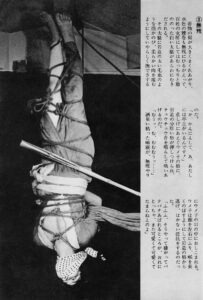
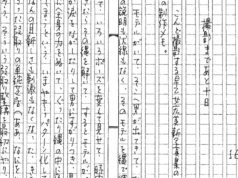
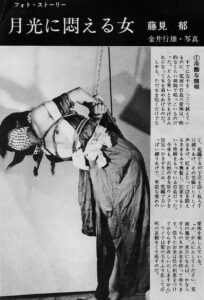
The page design itself reinforces this narrative function. The photographs do not stand alone as isolated rope images. They are arranged as titled episodes, with scene headings that tell the reader how to interpret what they are seeing: cruelty, sensuality, mercilessness, a locked room, a late-autumn moon, a wife’s grudge, the sound of split bamboo, the torment of the neck stocks.
The result is not simply a sequence of images, but a staged chain of evidence in which each photograph appears to document a fictional event, while the prose supplies motive, backstory, emotional pressure, and moral consequence. Rope gains meaning through the narrative. The body is not just posed; it is placed inside a chain of injury, memory, and retribution.
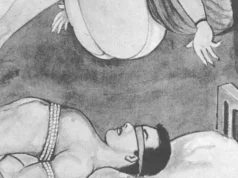
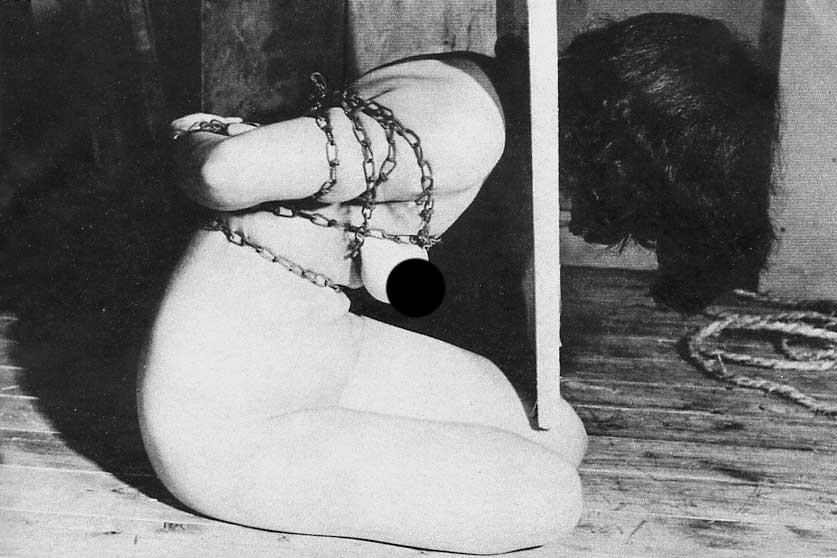
Looking at the layout, I do not get the sense that the photographs are merely illustrating a story that was already there. The title page makes this visible immediately. The byline separates author and photographer typographically (藤見郁 on one line, 金井行雄・写真 on another), presenting them as two distinct professionals documenting a real production. The numbered section headers, such as ① 冷酷な顔相 (“A Cruel Expression”) and ③ 無残 (“Mercilessness”), reinforce this documentary illusion by telling the reader how to interpret each image. In the opening page, the title names Iwazō’s cruelty, but the image shows only the bound woman; the villain himself is entirely out of frame. The caption supplies what the image cannot. That gap between what is named and what is visible is where the repair work happens.
There is also an important reversal here. Ordinarily, one might imagine photographs being taken to document a story, scene, or performance. In this case, the relation seems to move in the opposite direction: a story has been created to fit photographs that already carried their own uncertain history.
The images themselves seem to recall an earlier visual vocabulary, more reminiscent of 1950s-era bondage photography than of much of what appeared in 1974 magazines such as SM King. This suggests, though it does not prove, that the photographs came from elsewhere before the story was written around them.
The prose does not simply explain the images; it reassigns them. It gives them characters, motives, chronology, and consequence. This reversal is central to the ghostliness of the piece. The photographs seem to arrive first as archival remnants, and the drama comes later, like a new voice placed into an older body, telling a story that was never part of the original production.
Once the pages are read this way, Otori’s rage changes shape. Her rage is not merely personal anger, but the return of an unresolved injury: her husband’s destruction through Iwazō’s corruption and gambling. Umeko, too, seems powerless for much of the story, but her final act of stabbing Iwazō transforms endurance into retribution.
In both cases, the women function almost like living ghosts, carrying injuries that the social world has been unable to fix. Their vengeance remains secular, but it draws on a broader Japanese gothic logic in which female suffering can return as a disruptive, punitive force (Landau, 2024). The revenge plot is therefore not incidental to the bondage imagery; it is what gives the images their ghost-story pressure.
Identity and Desire
The story is published under the name Fujimi Iku, and the photographs are credited to Kanai Yukio. What is fascinating is that neither the author nor the photographer functioned as a stable identity in the ordinary sense.
Within kinbaku and SM culture, pseudonyms were not merely common; they were indispensable. They created safety, distance, and artistic freedom in a world where erotic production remained socially stigmatized and legally vulnerable. Names such as Nureki Chimuo, Minomura Kō, and Itoh Seiu were not only signatures, but working masks.
Fujimi Iku was, in fact, one of the many additional names that Nureki Chimuo used in his published work, raising the question as to why someone would adopt a pseudonym for a pseudonym?
The second pseudonym does more than conceal identity; it creates genre distance, allowing Nureki to divide himself into multiple functions: historian, editor, storyteller, archivist, and erotic producer.
The Kanai credit deepens this instability.
In his 1996 book A History of Japanese Bondage Photography (日本緊縛写真史), Nureki reveals the background of Kanai Yukio, or more accurately the mystery behind the origins of the photos.
In 1961, Nureki describes a trip to the home of a man named Ito Takesui, one of the main publishers of Itoh Seiu’s work through his publishing house Suikodo. During that visit, Minomura and Nureki acquired 1,200 negatives of bondage photography, intended for publication in the magazine Uramado (Akita, Nureki, & Fuji, 1996).
The actual photographers were unknown and may have included images created by Itoh Seiu as well as members of his inner circle who would meet for photo events and the images were often taken at the homes of the participants. Because no single photographer or rope artist could be identified, one had to be invented. The identity that Nureki created was Kanai Yukio (Akita, Nureki, & Fuji, 1996).
Aliases and Afterlives
The work is equally haunted at the level of production. Fujimi Iku is not a stable authorial presence but a pseudonym for Nureki Chimuo; Kanai Yukio, credited as photographer, is a fictional name created in the Uramado period and attached to photographs of uncertain provenance. Thus the photo-story’s ghostliness is not confined to its plot. Even the credits do not sit still. Fujimi Iku and Kanai Yukio name something, but they do not resolve who made what.
Read this way, A Woman in Torment Beneath the Moonlight is more than a lurid episode in 1970s SM publishing. It becomes a small but revealing case study in how kinbaku entered modern visual culture through unstable spaces: part fiction, part archive, part pornography, part theater. Its ghost-story structure gives narrative form to grievance and return, while its theatrical melodrama turns the bound body into a staged image of suffering, villainy, and climactic display.
At the same time, the pseudonyms Fujimi Iku and Kanai Yukio show that the people and images behind kinbaku also moved through masks, aliases, and uncertain archives. The story’s women are haunted by debts and injuries that have not been repaired; the publication itself is haunted by photographs whose origins cannot be fully recovered and by names that do not settle into ordinary identity.
This does not mean that the plot of A Woman in Torment Beneath the Moonlight should be treated as a record of actual events. The story itself appears to be fictional, a melodramatic narrative constructed around stock figures of debt, coercion, revenge, and punishment. But the photographs attached to that fiction may have a very different status. They belong to an uncertain archival history: older images, detached from stable authorship, later reattributed and reanimated through the name Kanai Yukio.
The real historical event behind the piece, then, may not be the suffering of Umeko or Otori, but the photographs’ own afterlife. Fictional narrative and archival residue are stitched together, producing a magazine object that is haunted not because it documents a real crime, but because it gives new life to images whose original circumstances cannot be fully recovered.
The Era of Censorship
In 1974, kinbaku was developing in a socially and morally unresolved space: visible enough to circulate in commercial magazines like SM King, but still marked as underground, obscene, dangerous, and culturally illegitimate. That unresolved status helps explain both the importance of alternate identities and the ghost-story logic of grievance. Pseudonyms and constructed credits did not merely hide people; they allowed writers, editors, photographers, and practitioners to operate in a world where desire required masks.
Kinbaku producers often split themselves into aliases because the culture around them had not granted their work a stable public identity. This unresolved status also created a field of tension around kinbaku production: censorship, social shame, moral policing, and the dismissal of the work as mere perversion rather than art, theater, literature, or visual culture.
While the legal situation of magazine bondage photography was not identical to theatrical film, the Nikkatsu Roman Porno trials indicate the broader climate of uncertainty surrounding erotic visual culture in the period (Cather, 2012; Sharp, 2008). Beginning with the prosecution of Nikkatsu’s Love Hunter in 1972 and continuing until acquittals in 1980, the trials showed that erotic images could still provoke serious legal scrutiny.
That context helps explain why kinbaku photo-stories in magazines such as SM King needed protective frames. Narrative could function as one such frame: by presenting bondage images through moonlight, revenge, and unresolved grievance, or through pose, melodrama, villainy, and suffering transformed into spectacle, the magazine could position the images as scenes within a cultural and dramatic tradition rather than as merely obscene display (Brandon & Leiter, 2002; Leiter, 2002).
Pseudonyms worked similarly. The creation of new names, personae, and identities did not just add atmosphere; they created distance, ambiguity, and plausible separation between the public person, the erotic producer, and the printed object. In a period when obscenity law and moral policing made erotic media vulnerable, kinbaku survived through masks: the mask of story, the mask of theater, the mask of folklore, and, most practically, the mask of another name.
These frames were not arbitrary disguises. Kaidan, onnen, and ghost-story motifs gave the images a language of haunting, grievance, and return, while the melodrama of the story supplied a grammar of pose, villainy, suffering, and climactic display.
Conclusion
The most important haunting in A Woman in Torment Beneath the Moonlight may not be supernatural at all. It lies in the afterlife of the images: older photographs detached from stable authorship, renamed through Kanai Yukio, and made to speak again through Fujimi Iku’s melodrama. The story’s women are haunted by debts that cannot be repaid; the publication is haunted by images whose origins cannot be recovered. Between those two hauntings, the piece offers a compact lesson in kinbaku history: rope did not become modern only through technique passed from hand to hand, but through magazines, masks, captions, pseudonyms, censorship, theatrical convention, and the strange second lives of photographs. To study kinbaku seriously, then, we have to follow not only the rope, but the ghosts attached to it.
References
Akita, M., Nureki, C., & Fuji, A. (1996). Nihon kinbaku shashin-shi 1 [A history of Japanese bondage photography 1]. Jiyū Kokuminsha.
Brandon, J. R., & Leiter, S. L. (Eds.). (2002a). Kabuki plays on stage: Brilliance and bravado, 1697–1766 (Vol. 1). University of Hawaiʻi Press.
Brandon, J. R., & Leiter, S. L. (Eds.). (2002b). Kabuki plays on stage: Villainy and vengeance, 1773–1799 (Vol. 2). University of Hawaiʻi Press.
Cather, K. (2012). The art of censorship in postwar Japan. University of Hawaiʻi Press.
Fujimi, I. (1974a, November). Gekkō ni modaeru onna [A Woman in Torment Beneath the Moonlight]. SM King.
Fujimi, I. (1974b, December). Shikei ni nureru onna [A woman aroused by private punishment]. SM King.
Fujimi, I. (1975, January). Ingyaku yuki jigoku [Snow hell of erotic cruelty]. SM King.
Landau, S. (2024). Passionate women, vengeful spirits: Female ghosts and the Japanese gothic mode. Manusya: Journal of Humanities, 27(1), 1–28.
Leiter, S. L. (2002). A kabuki reader: History and performance. M. E. Sharpe.
Reider, N. T. (2001). The emergence of kaidan-shū: The collection of tales of the strange and mysterious in the Edo period. Asian Folklore Studies, 60(1), 79–99.
Reider, N. T. (2010). Japanese demon lore: Oni from ancient times to the present. Utah State University Press.
Sharp, J. (2008). Behind the pink curtain: The complete history of Japanese sex cinema. FAB Press.