Article Summary
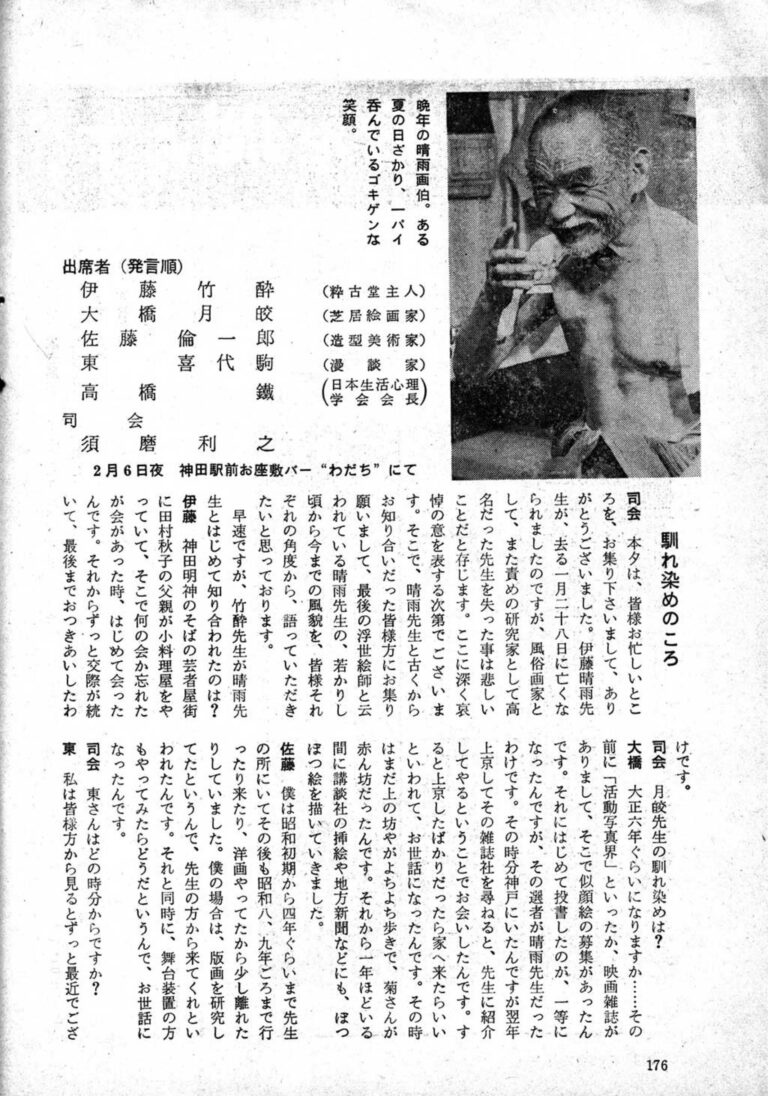
This eight-page memorial roundtable records reminiscences of Itō Seiu shortly after his death on January 28, 1961. Participants who knew him across several decades recall his early theatrical and illustration work, his relationships with publishers and performers, his brushes with police and censorship, his fascination with Japanese hairstyles and disheveled hair, and his use of models in staged scenes of kinbaku and seme. The discussion is historically significant because it presents Seiu not primarily through later legend but through first-person memories from associates who had known him since the Taishō and early Shōwa periods. Particularly valuable are accounts of his stage-design career, his collection of visual source material, the origins of some of his torment imagery, his preference for Japanese coiffure, anecdotes about models and rope, and the participants' insistence that his eccentric public reputation obscured a fundamentally sincere and warm personality. The article also includes several archival photographs of Seiu and staged scenes associated with his work.
Translation
Remembering the Artist Seiu
Participants, in order of speaking:
Itō Chikusui, proprietor of Suikodō
Ōhashi Gekkō, theatrical painter
Satō Rin’ichirō, plastic artist
Azuma Kiyokoma, comic storyteller
Takahashi Tetsu, president of the Japan Society for the Psychology of Everyday Life
Moderator: Suma Toshiyuki
Evening of February 6, at the zashiki bar Wadachi in front of Kanda Station.
MODERATOR: Thank you all for taking time from your busy schedules to gather here tonight. Itō Seiu passed away on January 28. The loss of a man renowned both as a painter of manners and customs and as a researcher of torment is a sad one, and I would first like to express our profound condolences. We have therefore invited those of you who knew Seiu for many years to speak about the man sometimes called the last ukiyo-e artist, describing him from your various perspectives, from his youth down to the present. To begin, Mr. Chikusui, when did you first become acquainted with Seiu?
ITŌ: Near Kanda Myōjin there was a geisha quarter where the father of Tamura Akiko ran a small restaurant. Some sort of gathering was held there, though I no longer remember what it was, and that was where I first met him. We remained in contact from then on, right up to the end.
MODERATOR: And how did you first meet him, Mr. Gekkō?
ŌHASHI: It would have been around Taishō 6, 1917. Before that there was a movie magazine, I think it was called Katsudō Shashinkai, and it held a competition for portrait drawings. The first picture I ever submitted won first prize, and Seiu was one of the judges. I was living in Kobe then, but the following year I came to Tokyo and visited the magazine office. They said they would introduce me to him, and that was how we met. I had only just come to Tokyo, so he told me I could stay at his house, and he looked after me. At that time his older boy was only just beginning to walk and Kiku was still a baby. During the year or so that I stayed there he was drawing illustrations for Kōdansha and for provincial newspapers as well.
SATŌ: I was with him from the beginning of the Shōwa period until around Shōwa 4, 1929, and after that I continued coming and going until around Shōwa 8 or 9. I was also studying Western-style painting, so there were periods when I drifted away. In my case, because I was studying printmaking, he was the one who asked me to come work with him. At the same time he said I ought to try stage design, so he took me under his wing in that field too.
AZUMA: Compared with all of you, my acquaintance with him was much more recent. It was around the time the broadcasting station was established at Atagoyama. Behind the Saigō statue in Ueno there was a famous restaurant called Tokiwa Kadan. There was a man named Nakamura, and there was also the pioneer of the Ginza publicity business. Nakamura was doing some kind of commissioned work for Tokyo City, and there seems to have been some matter they were discussing. I was called to the gathering, and when I arrived Seiu was sitting directly opposite me. That was how I met him.
SATŌ: His first wife, Takeo, married him in Meiji 34, 1901, and they separated in Taishō 9, 1920. During that period a woman whom he had been using as a model became his second wife, and she remained with him until around Shōwa 3. After her came a woman named Kikuko, who had likewise modeled for him. Kikuko had an older brother, Masaaki, who was killed in the war. Mr. Gekkō has known him longer than anyone here. Was Seiu already poor in those days?
ŌHASHI: Terribly poor. Yet even when he later had a household of his own, if a geisha came into the room he understood the situation perfectly and would never touch her. But if someone showed that she disliked something, then he was the sort who would feel tempted to do exactly that. [Laughter]
ITŌ: He had a contrary streak.
ŌHASHI: In those days he did a great deal of work for the shinpa theater, including at the Shintomiza and Kabukiza. He even drew the program bills himself.
ITŌ: He drew a tremendous amount for Sawamasa too.
SATŌ: The Zenshinza, Gorō, Akashi Ushio, Shinkokugeki. There was a period when he was extremely successful as a stage designer. At times he was handling three theaters simultaneously.
MODERATOR: I have heard that there were quite a few plays involving torment. Before the war there was a theater at Yaraishita called the Edogawa Theater, wasn’t there? He would stage the plays he liked and even paint the scenery himself.
AZUMA: There was also Komatsuya in Senju.
MODERATOR: Professor Takahashi, when did you first know him?
TAKAHASHI: Seiu once told me the exact date when I first met him, down to the year, month, and day in Shōwa 3. He was always like that. He could say, entirely from memory, ‘That happened on such-and-such a day of such-and-such a month and year.’
ITŌ: By around Shōwa 3 he was already publishing material on sexual abnormality and things in the earlier Decameron, wasn’t he?
TAKAHASHI: Yes.
ITŌ: Umehara Hokumei once printed some of Seiu’s photographs without permission and Seiu became absolutely furious.
SATŌ: Broadly speaking, his professional work consisted of stage sets, theater signs and bromides. He also contributed illustrations extensively to Sunday Mainichi, Shūkan Asahi, Kōdan Zasshi, Bungei Kurabu, and similar magazines.
MODERATOR: When did he use the art name Seiu, written as ‘quiet rain’?
SATŌ: In the Taishō period.
MODERATOR: His work must often have been misunderstood, and he must have had considerable difficulties, given the period he was working in.
ITŌ: When he published one of his illustrated scroll-type works, he distributed notices to executives around Marunouchi. Someone complained, and both the publisher and Seiu were summoned to the Marunouchi police station. [A portion of the title and surrounding wording is unclear in the print.]
SATŌ: During the affair involving Rongo Tsūkai, the Metropolitan Police Department was still at Ōtemachi. Somehow they traced it back to him. One morning four or five officers arrived and took away Rongo Tsūkai and some of his torment photographs. He came home that day, but everyone thought the matter was serious. The following day he went to the Enbujō and Ichimuraza, bought theater tickets, and gave them to people connected with the case by way of thanks. He had only been held overnight and released, but then the newspapers ran a three-column story about him. The police became involved again, and he and another teacher were hauled in and placed in temporary detention at Kodenmachō, then taken to Ichigaya the next day. He was an unconvicted detainee. The obscene-picture issue itself was not especially serious. This time he got caught up in a bribery case because of those theater tickets. [Laughter]
The Allure of Disordered Hair
TAKAHASHI: When did he begin holding those experimental meetings?
SATŌ: Already in the Taishō period. He was doing them quite regularly by then.
ITŌ: I think Seiu’s idea of torment came originally from Japanese coiffure.
MODERATOR: So destroying a Japanese hairstyle had a sexual quality for him. A bobbed cut or a permanent wave would not have produced the same feeling.
SATŌ: Upstairs in his house there were several old wigs.
ŌHASHI: Before Satō there was a man called Yamazaki. I think Seiu told him to bring back hair that women had cut off and offered at some roadside hall around Ōji.
AZUMA: [Partly unclear.] Whenever geisha came, he would inevitably look at the nape of the neck, and sometimes people were sent to fetch such things for him.
SATŌ: When a geisha came he would always peer at the nape of her neck. If she realized what he was doing, she’d run away.
ŌHASHI: He disliked people who were insensitive. Even while walking down the street he would spot someone and think, ‘That one could be tied.’ The person being tied had to possess some corresponding disposition. It was not simply a matter of forcing someone who felt nothing.
MODERATOR: In other words, the partner had to be a masochist.
TAKAHASHI: He was certainly a genuine sadist, but there is no question that he was also a hair fetishist. Disordered hair was probably the most attractive thing to him. He liked disorder generally. He said a slightly resentful, forlorn expression was the most appealing. Yet there also had to be some pleasure in the woman’s face. If anything, he preferred a woman who looked a little worn or downcast.
ŌHASHI: In the end, his starting point was Urasato.
SATŌ: Among his old collection of material concerning torment there were many Urasato prints and theatrical photographs.
The Model’s Misfortune
SATŌ: Once he hired a model from Miyazaki and gave her money to have her hair dressed in a Japanese style because he said he wanted to paint her. She was delighted and came over. He told me, ‘Satō, go upstairs and do some research,’ and worked downstairs so that even I would not see what he was doing. It went on and on until finally the lights came on. What had he been doing? He had cut straight through the motoyui cord holding together her beautifully dressed hair, said, ‘All right, just a moment,’ and eventually tied her up. Among the models he gained a reputation as a terrifying sort of artist. His usual thin cord and rough rope were there. I found myself wondering exactly what he had done. [Laughter]
ŌHASHI: He used to say things like that even in the old days. [A short portion is unclear.]
TAKAHASHI: Did Seiu have any homosexual inclination?
MODERATOR: What I heard was that it did not absolutely have to be a woman. He might put a woman’s wig on an onnagata actor, tie him, and then do something afterward. That sort of story.
AZUMA: My impression is that Seiu did not particularly require direct bodily contact.
MODERATOR: You mean he would arrange a woman in a certain form and simply look at her?
AZUMA: There was the fire-roasting business. Takahashi Yoshinobu and Satsuki Nobuko were involved in that. Seiu was the model for it, wasn’t he? At the Kadoza in Osaka, or somewhere like that, Ōtsuji Shirō said to me, ‘I’ll show you something good,’ and we watched it from right at the front. Seiu was a remarkably pure man. [Laughter]
SATŌ: Once a woman had become his model, if she worked at a café or little restaurant he would spend absurd amounts of money going there. Meanwhile Kikuko and I sometimes had no rice to eat. One New Year’s we even had to go to a pawnshop. We took Rongo Tsūkai to Mr. Chikusui and asked him to lend us money on it, but Mr. Chikusui was rather reluctant. [Laughter]
AZUMA: Once he came into the dressing room carrying an electric fan. He had drawn little pictures of [unclear name or subject] all over a balloon, inflated it, and then got on the train still carrying the thing. A policeman chased him. He said, ‘There’s nothing wrong with me carrying something that’s mine,’ and refused to apologize. Finally he burst the balloon and said, ‘Now there’s no evidence, is there?’ [Laughter]
People Built the Fence for Him
SATŌ: Back when Gorō and the others were performing at the Enbujō, there was a police lantern outside. The audiences of the Tōgeki, Enbujō, and Kabukiza all walked toward Yūrakuchō, so it was used for traffic control. It had the word ‘rope’ written on it in those old-fashioned police-office characters, with two black bars. Seiu took it and walked along the tram tracks all the way to Owarichō, where he was arrested. [Laughter] Someone connected with Gorō went to apologize and Seiu had to write a statement. He was delighted, saying, ‘This lantern is wonderful. Everyone stops for me.’ [Laughter]
ŌHASHI: The bamboo fence at his house was broken. Even in broad daylight he would do whatever he pleased inside the house. Neighborhood children would peep through, and complaints were made. People told him, ‘Do something about that fence.’ He replied, ‘It’s my fence. What I do with it is my business. What I do inside my own house is my business too.’ In the end the neighbors built the fence themselves. [Laughter] Then he kicked the fence because it was his fence. [Laughter]
ŌHASHI: His forehead would move up and down in this peculiar way. He used to say, ‘I’m not the only one. There are two or three people in Japan who can do this.’ If I went shopping for him, I would skim off a little of the change and hide it on the shelf above the entrance. He could go out completely penniless without worrying about it. Then I’d say, ‘Sensei, here’s your tram fare,’ and hand him the coins I had hidden. He would take them without even asking where I had found the money. [Laughter] If you went out with him, he would make you walk endlessly, which was exhausting.
MODERATOR: Once at Shimbashi he cut directly through the inside of a shop, saying, ‘It’s a shortcut,’ from the front entrance right through to the rear. Eventually the shopkeeper became angry. Seiu had already toddled off ahead, and I was the one who got caught. [Laughter]
ŌHASHI: Once we went to a drinking place around Kurumazaka and were short of the bill. Seiu produced half of a tram ticket. [Laughter] Somehow that settled the account, and he behaved as though he had every right to be proud of himself.
SATŌ: Some very unusual people came to him as well. One person came in saying he wanted a picture by Seiu and offered to become a model. He was some sort of teacher. He had modeled at Joshibi or another women’s art school but found that boring. He wanted to be tied as a model. So Seiu said, ‘Then let’s paint a picture of Christ,’ put a wig on him and tied him to a pole.
TAKAHASHI: Was simply being tied enough for him? A chemise or something like that would not do. The hair had to be long and, above all, it had to be dressed in Japanese style.
[Speaker attribution continues from the preceding passage.] He would give me fifty sen or a yen and say, ‘Student, why don’t you go to the movies?’ or ‘Go and get yourself something to eat.’ That only made it more obvious what he was about to do. [Laughter] The door of his studio was warped, so you could see in from almost anywhere. When I thought, ‘Sensei has started again,’ I would watch without letting him notice. From time to time I would deliberately look in the way I knew would please him, while taking care not to be caught. [Laughter]
The Truth Behind the Fire-Roasting Story
ŌHASHI: He was extraordinarily unconcerned about appearances. He might go three months or half a year without visiting a barber, and he disliked washing his face. If you handed him a towel it would come back with three black finger marks on it. [Laughter] He was not a fussy or petty man.
MODERATOR: At one of the drinking places he frequented, when the conversation became especially lively his clothing would gradually fall open. The proprietress would routinely straighten it for him. [Laughter]
ŌHASHI: The real source of that ‘fire-roasting’ story actually came from me. After leaving Seiu’s house I was talking about his life, and Suzuki Senzaburō later wrote it. Long ago Seiu used to visit the home of a famous newspaper reporter whom I’ll call K. His first wife, Takeo, had been a maid in that household. K had already had relations with her, and Seiu ended up taking her away. Along with her he also received that great quantity of books. You remember what a remarkable library he had. Later, when the story became a play, people began saying that since the female model was Seiu’s wife, the man involved with her in the play must have been me. [Laughter]
MODERATOR: Since you just said the story originated with you, I began wondering exactly what your relationship with his wife had been. [Laughter] If Mr. Gekkō was the model for the fire-roasting story, does that mean there was something of that sort?
ŌHASHI: Nothing of the kind. I was twenty-two years old and still a virgin.
MODERATOR: I see. [Laughter]
ŌHASHI: When I saw it at the Hōgakuza, there was a scene in which he says, ‘My previous wife was sleeping with my master, and now you’re sleeping with my master too!’ Seiu was the only person in the audience who clapped his hands at that point. [Laughter] I knew absolutely nothing of that part of the story and had never told the author anything about it. The author had merely inferred something on his own, and by coincidence it matched reality in a curious way.
ITŌ: In his later years he once asked me to publish a book called Nihongami, Japanese Hairstyles. He said he did not need any author’s fee. It was to be about Japanese hairstyles and their forms. By then he was already in his seventies and I told him that drawing such fine lines would be difficult. Before anything could be realized, he died. If only he had been ten years younger, it could have been a splendid book. He was extraordinarily attached to hair.
ŌHASHI: During the war, before conditions became too severe, he held an exhibition in Ginza. Everyone was trying to appear refined, while Seiu deliberately called some of his works gofun pictures or mud paintings, meaning that instead of using expensive orthodox nihonga materials he painted with cheap pigments more like those used for signs. I forget exactly where the exhibition was held. Kikuko was there too. Even though supplies were extremely scarce, they somehow served coffee to visitors, and the whole occasion had a relaxed, peaceful atmosphere.
MODERATOR: In any event, he was a man who spent his life doing exactly what he wished, with all his strength. He hated other people interfering with him, but at the same time he did not interfere with other people.
ŌHASHI: Yes. He disliked being obstructed, and he did not obstruct others.
SATŌ: Weekly magazines often called him an eccentric or a strange man, but in truth he lived a life without pretense and without concealment. I think that was a genuinely sincere way to live. He was neither a crank nor a freak. He was a warm, kindly old gentleman, a man with real blood in his veins. It is a great loss.
MODERATOR: We could undoubtedly continue talking for a long time, but we will bring this discussion to a close here. Thank you all very much.
Translation Notes
The printed title 晴雨画伯を偲んで literally means Remembering or Recalling the Artist Seiu; 画伯 is an honorific for an accomplished painter. 伊藤晴雨 is rendered as Itō Seiu. The participants' name readings are provisionally rendered as Itō Chikusui, Ōhashi Gekkō, Satō Rin'ichirō, Azuma Kiyokoma, Takahashi Tetsu, and Suma Toshiyuki; several should be checked against KRP authority records. 責め is translated contextually as torment, while 縛る and related forms are translated as tie or bind rather than automatically as kinbaku because the speakers are discussing both artistic staging and actual rope restraint. 日本髪 refers to traditional Japanese women's coiffure, a central subject of the conversation. 元結 is the cord used to secure a traditional hairstyle. 細引 is thin cord and 荒縄 is coarse rope. The participants repeatedly connect Seiu's erotic imagery with deliberately disordered Japanese hair, suggesting that hair was at least as important to his visual imagination as rope itself. 浦里 is retained as Urasato because the conversation treats it as a specific historical or theatrical reference familiar to the participants. The anecdote labeled 火あぶり concerns the origin of a dramatized fire-roasting or burning scene associated with Seiu; parts of the biographical chain behind it are conversational and elliptical. The scans contain a few names and phrases that are too soft or compressed to read with confidence; these are explicitly marked rather than silently reconstructed.
Uncertain readings:
- The name of the woman described on PDF page 173 as Seiu's model who became his second wife is not sufficiently clear in the scan for a confident transcription.
- A title or phrase in Itō Chikusui's discussion on PDF page 175 immediately before the account of police action is unclear.
- A short portion of Ōhashi Gekkō's response immediately after the model anecdote on PDF page 176 is difficult to read.
- The name or subject that Azuma says Seiu drew repeatedly on a balloon on PDF page 177 is unclear.
- The exact reading of 大橋月皎 is provisionally Ōhashi Gekkō.
- The exact reading of 東喜代駒 is provisionally Azuma Kiyokoma.
- The exact reading of 須磨利之 is provisionally Suma Toshiyuki.
- The term or establishment name in the moderator's anecdote immediately before the fire-roasting discussion on PDF page 179 is not fully clear.
Missing or illegible text:
- PDF page 175: a short phrase identifying an earlier publication or scroll-like work in Itō Chikusui's censorship anecdote is unreadable with confidence.
- PDF page 176: a brief sentence following Ōhashi Gekkō's comment that Seiu had said similar things in earlier years is indistinct.
- PDF page 177: one proper name or descriptive phrase in the electric-fan and balloon anecdote is illegible.
- PDF page 179: a few characters identifying the drinking establishment in the moderator's anecdote are indistinct.