Beautiful Bondage
June 1967
← Back to magazine archive
Issue Details
- PDF pages
- 32
Summary
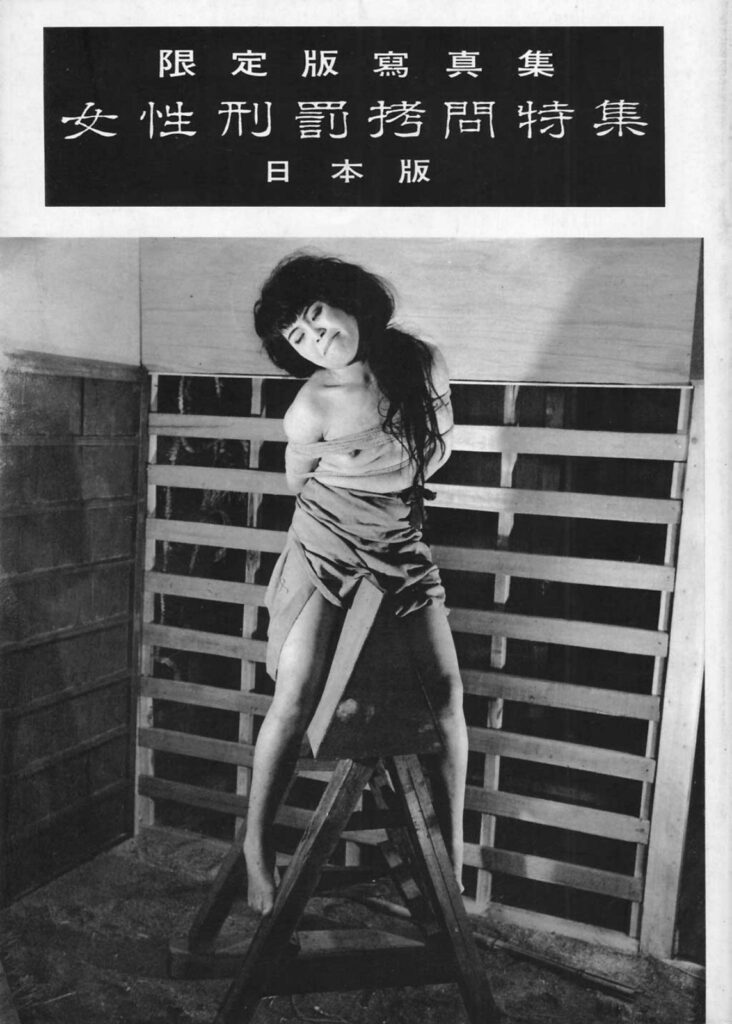
This 1967 installment of Beautiful Bondage presents itself on the cover as a limited-edition 女性刑罰拷問特集 日本版, a Women’s Punishment and Torture Special Feature: Japanese Edition. Where the preceding Western-style installment emphasized leather restraints, chains, masks, harnesses, and manufactured apparatus, this volume deliberately shifts back toward a Japanese visual vocabulary. Its dominant materials are rope, coarse fiber cord, bamboo poles, straw mats, wooden frames, rough garments, and improvised architectural supports. The setting resembles a rustic shed or punishment chamber, and the photography uses those materials to evoke historical or period-inflected scenes rather than contemporary fetish equipment.
Read full summary Close full summary
Loading PDF…
Visual Catalog 11 sequences
-
限定版写真集 女性刑罰拷問特集 日本版 Archival title: Front cover with wooden-trestle photograph Cover Mechanical Publication cover combining the printed Japanese publication title with a staged black-and-white photograph in a rustic slatted-wall interior.
-
Straw-floor rope and bamboo-pole sequence Photographic Portfolio Extended rustic-interior sequence centered on a restrained woman kneeling, sitting, curling, and lying on a straw-covered floor. Rope binds the arms and upper torso, while another adult person intermittently enters the frame and long bamboo poles become recurring staging props.
-
Dense torso-rope kneeling sequence Photographic Portfolio Multi-image kneeling portraits in a lighter wooden interior with dense horizontal and diagonal rope around the torso and upper arms. Pose and camera angle vary, and a bamboo pole appears late in the sequence.
-
Block-supported supine restraint sequence Photographic Portfolio The restrained woman lies horizontally across two large rectangular blocks, with rope securing the torso and legs. A second adult person appears at the head in one image.
-
Kneeling platform and block-apparatus sequence Photographic Portfolio A restrained woman kneels on a low wooden platform while another adult person handles a bamboo pole and a large rectangular block or box positioned across the front of her body.
-
Kneeling bamboo-pole floor sequence Untitled Visual Sequence Short floor-based sequence in which a kneeling restrained woman is photographed with another adult person manipulating clothing and multiple bamboo poles.
-
Wooden A-frame restraint sequence Photographic Portfolio A woman is restrained directly to a wooden trestle or A-frame, first bent forward with wrists secured to opposite sides and then draped or arched across the structure with additional lower-leg restraint.
-
Light-wrap floor rope sequence Photographic Portfolio A floor-based sequence featuring an adult woman in a light-colored hip wrap, with upper-body rope and arms restrained behind. She moves through side-seated, curled, reclining, and tightly folded positions, with a bamboo pole appearing at the beginning.
-
Kneeling chest-rope and bamboo-pole sequence Photographic Portfolio Two-page kneeling sequence with prominent chest and upper-arm rope, a loose darker garment, and a long bamboo pole positioned across or near the upper body.
-
Patterned-garment back-rope sequence with apparatus transition Needs Review A woman in a distinctive patterned garment is photographed crouching, kneeling, and reclining with dense rope across the torso and back and wrists tied behind. The lower photograph on page 31 introduces a markedly different wooden framework and may begin the next setup.
-
Back-cover inverted suspension photograph and publisher notice Cover Mechanical Final-page photograph of a woman inverted by bound ankles from an overhead beam, accompanied by publisher, sales, and price text.
Highlights
- The cover identifies the volume as a limited-edition Women's Punishment and Torture Special Feature: Japanese Edition and immediately establishes a rustic Japanese setting with a bound woman posed against rough wooden construction. (PDF p. 1).
- The opening sequence develops a sustained captivity scenario using coarse rope, a loosely wrapped garment, straw and dirt underfoot, and a rough wooden enclosure, giving the photographs a deliberately historicalized atmosphere. (PDF pp. 1–5).
- A male tormentor appears repeatedly during the main sequence, physically repositioning the bound woman, handling her clothing and restraints, and using rope and bamboo poles to control her posture. (PDF pp. 6–9, 16–19).
- Pages 10–13 function as a comparative study of dense upper-body rope restraint, showing the model kneeling, twisting, bending, and collapsing while coarse cord encircles the chest, waist, and arms. (PDF pp. 10–13).
- A particularly theatrical sequence places the restrained woman across rough wooden blocks, introduces a blindfold, and then compresses her between or against improvised supports, emphasizing the material texture of straw, rope, wood, and exposed skin. (PDF pp. 14–17).
- The wooden-frame sequence binds a woman over an A-frame-like structure with her wrists and ankles secured to different points, turning an ordinary rough construction into a restraint device. (PDF pp. 20–21).
- The later portfolio introduces another model and concentrates on tight behind-the-back arm bondage, folded floor positions, chest rope, and bamboo-pole pressure or leverage applied to the upper body. (PDF pp. 22–27).
- Pages 28–30 provide especially clear rear and three-quarter views of the rope structure, showing wrists secured behind the back and rope crossing the torso over a patterned garment. (PDF pp. 28–30).
- The volume concludes with increasingly severe-looking restraint positions, including reclining bondage followed by an inverted suspension in which the model hangs by her bound ankles. (PDF pp. 31–32).
- The final page identifies Tenseisya of Abeno, Osaka as publisher, states that the publication is not sold through bookstores, and gives the limited-edition price as 1,000 yen. (PDF p. 32).