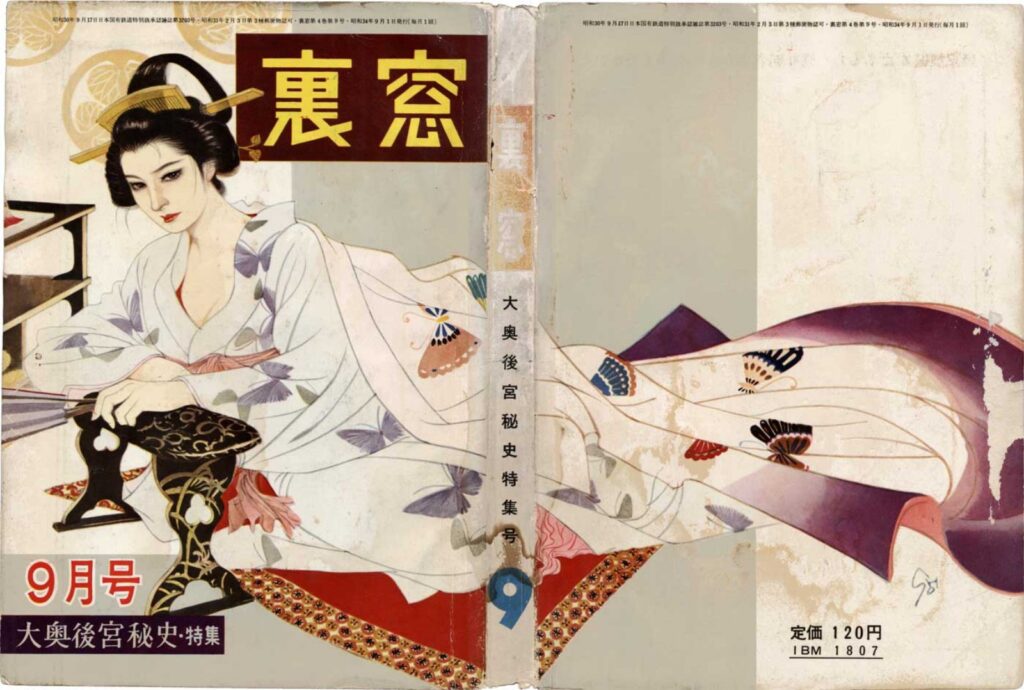
Uramado
September 1959
← Back to magazine archive
Issue Details
- Volume
- 4
- Issue
- 9
- PDF pages
- 261
Summary
The September 1959 issue of Uramado is a large special number centered on sensationalized histories and fantasies of the Ōoku, the shogunal women’s quarters, and the wider world of the early-modern inner palace. Its editorial mixture is characteristic of Uramado: illustrated fiction, historical melodrama, erotic and grotesque anecdote, supernatural tales, nude photography, essays, and contemporary crime stories are interwoven rather than separated into rigid departments. The opening establishes this range immediately with the illustrated story The Pink Phantom Thief, Fujisawa Osamu’s Nude Masterpieces photographic portfolio, and the editorial miscellany From the Unsorted Shelf.
Read full summary Close full summary
Table of Contents 21 items
-
The Pink Phantom Thief
Summary
An illustrated erotic crime mystery follows journalist Tsuruta as he investigates the elusive Pink Phantom Thief, whose nighttime attacks, disguises, a circus fire, and hidden clothing generate a trail of sensational clues. The investigation focuses on a suspected artist and the possibility that the thief is a cross-dressed man, combining suspense with suggestive encounters and visualized erotic danger.
-
Nude Masterpieces
Summary
A photographic portfolio titled “Nude Masterpieces,” credited to Fujisawa Osamu, presents a nude female model in a series of carefully composed floor-based poses, stretches, and contortions against patterned and plain studio backdrops.
-
From the Unsorted Shelf
Summary
This installment of “From the Unsorted Shelf” presents the erotic fiction “Tattoo Mansion,” centered on an orphaned young woman employed in an elaborate household. Her encounters with the enigmatic master and the mansion’s secluded spaces develop into voyeuristic, fetishistic, and coercive episodes involving tattoo imagery, sexual control, and attempted escape.
-
Secret Chiyoda Picture Scroll: Lady Kasuga
Summary
A serialized historical erotic narrative about Lady Kasuga in the Tokugawa inner palace, portraying her jealous control over the shogun’s women and her use of attendants, physicians, confinement, and violent punishment to enforce her authority. Illustrated scenes depict palace intrigue, coercion, restraint, humiliation, and sexualized cruelty involving the women of the Ōoku.
-
Hair Benten
Summary
A serialized first-person erotic narrative follows a young factory worker whose encounters with employers, coworkers, and women become entangled with his intense fascination with black hair. The story combines workplace hardship, humiliation, coercive sexual dynamics, and dramatic episodes centered on hair, beauty, and submission.
-
Demon Palanquin
Summary
A serialized historical erotic tale set amid the secrecy, rivalries, and power struggles of the Edo-period Ōoku. The narrative follows palace women and retainers through abduction, pursuit, interrogation, and elaborate rope restraint, accompanied by staged erotic illustrations.
-
The Devil from the Graveyard
Summary
A serialized supernatural SM story in which a woman adopts an ominous black cat linked to a graveyard, only to encounter its terrifying transformation and vengeful, sexually threatening powers. The narrative combines domestic unease, captivity, coercion, and occult horror, accompanied by staged erotic illustrations.
-
Historical Fact and Fiction of Female Seppuku
Summary
Nakayasu Hiromichi examines accounts and fictional representations of female seppuku, focusing on stories of women in the Edo-period inner palace and related sword-wielding heroines. The article compares historical records with novels, stage and visual adaptations, emphasizing how sensational and eroticized conventions reshape narratives of loyalty, desire, violence, and death.
-
The Flying Squirrel's Long-Cherished Wish
Summary
A historical erotic adventure set in the Tokugawa Ōoku, this story follows intrigue surrounding Lady Gekkōin, Tamoo, and the succession after the death of Shogun Ienobu. Rumors of forbidden relations lead to espionage, nighttime infiltration, violent pursuit, disguise, and capture amid the secret spaces of Edo Castle.
-
Pencil Hell
Summary
A serialized SM mystery following detective Yamamoto as he investigates a woman’s suspicious relationships, disappearance, and secret encounters. The investigation develops into scenes of coercion, captivity, physical punishment, and pencil-based torture, accompanied by dramatic erotic illustrations.
-
Beautiful-Skinned Page
Summary
An illustrated historical erotic tale set around a Buddhist temple, involving a beautiful page who conceals her gender amid intrigue, pursuit, and shifting power relations. The narrative features rope bondage, whipping, restraint, escape, and voyeuristic discovery, ending amid violence and flight.
-
Two Komachi of Vengeance
Summary
An Edo-period revenge tale centered on the women Kotoji and Yaえ, whose conflicts with Izumi-no-kami, Ogino, and other adversaries unfold through deception, coercion, captivity, and swordplay. The illustrated narrative combines eroticized restraint and punishment with a climactic struggle for vengeance and survival.
-
Illustrated Flowers in Combat in the Ōoku
Summary
A richly illustrated historical erotic narrative set in the Tokugawa Ōoku, portraying rivalries, jealousies, coercive relationships, punishments, and sexual intrigue among palace women and their attendants. Dramatic episodes are accompanied by staged drawings of restraint, humiliation, and intimate encounters, presenting the inner palace as a closed world of erotic power struggles.
-
Tsugomori Pond
Summary
A surreal erotic tale set around a mysterious pond, where Aguri encounters a snake-bodied man and becomes entangled in a dreamlike relationship marked by desire, metamorphosis, and death. The story combines folkloric supernatural motifs with psychologically charged erotic fantasy and accompanying illustrations.
-
Sinister Clouds over Nerima Palace
Summary
An illustrated historical erotic fiction set in and around the Tokugawa Ōoku, this tale follows intrigues, punishments, abductions, and violent encounters connected with the “Dog Shogun” and the Nerima palace. The narrative combines sensational court rumor, sexual coercion, bondage, animal attacks, and dramatic reversals with period-style dialogue and artwork.
-
The Strange Kappa Boy
Summary
An illustrated Edo-period supernatural adventure follows Genzaburō and his companions as they investigate rumors of a strange kappa-like boy and a series of uncanny assaults. Their pursuit leads through riverside settlements, hidden houses, mysterious women, martial encounters, transformations, and revelations about the creature’s identity and origins.
-
The Mad Consort's Trap
Summary
A historical erotic tale set in the Ōoku, in which the neglected consort Suikihi plots a trap against the favored beauty Yōkin. Palace jealousy, secret alliances, manipulation, captivity, and punitive sexualized scenes drive the narrative, accompanied by dramatic illustrations.
-
Oryū's Secret Notebook
Summary
A serialized historical erotic tale following Oryū and Chōtarō through abduction, confinement, pursuit, and attempted escape amid rival schemes and revenge. The narrative combines dramatic dialogue with illustrations of rope restraint, captivity, and sensational encounters in the inner-palace setting.
-
Records of Wicked Women and Villains
Summary
A historical miscellany of notorious women and male villains, presenting Edo-period anecdotes of murder, arson, poisoning, theft, sexual scandal, betrayal, and other crimes. The account emphasizes sensational case narratives, punishments, executions, social disorder, and the perceived psychological or moral causes of criminal behavior, accompanied by dramatic illustrations.
-
In Tokyo's Blind Spot
Summary
A serialized crime narrative set in postwar Tokyo follows an American serviceman and others as they search for a missing woman amid deception, surveillance, kidnapping, and murder. The story combines investigative suspense with scenes of coercion, restraint, and sadistic violence, framed by cross-cultural encounters between Americans and Japanese characters.
-
Chronicle of the Ōjō Group
Summary
A serialized Edo-period sensational fiction follows the rōnin Namikawa Jūrō and the performer Kogiku amid seduction, betrayal, murder, suicide, and mysterious identities. The narrative repeatedly depicts eroticized rope binding, coercion, torture, and violent retribution, framed by melodramatic illustrations and dramatic dialogue.
Highlights
- The Pink Phantom Thief opens the substantive issue as a lavishly illustrated crime story, using alternating red and green page designs and cinematic scenes of pursuit, disguise, and seduction. (PDF pp. 6–13).
- Fujisawa Osamu's Nude Masterpieces is a monochrome photographic portfolio emphasizing sculptural poses, bodily curvature, gesture, and studio composition. (PDF pp. 14–19).
- Secret Chiyoda Picture Scroll: Lady Kasuga launches the Ōoku special feature with a long illustrated historical narrative about Lady Kasuga and the political and erotic dynamics of the shogunal inner chambers. (PDF pp. 29–42).
- Demon Palanquin develops the special issue's combination of palace intrigue, coercion, punishment, and illustrated historical melodrama across one of the issue's longest early features. (PDF pp. 55–70).
- Historical Fact and Fiction of Female Seppuku treats women's ritual suicide as both a historical and literary subject, pairing commentary with period examples and illustrations. (PDF pp. 85–94).
- Beautiful-Skinned Page is an illustrated narrative focused on an attractive male page, making male beauty and homoerotic attention unusually explicit within the issue's broader erotic program. (PDF pp. 126–133).
- Illustrated Flowers in Combat in the Ōoku presents rivalry among women of the inner palace through prose and numerous period-style illustrations of confrontation, intrigue, and punishment. (PDF pp. 143–154).
- The Mad Consort's Trap is a substantial late historical narrative by Fujimi Iku, returning to the special issue's central concerns with court sexuality, manipulation, danger, and entrapment. (PDF pp. 193–206).
- Records of Wicked Women and Villains combines Edo-period criminal and erotic material with illustrated episodes involving deception, violence, and socially transgressive women. (PDF pp. 219–232).
- Chronicle of the Ōjō Group carries the issue into a modern underworld setting and occupies most of the final substantive pages before publication notices and the colophon. (PDF pp. 243–260).
Contributors
Named contributors represented in this issue:
- Enjōji Tatsu
- Fujimi Iku
- Fujisawa Osamu
- Hasegawa Isamu
- Hashizume Hikoshichi
- Henjūshi
- Iida Toyokichi
- Kuga Fūtarō
- Kuroha Shin
- Nakabayashi Setsuji
- Nakajima Yoshimi
- Nakayasu Hiromichi
- Narumi Genkichi
- Odagiri Sō
- Shima Fuji
- Shimamoto Haruo
- Suzuki Kazuo
- Suzuki Tarokubei
- Toyoda Ichirō
- Usurogi Jakushi
- Yagiri Jūhachi