Fuzoku Soshi
September 1954
← Back to magazine archive
Issue Details
- PDF pages
- 189
Summary
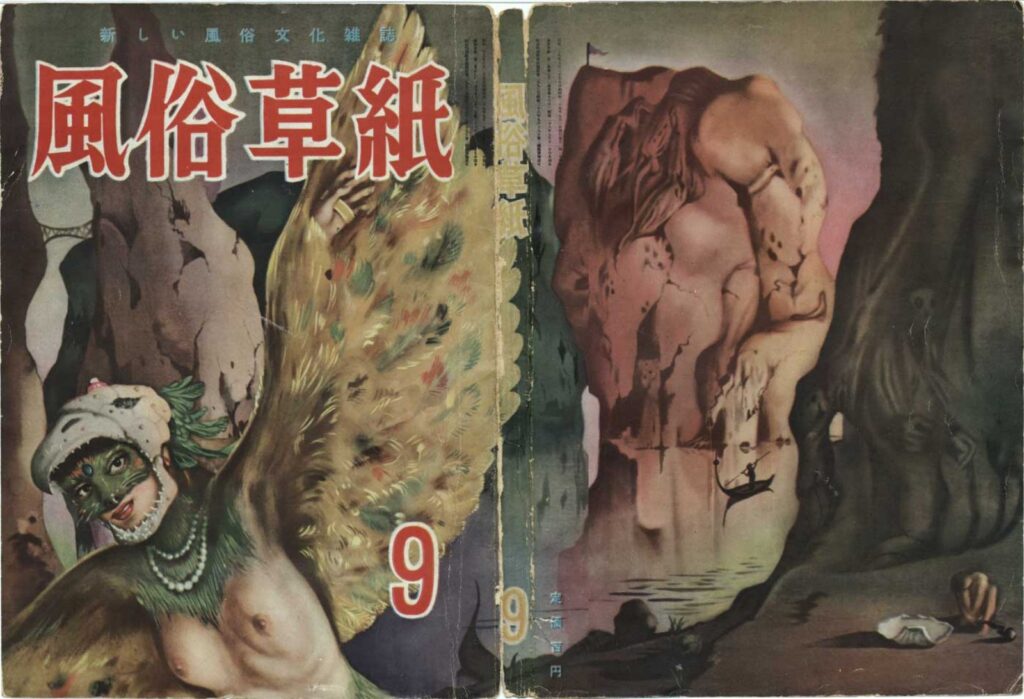
The September 1954 issue of Fuzoku Soshi is a large, densely packed postwar popular-culture magazine combining erotic illustration, sensational fiction, sexual psychology, historical curiosities, crime narratives, social observation, and reader-oriented features. Its visual identity is established immediately by a surreal painted cover and a varied front-matter portfolio that places Japanese staged bondage photography beside European punishment imagery, American fetish photographs, historical martyrdom scenes, and illustrations of legendary women. A formal illustrated contents spread then presents the issue as a broad survey of abnormality, desire, violence, and marginal social worlds.
Read full summary Close full summary
Table of Contents 25 items
-
Three Scenes by Itō Kōzō: Jealousy, Cruelty, and Exposure
Summary
A sequence of erotic illustrations dramatizes a husband’s jealousy and desire for revenge after his wife elopes, presenting scenes of marital betrayal, punishment, and exposure.
-
The White Queen of the Ruined City
Summary
An erotic illustration from “The White Queen of the Ruined City” depicts a dominant woman physically controlling and restraining a submissive man in a stylized fantasy scene.
-
American Photo
Summary
This photographic feature presents staged American bondage scenes in which a woman is chained or strapped to beds, tables, and chairs in varied restrained positions.
-
The Martyrdom of Saint Concordia
Summary
An illustration and accompanying note depict the martyrdom of Saint Concordia, emphasizing her public stripping, whipping, killing, and sacred suffering.
-
The Miracle of Saint Agnes
Summary
An illustrated account of Saint Agnes recounts her refusal of a Roman prefect’s marriage proposal, her threatened sexual violence and execution, and her miraculous survival at the stake before being killed by the sword.
-
Flower and Flower
Summary
This erotic illustration titled “Flower and Flower” portrays two nude women in an intimate reclining embrace.
-
From History
Summary
A historical illustrated feature surveys scenes of captivity, confinement, torture, and punishment, drawing on religious, classical, and legendary sources and emphasizing the spectacle of restrained bodies.
-
The Color Quarter of Akegarasu
Summary
A serialized historical erotic narrative follows the courtesan Sayoye and the men around her through episodes of seduction, jealousy, coercion, bondage, punishment, and sexualized power struggles in an early-modern pleasure-quarter setting.
-
The Lustful Rain Does Not Cease
Summary
A serialized erotic narrative follows Chikako and other characters through jealousy, coercion, captivity, and escalating bondage and punishment, accompanied by dramatic illustrations and dialogue.
-
Crawling in Summer
Summary
This erotic narrative depicts a summer encounter that develops into coercive sexual domination, confinement, physical punishment, and fetishistic attention to the bound body, with accompanying illustrated scenes.
-
Psychiatric Evaluation of the Sexually Abnormal
Summary
A sexological essay examines sexually atypical desire and behavior, distinguishing abnormality from ordinary variation while discussing psychological factors, criminality, treatment, and social judgment.
-
The Female Party Member Gasping Beneath the Bloodstained Whip
Summary
A sensational account of a female Communist Party member implicated in a brutal murder, tracing the police investigation, her escape and armed resistance, and her eventual capture and punishment.
-
How Much I Have Changed in Ten Years
Summary
An autobiographical memoir recounts the author’s decade-long transformation from fearing moxibustion to pursuing its intense heat and pain as erotic pleasure, including repeated treatments, bodily scars, and intimate encounters with a fellow enthusiast.
-
Distorted Affairs
Summary
A sequence of fictionalized episodes presents adulterous and emotionally distorted encounters involving married couples, widows, lovers, jealousy, secrecy, and erotic manipulation, framed through literary storytelling and commentary.
-
The Female Animal Trainer
Summary
This serialized erotic adventure follows Julia, a female animal trainer caught among criminals and captors, as coercion, confinement, whipping, and forced performances with wild animals shape her ordeal and eventual transformation into a spectacle. The story combines melodramatic captivity with staged scenes of animal control, punishment, and sexualized submission.
-
Twelve Chapters Concerning Abnormality
Summary
A twelve-part pseudo-sexological survey of “abnormality” presents case histories, dialogues, historical anecdotes, and illustrations concerning fetishism, sadism, masochism, exhibitionism, gender variance, same-sex desire, sexual violence, and other taboo practices. Its sensational medical and criminological framing is interwoven with eroticized visual scenes and fictionalized personal testimony.
-
Oda Nobunaga and Male Love
Summary
A fictionalized historical narrative about Oda Nobunaga’s relationships with male attendants, especially the young Mori Ranmaru, blending battlefield history, courtly intrigue, and eroticized male love.
-
The Woman with Tattooed Breasts
Summary
A serialized sensational erotic mystery about a woman marked by breast tattoos, her sexual allure and unusual bodily practices, and the investigations, relationships, and disturbing incidents surrounding her.
-
Youth Crying Out
Summary
A serialized erotic narrative follows schoolgirls subjected to escalating teacher-imposed discipline, bondage, humiliation, and corporal punishment, framed through the girls’ fear, curiosity, and conflicted responses. The story emphasizes institutional authority and the sexual psychology of coercive punishment.
-
Women of the Bicycle Racetrack
Summary
A serialized narrative set around a women’s bicycle racetrack depicts female racers, spectators, gambling, domestic tensions, and eroticized competition, linking athletic display and public spectatorship with sexual rivalry and personal vulnerability.
-
Two Women of Summer
Summary
A fictional summer narrative presenting two erotic encounters shaped by attraction, infidelity, secrecy, and emotionally charged relations between men and women.
-
The Woman Who Sleeps on Nails
Summary
A serialized sadomasochistic thriller follows a young woman through seduction, coercive control, confinement, and a violent nail-bed ordeal involving doctors, professors, and other observers.
-
Letters from a Young Obstetrician-Gynecologist
Summary
Framed as letters from a young obstetrician-gynecologist, this eroticized medical narrative describes intimate examinations, instruments, operations, and the unequal power relations between physicians and female patients.
-
A Woman in Slavery
Summary
A fictional first-person account follows a female factory worker who becomes a domestic servant and is subjected by her employer to coercive sexual exploitation, humiliation, and bondage. Illustrated episodes emphasize her enforced submission and loss of autonomy.
-
Rainbow of the Enchantress
Summary
The fourth installment of a serialized erotic novel, “Rainbow of the Enchantress,” depicts an artistically framed encounter with a mysterious, sexually charged woman through scenes of modeling, spectatorship, fetishized bodies, and erotic domination.
Highlights
- The opening portfolio juxtaposes staged Japanese bondage photography, American fetish photographs, historical punishment illustrations, Christian martyrdom scenes, and images of legendary women, establishing the issue’s transnational visual vocabulary. (PDF pp. 2–11).
- The formal contents spread is itself an elaborate two-page design with playing-card, dagger, candle, and pin-up motifs, organizing the issue into fiction, medical commentary, social observation, historical material, and illustrated features. (PDF p. 12).
- “The Color Quarter of Akegarasu” is a long illustrated period tale of sexual exploitation, rivalry, humiliation, and revenge in a pleasure-quarter milieu. (PDF pp. 15–26).
- The final installment of “The Lustful Rain Does Not Cease” uses hotels, cabarets, theatrical performers, jealousy, bondage, and betrayal to construct a distinctly modern urban erotic drama. (PDF pp. 27–38).
- Ōta Tenrei’s “Psychiatric Evaluation of the Sexually Abnormal” reflects the issue’s recurring attempt to place sensational sexual material within a medical and criminological framework. (PDF p. 48).
- “The Female Party Member Gasping Beneath the Bloodstained Whip” combines political persecution, criminal investigation, torture, and sensational illustration. (PDF pp. 49–55).
- The special feature “Twelve Chapters Concerning Abnormality” forms the issue’s largest quasi-encyclopedic section, presenting illustrated discussions of sexual behavior, fetishism, gender, prostitution, reproduction, and bodily difference. (PDF pp. 81–108).
- “Oda Nobunaga and Male Love” treats male homosexuality through historical biography and illustrated period narrative. (PDF pp. 109–120).
- The late-issue sequence includes writing on breast tattooing, troubled youth, competitive public spaces, summer desire, medical correspondence, and women imagined as slaves or social outsiders. (PDF pp. 121–180).
- Ryūtanji Yū’s “Rainbow of the Enchantress” provides a literary closing feature before the final columns and publication notices. (PDF pp. 181–189).
Contributors
Named contributors represented in this issue: