Beautiful Bondage
August 1965
← Back to magazine archive
Issue Details
- Issue
- 6
- PDF pages
- 32
Summary
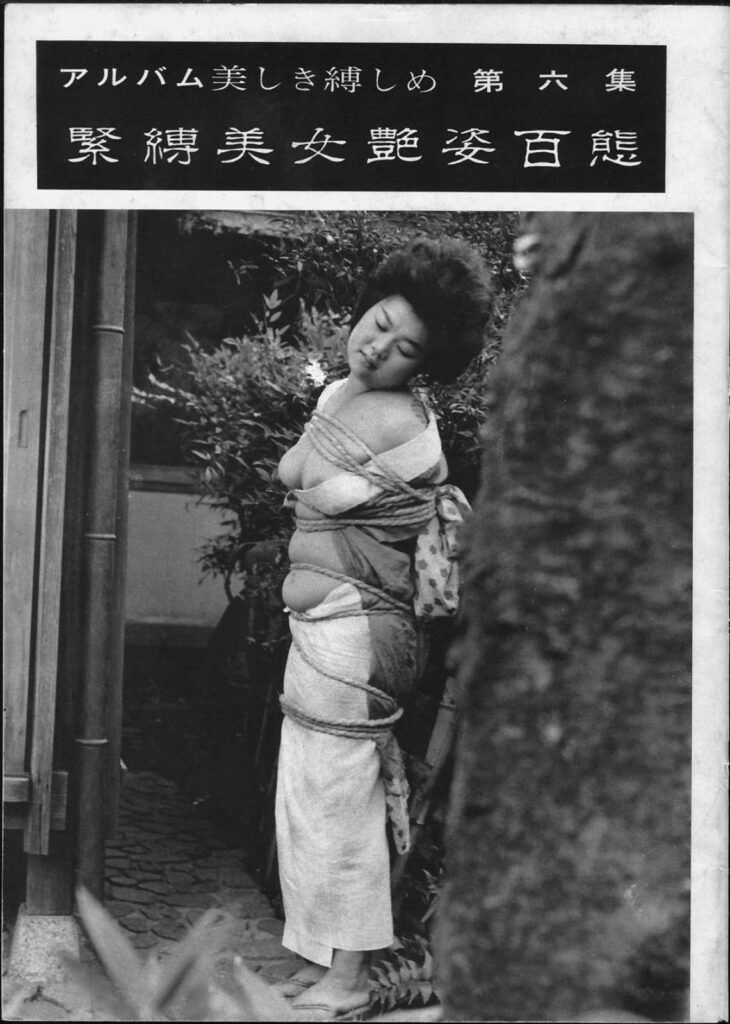
The August 1965 installment of Beautiful Bondage identifies itself as Album Beautiful Bondage, Collection 6 and carries the prominent title 緊縛美女艶姿百態, approximately One Hundred Alluring Poses of Bound Beauties. Rather than following a single model or extended scenario, the volume is conceived as an anthology. It presents a large assortment of women, tying styles, body types, costumes, settings, and degrees of restraint, creating an early visual taxonomy of the repertoire that the Beautiful Bondage series had developed by the middle of the 1960s.
Read full summary Close full summary
Loading PDF…
Highlights
- The cover identifies the volume as Beautiful Bondage, Collection 6 and gives the principal title One Hundred Alluring Poses of Bound Beauties, establishing the issue as a broad anthology rather than a single sustained photographic scenario. (PDF p. 1).
- The opening portfolio juxtaposes dense kimono bondage, black strap or leather restraint, floor bondage, rear-arm ties, and a variety of body types, immediately establishing the comparative character of the collection. (PDF pp. 2–6).
- Several photographs include small printed Japanese captions identifying particular visual or technical motifs, including Japanese coiffure bondage, black-leather fundoshi bondage, rough-rope torment, rear-hand restraint, and other named configurations. (PDF pp. 2–16).
- Architectural restraint becomes an important recurring motif, with models tied against columns or supports, wrists secured overhead, and bodies pulled into standing or extended positions by ropes attached beyond the frame. (PDF pp. 7–8, 13, 16, 20, 24, 29, 32).
- The collection repeatedly uses patterned and plain cloth gags in combination with chest and arm bondage, providing a sustained visual study of how facial covering alters the appearance and emotional tone of the restrained figure. (PDF pp. 3, 5–6, 8–10, 12–16, 19–20, 22–23, 25, 28–29, 31).
- Outdoor bondage appears throughout the volume in wooded and garden settings, including tree restraint and floor or ground poses that contrast rope-bound bodies with vegetation, stone, and natural textures. (PDF pp. 1, 9, 11, 17, 20, 23, 31).
- Several photographs move beyond conventional standing or kneeling ties into suspension, including overhead wrist restraint, a horizontally suspended figure, an inverted suspension, and partially suspended standing positions. (PDF pp. 7, 13, 15–16, 24, 29, 32).
- The later portion emphasizes close views of rope construction around the back, shoulders, chest, and wrists, making knots, directional tension, and the relationship between torso restraint and arm position especially visible. (PDF pp. 21–30).
- A small number of images incorporate other restraint or punishment props, including chains and handheld implements, broadening the issue beyond rope while preserving bondage as its organizing visual subject. (PDF pp. 15, 22, 29–30).
- The final page combines a standing upper-body bondage photograph with the Tenseisya imprint from Abeno, Osaka and states that the limited edition is not sold through bookstores. (PDF p. 32).