Fuzoku Kitan
November 1960
← Back to magazine archive
Issue Details
- PDF pages
- 74
Summary
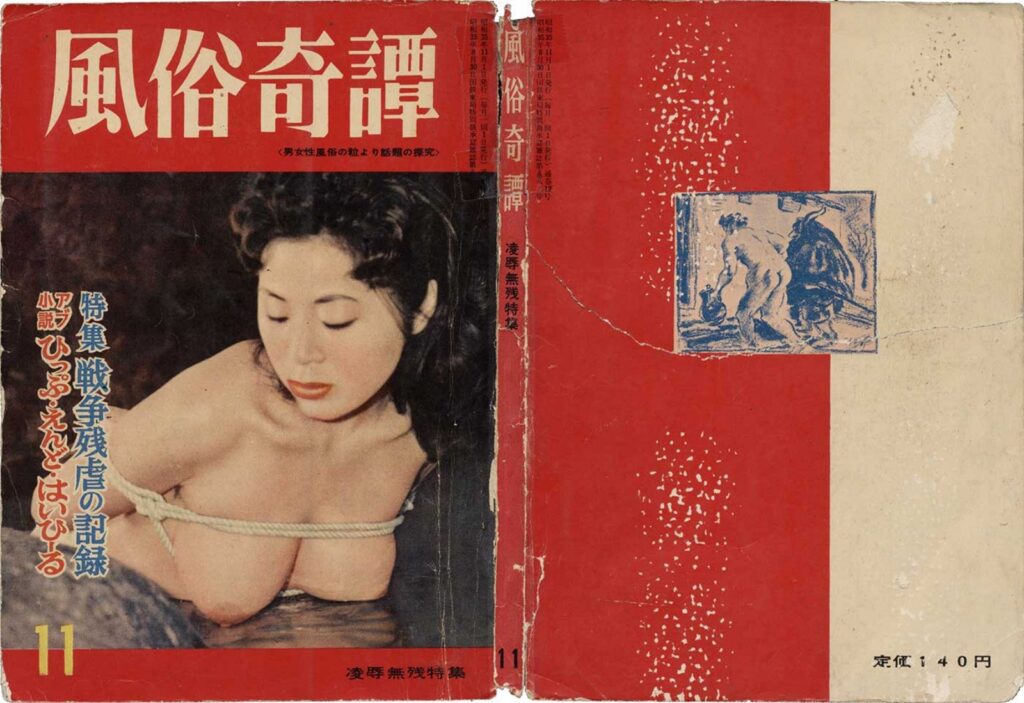
The November 1960 issue of Fuzoku Kitan is organized around spectacular images and narratives of cruelty, humiliation, wartime violence, punishment, bondage, and bodily ordeal. Its cover announces a special feature on merciless humiliation, while the formal contents page foregrounds both a Record of Wartime Atrocities feature and a large gravure section. The publication moves between eroticized staged imagery and documentary or quasi-documentary representations of historical violence, producing an unusually stark juxtaposition between fantasy, fetish photography, wartime testimony, and illustrated historical narratives.
Read full summary Close full summary
Table of Contents 21 items
-
Water Hellfoldout
Summary
An illustrated water-torture scene depicts a naked woman restrained spread-eagled while being forced to drink water until her stomach painfully distends.
-
Gorgeous Cruelty
Summary
A photographic and textual feature presents staged scenes of whipping, restraint, and humiliating punishment involving a youthful male subject and women, framed as an aestheticized form of cruelty.
-
Flamboyant Foot Suspension
Summary
A photographic portfolio shows women bound and suspended by their feet in traditional Japanese interiors, emphasizing inverted poses and elaborate rope arrangements.
-
The Pose of Love-Rope
Summary
A photographic feature depicting a woman bound with rope in varied poses among rocks and vegetation, presenting outdoor rope restraint as an erotic visual tableau.
-
Dog-Collar Brassiere
Summary
A photographic feature demonstrating a woman wearing a brassiere-like restraint incorporating a dog collar, with close views of the apparatus and several posed configurations.
-
Pole Binding
Summary
A photographic instructional feature showing a woman restrained with ropes and poles in seated and floor positions, accompanied by captions describing the tying arrangement.
-
Standing Figure in Torment
Summary
A photographic bondage feature depicts a woman tied upright to bars and forced into physically strained, exposed poses, emphasizing ordeal and humiliation.
-
Red-and-White Rope Binding
Summary
This photographic portfolio presents varied red-and-white rope bindings, including restraints to bars and complex body bindings modeled in staged seated, standing, and reclining poses.
-
Moment of Ecstasy
Summary
A photographic sequence titled “Moment of Ecstasy” shows a woman in elaborate rope restraints adopting seated and reclined poses that frame bondage as an intense sensory experience.
-
Embarrassing Pose
Summary
A staged photographic sequence presents a woman bound with rope in deliberately awkward and exposing poses, emphasizing embarrassment, restraint, and the viewer’s observation of her discomfort.
-
Suspension Torment
Summary
This photographic feature depicts a woman secured in a series of rope suspension positions, including elevated and strained poses that frame bondage as physical torment and spectacle.
-
The Coiling Snake
Summary
A staged photo story shows a woman interacting with and being encircled by a coiling snake amid rope-bound poses, combining animal imagery with eroticized restraint and fetish spectacle.
-
The Horror of the Log Cabin / Crucifixion on the Rocks
Summary
Two erotic illustrations depict women subjected to extreme restraint and torment, including binding inside a log cabin and crucifixion-like immobilization on rocky terrain.
-
Bamboo-Binding Torment / The Shooting Target
Summary
Two illustrated scenes present women bound with bamboo and ropes in punitive, threatening settings, including one portrayed as a shooting target.
-
Record of Wartime Atrocities
Summary
A photographic record documents wartime atrocities, showing executions, corpses, mass violence, and other abuses committed against civilians and prisoners in Poland, China, and elsewhere during World War II.
-
The Greatest Sadism
Summary
An essay examining sadism as a destructive human impulse, linking individual cruelty and group violence to wartime atrocities and the psychology of domination.
-
Torture Warehouse
Summary
A first-person reportage account by detained military nurses describing their capture during the postwar collapse in Manchuria, confinement in a makeshift torture warehouse, and repeated beatings, sexual violence, humiliation, and attempts to escape from Soviet military custody.
-
Hair Burning and Hair Suspension
Summary
A historical account of wartime interrogation and punishment in China in which a woman is subjected to hair burning, hair suspension, physical abuse, and extreme humiliation by military personnel.
-
The Mass Crucifixion of 122 People
Summary
A historical erotic narrative depicts the mass capture, bondage, humiliation, torture, and execution of 122 women during the Sengoku period, illustrated with scenes of restraint and violence.
-
Sisters Subjected to Fire and Water Torture
Summary
This historical account describes two sisters subjected to fire and water torture amid religious persecution and wartime repression, emphasizing their physical suffering and the cruelty of punishment.
-
Reader Salon
Summary
A reader-salon section brings together correspondence, personal contributions, editorial replies, and discussion of erotic magazines, fetish imagery, photography, gendered interests, and readers’ experiences.
Highlights
- The opening color plate Water Hell by Doi Keiko depicts a restrained woman being forced to drink water and establishes the issue's recurring fusion of punishment imagery and eroticized suffering. (PDF pp. 3–4).
- The principal gravure portfolio presents an extended sequence of staged bondage tableaux including ankle suspension, breast restraint, pole binding, standing restraint, suspension, humiliating poses, and snake imagery. (PDF pp. 8–31).
- Four full-page illustrations by Tagami Keiko and Oda Toshimi depict women bound in a log cabin, restrained against rocks, tied with bamboo, and used as a shooting target. (PDF pp. 32–35).
- Record of Wartime Atrocities reproduces documentary photographs of executions, shootings, bodies, and punitive violence, including material concerning Poland, Nazi forces, and wartime violence in China. (PDF pp. 36–42).
- Ōdachi Kinji's The Greatest Sadism interprets warfare as sadism magnified to the scale of collective human behavior, providing an explicit editorial bridge between the issue's historical and erotic material. (PDF p. 43).
- Torture Warehouse by Shimaki Keiko is a lengthy first-person wartime captivity narrative centered on nurses, military collapse, imprisonment, attempted escape, coercion, and physical abuse. (PDF pp. 44–58).
- Hair Burning and Hair Suspension by Banba Takeo surveys forms of punishment directed at women, including the burning and suspension of victims by their hair. (PDF p. 59).
- The Mass Crucifixion of 122 People by Shinoda Fujimi presents a Sengoku-period account of collective crucifixion and military vengeance. (PDF pp. 61–66).
- Sisters Subjected to Fire and Water Torture by Iwasaki Kōichi continues the issue's historical punishment material with an account centered on two women subjected to fire and water ordeals. (PDF p. 67).
- Reader Salon provides several pages of reader correspondence on sexual practices, fetish interests, personal experiences, and reactions to the magazine's content. (PDF pp. 68–71).
Contributors
Named contributors represented in this issue: