Uramado
November 1956
← Back to magazine archive
Issue Details
- PDF pages
- 189
Summary
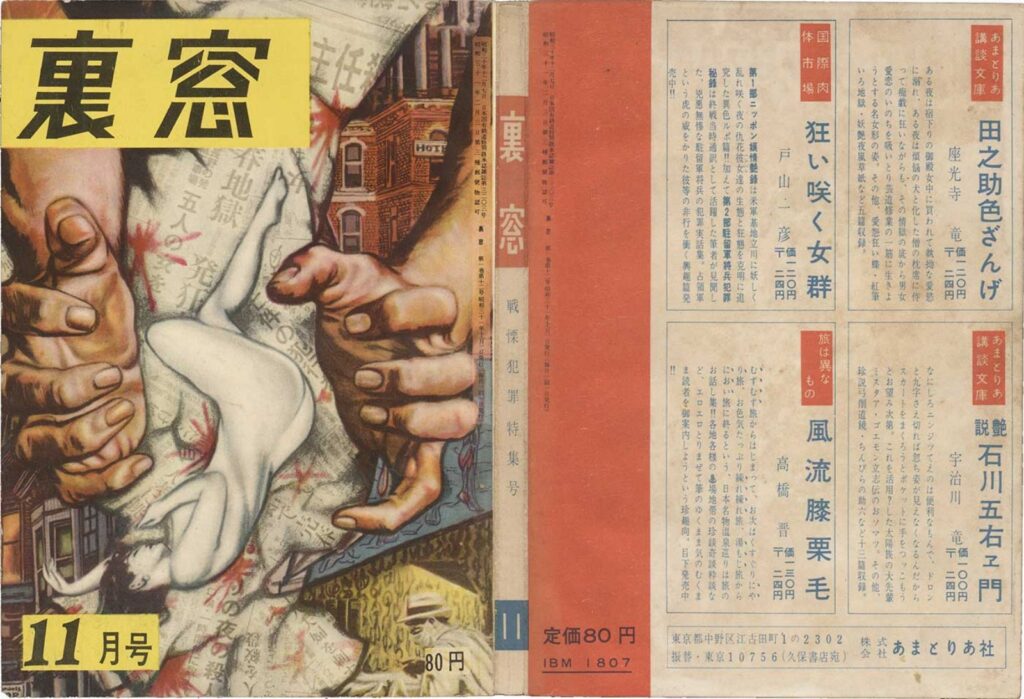
The November 1956 issue of Uramado is a broad sensational magazine rather than a narrowly specialized SM publication. Crime reporting, mystery fiction, sexual customs, medicalized discussions of sexuality, foreign photographs, humor, historical tales, and illustrated pulp fiction all share the same pages. Its importance lies precisely in this mixture. Erotic cruelty, captivity, murder, sexual abnormality, and voyeurism are presented as neighboring forms of “hidden” knowledge rather than as a clearly separated SM culture.
Read full summary Close full summary
Table of Contents 23 items
-
East-West Uramado Erotic Anecdotes
Summary
A serialized collection of comic erotic anecdotes set across Japanese and Western contexts, presented through short narrative episodes, dialogue, and spot illustrations. The stories explore secret desire, voyeuristic situations, marital and domestic sexual scenarios, and playful erotic misadventure.
-
The Autumn Festival That Was Toyed With
Summary
A sensationalized account of a young woman’s murder during an autumn festival, beginning with the discovery of her strangled body in a cabbage field. The article follows the police investigation, forensic observations, witness interviews, reconstruction of the victim’s relationships, and pursuit of a male suspect, accompanied by dramatic illustrations.
-
The Bedroom Phantom Thief
Summary
A sensational serialized crime narrative follows a fugitive “phantom thief” who enters a bedroom, threatens and overpowers women, and becomes connected to murder, robbery, and an attempted escape. Police investigators pursue clues across rural communities, while accompanying illustrations emphasize danger, coercion, captivity, flight, and the eventual manhunt.
-
The Lady Doctor Is Frightening! A Film Studio Cut Open by an Actress’s Scalpel
Summary
A sensational reportage-style examination of actresses, doctors, directors, and studio personnel, portraying the film studio as a site where erotic desire, ambition, rivalry, and emotional vulnerability intersect. Through anecdotes and commentary on actresses’ careers, romances, performances, and public images, the article presents the “scalpel” as a metaphor for exposing the hidden sexual and psychological dynamics of the postwar film world.
-
The Demon’s Tentacles
Summary
An illustrated crime-and-captivity fiction involving a brutal attack on women, military police investigations, and the pursuit of suspects through nighttime urban and rural settings. The narrative combines eroticized violence, restraint, interrogation, blood evidence, and sensational encounters with foreign soldiers and civilians.
-
Could Your Name Cause You to Kill?
Summary
This article examines Japanese name-based divination, arguing that surname and given-name kanji—and their stroke counts—can reveal personality, fortune, criminal tendencies, and even susceptibility to violent acts. It applies a numerological system of main, secondary, total, and supplementary fortunes to several sensational murder cases and discusses the supposed relationship between names, fate, and behavior.
-
The Mystery of the Pawn Ticket
Summary
A crime-mystery narrative follows the investigation of a bizarre riverside murder, with a pawn ticket providing the crucial clue. Police interrogation and the killer’s confession gradually reveal a story of betrayal, obsession, and revenge involving an older woman.
-
The Dōgenzaka Beautician Murder
Summary
A sensational account of the murder of a Dōgenzaka beautician, whose strangled body is discovered at home. Police interrogate associates and reconstruct a web of jealousy, concealed relationships, and forbidden desire surrounding the crime before identifying the culprit.
-
The Woman Who Came from the Demon Tower
Summary
This illustrated erotic-grotesque fiction follows a mysterious woman from the Demon Tower who arrives at a remote hot-spring inn and becomes entangled with a doctor, his associates, and other guests. Sexual obsession, jealousy, mental disturbance, violence, and apparent supernatural or grotesque transformations escalate into murder and psychological collapse.
-
Decoding the Imperial Navy’s Erotic Cipher
Summary
Usami Masao deciphers the euphemisms, abbreviations, and coded vocabulary used for sexual behavior and relationships within the Imperial Japanese Navy. Drawing on naval life, wartime anecdotes, and illustrated examples, the article discusses prostitution, same-sex encounters, gendered roles, secrecy, and the psychological meanings attached to military slang.
-
The Woman Used as a Gambling Stake
Summary
A serialized erotic narrative in which a woman becomes the stake in a gambling contest among men. As the wagers escalate, she is subjected to coercive possession, humiliation, restraint, and sexual exploitation, with the story framed through melodramatic scenes and accompanying erotic illustrations.
-
The Blood-Soaked Lust Demon
Summary
An illustrated serialized erotic crime narrative following Keijiro’s predatory encounters with women, marked by coercion, captivity, physical violence, and bloodshed. The story moves between eroticized assaults and their aftermath, including medical attention, police involvement, and attempts to identify or apprehend the perpetrator.
-
An Evening of Crime-Prevention Films
Summary
A satirical mock program for an evening of “crime-prevention” films, presenting sensationalized scenes of sexual misconduct, assault, abduction, voyeurism, and fetishized encounters through pseudo-official narration, film captions, and cartoons. The feature combines moralistic public-safety rhetoric with eroticized visual spectacle and exaggerated case-reporting.
-
The Woman Demon I Peeped At
Summary
A first-person erotic mystery recounts the narrator’s voyeuristic peeping into a woman’s room and his growing fascination with her apparently beautiful yet uncanny, demon-like body. The narrative develops through investigation, testimony, and grotesque transformations, accompanied by sensational illustrations of nudity and bodily abnormality.
-
Why Did These Women Kill Their Own Relatives?
Summary
Kojika Aiko examines several sensational cases in which women were accused or convicted of killing relatives, including the murder of a university student and alleged family-linked insurance crimes. The article reviews court testimony, evidence, family relationships, personality, motive, and the psychological and social pressures presented as explanations for the crimes.
-
The Uramado Wife Murder Case: Exclusive Trial Record
Summary
An exclusive trial-record feature reconstructs a wife-murder case involving alleged arsenic poisoning, marital conflict, suspected infidelity, and the testimony of the accused and witnesses. Presented through police reports, courtroom questioning, and witness statements, the account emphasizes domestic secrecy, sexual relationships, suspicion, and the sensational mechanics of the case.
-
The Interfering Man Is Eliminated
Summary
A sensational account of the Clayton/Applegate household describes a sexually transgressive family, the murder of the husband, and the police investigation that follows. The narrative combines crime reporting, interviews, medical commentary, and lurid depictions of forbidden family relationships.
-
Three-Way Battle
Summary
A narrative feature recounts a teacher’s sexually charged encounter with two young women, whose rivalry and shifting advances produce the article’s “three-way battle.” Dialogue, staged scenes, and illustrated erotic situations frame the episode as sensational erotic storytelling.
-
A Glimpse of Eroticism
Summary
A humorous essay on eroticism in postwar everyday life, using imagined conversations, domestic episodes, and commentary on marital behavior, sexual appeal, and changing social attitudes. The accompanying cartoons reinforce its satirical treatment of intimacy, embarrassment, and ordinary couple relationships.
-
Aoki Residence Diary
Summary
A fictionalized diary-style narrative following the social and romantic entanglements of the Aoki household and its acquaintances. Through comic conversations and illustrations, it explores dating, generational differences, courtship, secrecy, and the tensions between conventional respectability and modern sexual culture.
-
The Secret Chronicle of Suruga Dainagon: The Chapter of His Origins
Summary
An illustrated historical erotic serial set in the Edo period, following Suruga Dainagon and the woman Yuki amid intrigue, captivity, and encounters with a mysterious white ape. The chapter combines feudal drama with scenes of bondage, coercion, humiliation, and supernatural menace.
-
Worldly Night Tales
Summary
A collection of eroticized tales set in different countries, including Sweden, Japan, Denmark, and South Africa. The stories depict seduction, sexual intrigue, fetishistic situations, and imagined encounters involving travelers, servants, historical figures, and wartime settings.
-
Publication Information
Summary
Publication information and promotional notices for the issue, including book advertisements, subscription and pricing details, publisher information, and an invitation for readers to submit material.
Highlights
- The international opening portfolio presents nude and partially dressed women as examples of strange Western customs and modern sexual life (PDF pp. 6–13).
- A long illustrated advice section turns adultery, courtship, embarrassment, and sexual misunderstanding into short comic case histories (PDF pp. 14–21).
- The issue’s principal special section is devoted to crime, violence, and sensational criminal investigation (PDF p. 22 onward).
- “The Stolen Autumn Night” begins with the discovery of a woman’s body and follows an investigation through forensic clues and witness testimony (PDF pp. 23–31).
- The story’s illustrations emphasize the victim’s clothing, bodily position, and surrounding objects as evidence to be visually examined (PDF pp. 23–30).
- “The Monster Thief of the Bedroom” transforms domestic privacy into a site of intrusion and danger (PDF pp. 32–40).
- A hotel or lodging-house murder story links sexual secrecy, travel, and anonymous modern spaces (PDF pp. 32–40).
- “The Demon’s Hand” presents violent crime through the conventions of American or imported pulp fiction (PDF pp. 47–55).
- A dancer-centered crime report combines nightclub culture, female performance, and murder investigation (PDF pp. 47–55).
- “Why Do Actresses Kill People?” uses the film world to connect female visibility with scandal, danger, and exploitation (PDF p. 56).
- A statistical feature classifies crime and abnormal behavior through numbers, charts, and pseudo-scientific explanation (PDF pp. 57–62).
- Several stories turn women’s bodies into forensic objects interpreted by police, doctors, and readers (PDF pp. 23–40 and 47–62).
- A mystery involving an older woman and a younger man combines courtship, deception, money, and murder (PDF pp. 63–69).
Contributors
Named contributors represented in this issue: