Kitan Club
May 1963
← Back to magazine archive
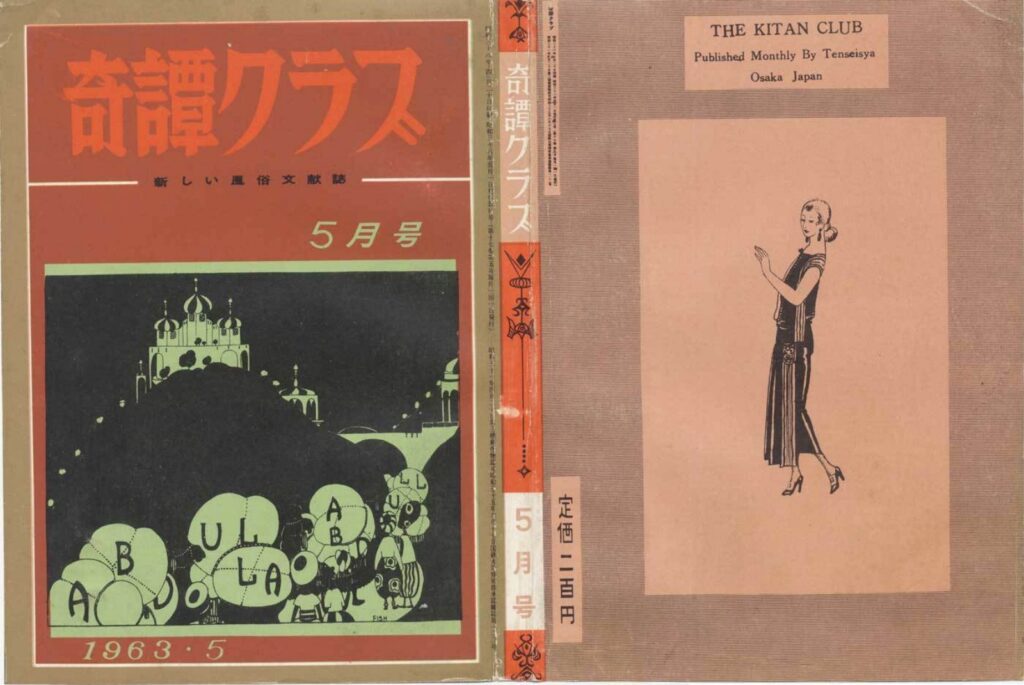
Issue Details
- Volume
- 17
- Issue
- 5
- PDF pages
- 188
Summary
The May 1963 issue of Kitan Club is organized as a broad anthology of bondage photography, fetish illustration, supernatural adventure, historical fiction, personal testimony, cultural commentary, and reader correspondence. Its opening pages establish the issue’s visual character through staged scenes of blindfolding, gagging, trampling, tightly compressed rope positions, kimono bondage, and women alternately occupying dominant and submissive roles. A substantial illustration portfolio follows, with contributions by Shima Takashi, Claude Koga, Kurokawa Fujio, and Taki Reiko depicting warehouse restraint, tongue suspension, breast-weight bondage, group punishment, imagined disembowelment, female same-sex intimacy, and headlock wrestling.
Read full summary Close full summary
Table of Contents 21 items
-
Opening Gravure Portfolio
Summary
An opening visual portfolio presents staged erotic scenes of women and men subjected to rope bondage, gagging, masking, and restrained poses in domestic and outdoor settings.
-
Illustration Portfolio
Summary
An illustration portfolio depicts stylized erotic scenes involving bound, gagged, captured, and otherwise physically controlled women, with recurring motifs of restraint, coercion, and submission.
-
Second Gravure Portfolio
Summary
A second photographic portfolio shows women immobilized with rope in seated, kneeling, floor-based, and other staged bondage positions, often with covered or blindfolded faces.
-
Valley of the Dead
Summary
A grotesque supernatural tale set in a haunted valley, where a mountain man, a witch-like woman, and a traveling performer become entangled in violent torture, poison, death, and occult revenge.
-
Notes of a Gun-Making Maniac
Summary
A conversational notebook-style column presents comic exchanges about apartment moves, deliveries, money, and erotic merchandise, alongside a mail-order advertisement for a women’s bondage photo collection and fetish garments.
-
The Women of Sunpu Castle
Summary
This historical erotic adventure portrays rival women of Sunpu Castle whose beauty, martial prowess, jealousy, and violent struggle culminate in swordplay, decapitation, and fatal revenge.
-
A Beautiful Cry
Summary
A serialized erotic story follows Akiko as she enters an increasingly coercive relationship in which she is disciplined, restrained, humiliated, and compelled to endure painful punishment, while her emotional distress and cries are eroticized by the surrounding characters.
-
The Ordeal of the Diapered Child
Summary
The concluding ordeal centers on a young woman subjected to diapering, physical discipline, restraint, and degrading treatment, while the later pages discuss Tanizaki Jun’ichirō’s Diary of a Mad Old Man, its film adaptations, and the elderly protagonist’s fetishistic fixation on women’s feet. The unit thus links fictional punishment with literary and cinematic representations of fetishism, aging, and sexual obsession.
-
Tales of the Thirty-Ninth Night: Twenty-Fourth Night
Summary
This installment of the serialized fantasy follows encounters at a bathhouse and temple that develop into voyeuristic discovery, supernatural menace, and elaborate scenes of erotic punishment and restraint.
-
Longing for a Long Sentence
Summary
A dark erotic narrative centers on obsessive planning and enactment of prolonged punishment, with characters subjected to beatings, burning, binding, suspension, and psychological domination.
-
Marriage: The Withered Chapter
Summary
A serialized erotic narrative portrays a marriage deteriorating into coercive domestic sadism, with jealousy, humiliation, physical restraint, and psychological submission shaping the relationship.
-
Secret Tales of Female Seppuku
Summary
This historical erotic tale follows a woman in a samurai-era setting who is compelled toward ritual female seppuku, presenting execution, obedience, spectatorship, and bodily suffering as a highly stylized dramatic spectacle.
-
The Wife of the Cross, Continued
Summary
A serialized erotic fiction installment portrays a wife subjected to rigid household rules, forced domestic service, physical punishment, sexualized humiliation, and repeated attempts at escape within an abusive marital and family regime.
-
Intoxicated by the Words of an Enema
Summary
This reader confession by a young woman traces the development of her fascination with enemas from childhood experiences into a private erotic fixation involving medical imagery, self-experimentation, and fantasy.
-
Observations on Women in Male Dress
Summary
The essay examines the erotic and imaginative appeal of women in male dress, drawing on literary, cinematic, illustrated, military, and historical examples to discuss gendered appearance, role reversal, and masculine presentation.
-
Reflections on Bondage Photography
Summary
An essay reflecting on bondage photography discusses the visual appeal of bound bodies, the role of costume and restraint, and the tension between documentary realism and erotic staging.
-
Love’s Bewilderment
Summary
An extended erotic narrative follows the narrator’s obsessive relationship with Keiko, whose illness, authority, and sexual demands draw him into coercion, humiliation, bondage, rivalry, and fantasies of suffering and death.
-
The Women’s Sumo of the Wives
Summary
A reportage-style feature describes a village wives’ sumo contest, emphasizing the women’s physical competition, spectatorship, local festival atmosphere, and eroticized wrestling imagery.
-
The Woman of the Ginkgo Mansion
Summary
A serialized erotic narrative follows Tokunoichi and Yoshiji through encounters involving abduction, coercion, physical restraint, and sadistic sexual violence, culminating in an assault at the Ginkgo Mansion.
-
Happiness: An Eight-Millimeter Memoir
Summary
Ōtsuka Keiko’s memoir reflects on her experiences with women’s nude modeling, erotic photography, and 8-millimeter filming, considering the emotional and psychological dimensions of being viewed and recorded.
-
Reader Communications
Summary
A wide-ranging reader correspondence section presents readers’ reports, requests, opinions, and personal experiences concerning bondage, nude photography, fetish practices, and participation in the magazine’s erotic community, alongside editorial responses and notices.
Highlights
- The opening photographic sequence presents blindfolding, trampling, exposed rope restraint, kneeling positions, and tightly compressed floor ties. (PDF pp. 6–13).
- A full-page illustration portfolio by Shima Takashi, Claude Koga, Kurokawa Fujio, Taki Reiko, and others depicts warehouse bondage, tongue suspension, breast-weight restraint, group punishment, disembowelment fantasy, and headlock wrestling. (PDF pp. 14–21).
- A second photographic portfolio places gagged and bound women in domestic and outdoor settings and includes female-on-male domination and compact rope positions. (PDF pp. 22–28).
- Nonaka Aizō’s “Valley of the Dead” is a long supernatural adventure combining an isolated criminal enclave, coerced performance, escape, and bodily transformation. (PDF pp. 30–38).
- Maki Shinji’s “The Women of Sunpu Castle” dramatizes rivalry, assassination, female sword combat, and ritual suicide in a historical setting. (PDF pp. 42–51).
- Yoshino Mayumi’s “The Ordeal of the Diapered Child” provides a substantial treatment of infantilism and humiliation as an erotic and psychological fixation. (PDF pp. 64–71).
- The central run of serial and case-oriented writing explores imprisonment fantasies, troubled marriage, female seppuku, and the continuing story “The Wife of the Cross.” (PDF pp. 72–121).
- Later documentary pieces address enema practices, women in male dress, and the culture of amateur bondage photography. (PDF pp. 122–133).
- The final literary section includes a confession of erotic bewilderment, a report on women’s sumo, the long story “The Woman of the Ginkgo Mansion,” and an eight-millimeter film memoir. (PDF pp. 134–173).
- The extensive closing correspondence and classified pages document reader networks, exchanges of photographs and publications, club activity, personal advertisements, and editorial communication. (PDF pp. 174–188).
Contributors
Named contributors represented in this issue: