Uramado
March 1960
← Back to magazine archive
Issue Details
- Volume
- 5
- Issue
- 3
- PDF pages
- 256
Summary
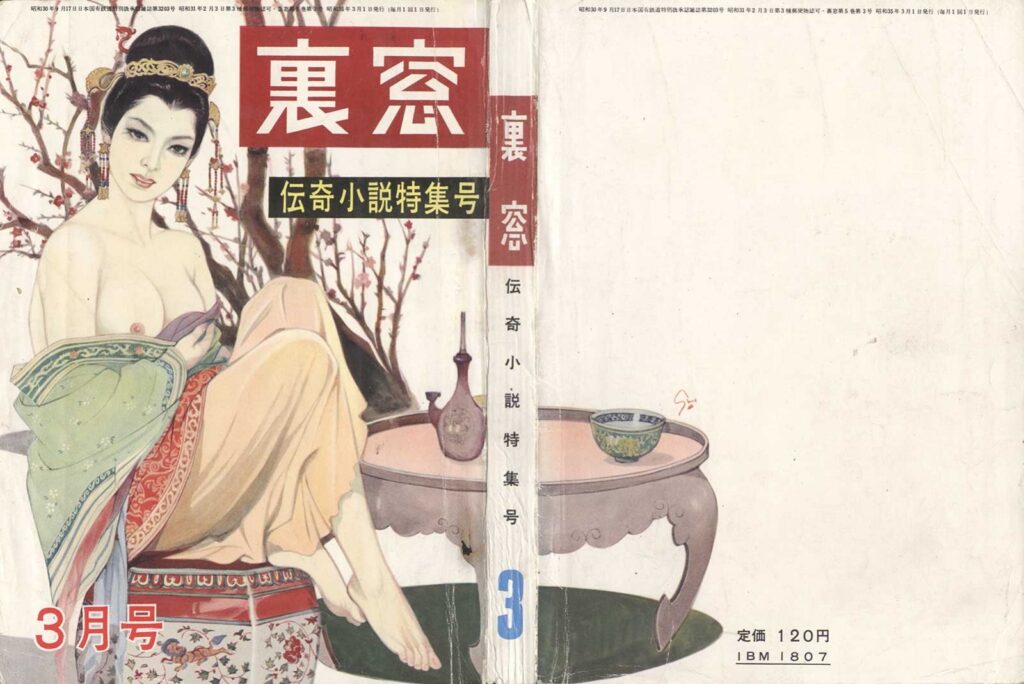
The March 1960 issue of Uramado is explicitly presented as a special issue devoted to denki shōsetsu, or legendary and fantastic fiction. Its editorial design combines historical adventure, crime and suspense, supernatural motifs, eroticized danger, female captivity, and illustrated spectacle. The opening pages establish this mixture immediately: an American erotic-torment picture story is followed by the color illustrated feature Extinguish the Fire of Bare Skin!! and a brief color nude presentation. The formal contents then leads into a succession of heavily illustrated historical and fantastic narratives.
Read full summary Close full summary
Table of Contents 23 items
-
American Edition: Erotic-Torment Picture Story
Summary
An American-edition erotic picture story presented through staged illustrated scenes of sexual torment, restraint, and voyeuristic spectacle.
-
Extinguish the Fire of Bare Skin!!
Summary
An illustrated erotic crime thriller follows a woman through encounters with armed men, pursuit, captivity, and coercive sexualized situations across Japanese urban and travel settings.
-
Woman Holding Her Hair
Summary
A photographic feature centers on a nude woman gathering and holding her long hair, emphasizing the body, pose, and hair as erotic visual motifs.
-
Legend of the White Monkey Tower
Summary
A historical erotic adventure follows the female bandit Osen and the swordsman Denkurō as they pursue a rumored cache of Takeda gold hidden near the White Monkey Tower, encountering deception, robbery, betrayal, drugged liquor, and pursuit along the Kōshū road. The illustrated serial concludes with the criminals captured after their schemes unravel.
-
Legend of Hawk's Nest Valley
Summary
An illustrated historical erotic adventure serial set in a mountainous valley, where warriors pursue a fabled treasure and become entangled in abduction, coercive sexual violence, brutal swordplay, revenge, and shifting loyalties among villagers and retainers. The narrative is accompanied by dramatic scenes of restraint, assault, captivity, and combat.
-
Blood Calls the Diamond
Summary
A serialized crime-adventure follows Jim, a diamond-mine worker whose theft, betrayal, flight, and encounters with doctors, police, and accomplices unfold across colonial Africa, with repeated scenes of coercion, pursuit, and restraint.
-
Strange Tale of Hōnenji
Summary
This historical erotic tale set around Hōnenji depicts samurai, entertainers, and other figures drawn into schemes of desire, deception, abduction, and physically restrictive punishment, accompanied by dramatic illustrations of bound and struggling bodies.
-
The Snow Demon Woman Has Four Fingers
Summary
A serialized supernatural erotic tale follows a traveler caught in a blizzard who encounters a mysterious snow-demon woman with four fingers, becomes entangled in her desperate appeals and an enigmatic household, and faces escalating fear, confinement, and forbidden desire.
-
Legendary Curse-Binding of the Hunting Tribe
Summary
A serialized Edo-period erotic adventure follows the secret agent O-Kyo as she carries a confidential document through the mountains, is pursued and captured by hostile warriors and members of the Shishi tribe, and endures elaborate bindings, humiliation, violence, and escape attempts amid rival schemes and revenge. The story combines sensational combat and captivity with supernatural or legendary tribal motifs.
-
The Cage That Summoned It
Summary
A serialized erotic-suspense story follows a theater enthusiast whose fascination with actresses, used tissues, bodily scent, and discarded personal items develops into obsessive fetishistic behavior, theft, deception, and an investigation involving performers and backstage spaces. The narrative repeatedly links theatrical spectatorship and staged scenes with secrecy, cross-gender presentation, and escalating desire.
-
A Certain Beauty Exercise
Summary
A reader-short-review section presents enthusiastic responses to the issue’s fiction, illustrations, and beauty-themed erotic material, alongside editorial discussion of forthcoming contributions and reader submissions. The notices emphasize readers’ participatory role in evaluating and shaping the magazine’s continuing content.
-
Asatarō Shigure
Summary
A serialized historical erotic fiction about Asatarō, a fugitive caught in political intrigue and familial conflict, whose attempts to protect his father and escape pursuit lead to captivity, coercion, and violent reversals.
-
Reader Short Reviews
Summary
A visual feature presents staged photographic scenes of women and men bound in varied positions, accompanied by an editorial list of unpublished reader-submitted works and contributors.
-
The Horinushi Mondo Incident, Part One
Summary
This serialized historical tale recounts the Edo-period Horinushi Mondo affair through samurai conflict, pursuit, betrayal, captivity, interrogation, and violent punishment, with eroticized scenes of coercion and restraint. The installment follows the protagonists’ escalating misfortunes and power struggles across battlefields, residences, and prison-like settings.
-
The Trap of the Shadow Flower
Summary
A serialized erotic mystery follows Mitsugi and the people around him through romantic entanglements, blackmail, and mounting suspicion before a woman is found shot in an apartment and police investigate fingerprints, forged evidence, and competing alibis. The narrative develops toward a psychologically tense confrontation in which hidden relationships and a possible staged suicide complicate the murder case.
-
Illustrated Notes on Punishment Implements and Customs
Summary
An illustrated historical survey of punishment in Japan, especially Edo-period criminal law, interrogation, torture, execution, and the implements used to restrain and punish offenders, with comparisons to older and foreign practices. The article also recounts historical cases and explains the forms and procedures of devices such as stocks, ropes, cages, branding tools, and execution implements.
-
Women in the World of Izumi Kyōka
Summary
This literary essay examines the women in Izumi Kyōka’s fiction, recounting characters whose beauty, desire, loyalty, and social constraints lead them through tragic romances, violence, captivity, and death. Accompanying illustrations visualize scenes of restraint, punishment, and peril from these narratives.
-
Legend of the Musasabi Incense Burner
Summary
A richly illustrated historical erotic adventure follows a group of seekers pursuing a legendary incense burner and hidden treasure associated with Amakusa Shirō, amid village intrigue, betrayal, pursuit, cave exploration, and repeated abduction and rope restraint of women.
-
Love-Hate Seal Impressions
Summary
A serialized historical erotic fiction narrative follows Sado-based characters through schemes, captivity, coercion, punishment, and violent romantic entanglements, accompanied by dramatic erotic illustrations.
-
Uramado Back-Issue Contents Index
Summary
An index of Uramado back issues lists prior issue dates, titles, fiction and visual features, special sections, prices, and ordering information.
-
Red Paper
Summary
An Edo-period erotic tale follows Koyuki as she is drawn into a coercive encounter with a samurai, emphasizing abduction, restraint, humiliation, and female submission within a historical setting.
-
The Nude Woman Collapses into a Demonic Dream
Summary
This serialized erotic fantasy follows artist Yoshida and model Reiko through increasingly coercive sessions involving nude modeling, altered consciousness, restraint, and psychological domination, blurring artistic practice with sadistic sexual control.
-
Hell-Picture Wife
Summary
An Edo-period erotic novella follows the beautiful Mihoyo, whose relationships with her husband, an artist, and other men lead to escalating scenes of obsession, abduction, rope restraint, humiliation, and punishment, accompanied by dramatic erotic illustrations.
Highlights
- The issue announces itself as a Special Issue on Legendary Fiction and uses a formal contents spread framed by reclining nude line drawings, visually joining literary fantasy with erotic illustration. (PDF pp. 1,4).
- An American erotic-torment picture story and Extinguish the Fire of Bare Skin!! open the issue with Westernized crime, firearms, nudity, and danger before the magazine turns to Japanese historical fiction. (PDF pp. 3,7–14).
- Legend of the White Monkey Tower is a substantial illustrated period adventure centered on travelers, bandits, a young woman, hidden treasure, violence, and the mystery of a white-monkey tower. (PDF pp. 17–25).
- Fujimi Iku's Legend of Hawk's Nest Valley is one of the issue's major long-form narratives, combining mountain adventure, a captive or endangered young woman, armed pursuit, family secrets, and hidden gold. (PDF pp. 26–45).
- Blood Calls the Diamond shifts the special issue into modern international crime and suspense, using illustrations of guns, pursuit, nightlife, and violence to evoke hard-boiled Western adventure. (PDF pp. 46–55).
- The Snow Demon Woman Has Four Fingers introduces an overt supernatural motif, with the four-fingered woman functioning as both mystery and uncanny erotic presence within an illustrated adventure narrative. (PDF pp. 68–81).
- A Certain Beauty Exercise is an unusual photographic feature presenting women restrained to chairs and supports under the guise of bodily exercise, making bondage itself the central visual subject. (PDF pp. 108–109).
- Illustrated Notes on Punishment Implements and Customs moves away from fiction into a historically framed discussion of penal objects, bodily punishment, and customary practices, accompanied by explanatory drawings. (PDF pp. 162–175).
- The essay Women in the World of Izumi Kyōka examines female figures in Kyōka's literary world and marks a shift from sensational fiction toward literary-cultural commentary. (PDF pp. 176–187).
- The closing group of Red Paper, The Nude Woman Collapses into a Demonic Dream, and Hell-Picture Wife returns the issue to eroticized psychological disturbance, uncanny femininity, and dark illustrated fiction. (PDF pp. 220–256).
Contributors
Named contributors represented in this issue: