Kitan Club
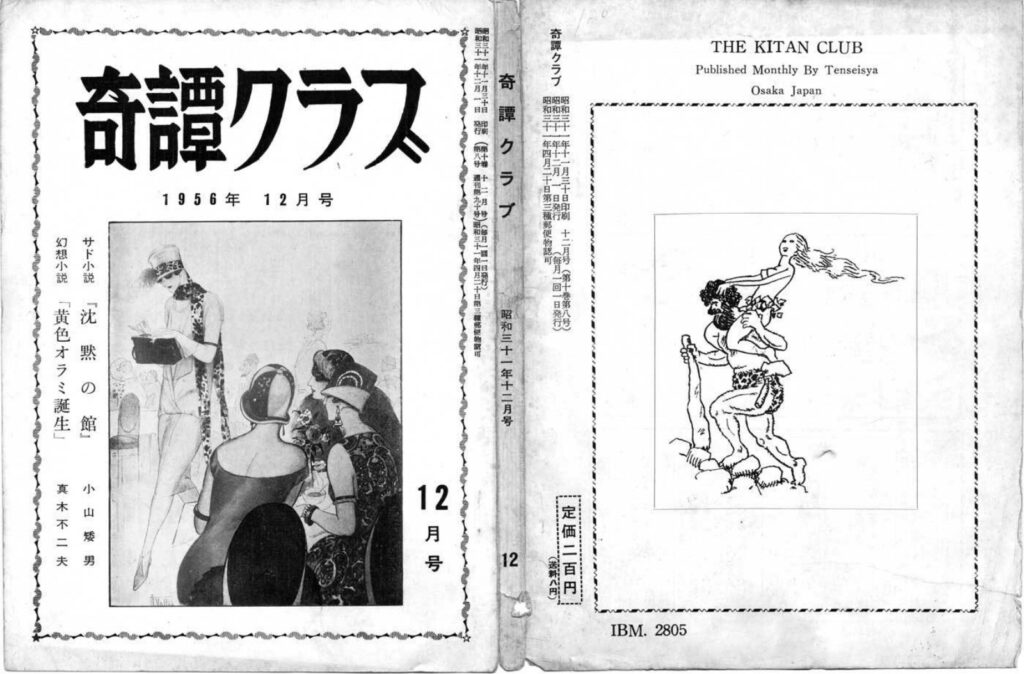
December 1956
← Back to magazine archive
Issue Details
- Volume
- 10
- Issue
- 8
- PDF pages
- 175
Summary
The December 1956 issue of Kitan Club combines illustrated fiction, personal testimony, cultural criticism, behavioral case studies, medical and psychological discussion, translated or adapted material, and an extensive reader-oriented back section. Its editorial identity rests on the constant movement between fantasy and documentation: bondage and punishment appear as motifs in stories and drawings, but also as subjects of correspondence, newspaper commentary, clothing analysis, psychiatric inquiry, and reports on contemporary film and print culture.
Read full summary Close full summary
Table of Contents 40 items
-
New Photograph Introduction, Part One
Summary
A photographic portfolio presenting staged images of a woman in rope restraints and constrained poses.
-
Ideyu
Summary
An illustrated bondage fantasy by Kitahara Junko, credited as adapted from work by Yoshiaki Izumi, depicting women restrained with rope in domestic and architectural settings.
-
Restrictive Clothing and Masks
Summary
A visual feature displaying restrictive clothing, masks, and other staged forms of bodily concealment and restraint, including a masked figure attended by another person.
-
Modern Masochism Art Review, Reprint Series No. 12
Summary
A reprint-series visual review of modern masochism, illustrated with photographs of women performing in close contact with tigers before an audience.
-
Takireiko Sketch Collection
Summary
A two-page sketch portfolio by Takireiko presenting nude female figures in varied, suggestive poses and arrangements.
-
New Euro-American Style, Part Four
Summary
The fourth installment of “New Euro-American Style,” a La Bonda illustration depicting a stylized group restraint pose involving several women.
-
Depictions of Torment in Literature
Summary
This literary essay surveys depictions of torment, coercion, restraint, and punishment in Japanese narrative works, using historical erotic fiction and accompanying illustrations to examine how scenes of female captivity and suffering are constructed.
-
Newspaper and Magazine Communications: Homosexuality Among American Soldiers in Shimbashi
Summary
A sensational news-style report describes two American soldiers in Shimbashi whose same-sex relationship culminates in a joint suicide attempt, with one soldier found dead and the incident reported to the police.
-
My Loincloth, Part Two
Summary
In this autobiographical continuation, the author discusses a personal fascination with wearing a fundoshi and related underwear, describing bodily sensations, appearance, domestic experiences, and changing clothing practices through text and illustrations.
-
Interest in the Same Sex Rather Than the Opposite Sex
Summary
A sexological advice essay considers a seventeen-year-old boy’s stronger interest in male friends than in women, attributing his feelings to developmental and environmental factors while discussing the possibility of same-sex desire.
-
The House of Silence
Summary
A serialized, heavily illustrated crime-and-captivity narrative follows a couple and prison authorities through abduction, interrogation, confinement, bondage, corporal punishment, and eventual execution, emphasizing elaborate scenes of coercion and suffering.
-
Corset Mambo
Summary
A first-person erotic account centers on a woman being tightly laced into a corset and subjected to prolonged restraint, physical discomfort, and enforced movement while the narrator reflects on the garment’s sensory and fetish appeal.
-
The Attraction of Skirts
Summary
An essay explores the author’s fascination with women’s skirts, discussing skirt styles, movement, fabric, and the erotic impressions they evoke through personal observations and anecdotes.
-
Adolescence: Letters Between Mother and Child
Summary
An epistolary account traces an adolescent’s development through letters exchanged with his mother, covering family concern, physical growth, sumo training, and the emotional distance and attachment between parent and child.
-
The Bride of the Prison
Summary
A historical erotic narrative set in the Edo period depicts a woman abducted and confined as a “prison bride,” with scenes of coercion, physical restraint, humiliation, and sexual domination.
-
The Birth of the Yellow Orami
Summary
A serialized erotic fantasy follows Sakai’s encounters in an imaginary female-ruled society where men are captured, restrained, humiliated, and subjected to coercive conditioning by powerful women, including the ruler Una and the mysterious Yellow Orami.
-
Proposal for an Exhibition of Women Bound in Japanese Dress
Summary
This proposal outlines an exhibition and discussion event devoted to women bound in traditional Japanese dress, combining photographs, drawings, demonstrations, and research into the techniques and visual presentation of kinbaku.
-
Ideas for Images of Beautiful Women
Summary
The article presents scenario ideas for staged erotic contests involving beautiful women, including wrestling, martial arts, and other physical confrontations that emphasize female strength, rivalry, domination, and dramatic spectacle.
-
Through the Light, Final Installment
Summary
The concluding installment of a sensational hospital reportage examines psychiatric patients, ward life, staff practices, sexuality, abuse, and the need for more humane institutional care.
-
In Praise of Eyelashes
Summary
An essay celebrates women’s armpit hair as a natural bodily feature, contrasting it with modern grooming norms and exploring its visual and erotic appeal.
-
Female Warrior with a White Blade
Summary
This illustrated historical erotic fiction follows female warriors amid battlefield combat, captivity, sexual coercion, bodily violence, and self-sacrificial death during Japan’s summer campaigns.
-
From a Dreamer’s Notebook
Summary
A collection of erotic dream scenarios depicting bondage, sexual service, interracial and occupation-era fantasies, and unequal relationships between Japanese women and foreign men. The pieces mix imagined encounters with commentary on gender, desire, and postwar sexual culture.
-
Fantasy of Ugliness
Summary
A serialized erotic fantasy follows a woman undergoing medical treatment and surgical intervention before becoming the focus of fetishistic observation, restraint, humiliation, and sexualized caregiving. Its scenes move between hospital settings and domestic encounters, emphasizing bodily alteration, disability, and masochistic submission.
-
Collected Manuscript Gleanings
Summary
An editorial compilation of submitted manuscripts and autobiographical writings, presenting readers’ erotic fantasies, bondage and punishment scenes, gendered power struggles, and personal sexual recollections alongside editorial framing and commentary. The section demonstrates the magazine’s role as a venue for participatory erotic writing and reader exchange.
-
The Person with an Afflicted Soul
Summary
A psychologically intense erotic narrative follows an artist and her associates through obsessive attraction, illness, confinement, and scenes of coercive bondage and physical abuse. The accompanying illustrations reinforce the story’s staged, dramatic atmosphere.
-
My Image: F4’s Soliloquy
Summary
A first-person “F4” soliloquy presents erotic bondage imagery and detailed descriptions of tying, restraint positions, bodily sensation, and submission, accompanied by illustrations of bound figures.
-
Two Confessions
Summary
Two first-person confessions explore erotic fascination with men’s hairy legs and bodies, moving between personal encounters, fantasy, voyeuristic observation, and sexualized memories of body hair.
-
The Domesticated Human Yapoo
Summary
This serialized erotic fantasy follows Japanese protagonists who are captured and reduced to domesticated “Yapoo,” combining futuristic racial hierarchy with bodily transformation, forced service, humiliation, and bondage. The narrative repeatedly stages coercive sexualized control through restraint, punishment, and the conversion of human bodies into apparatuses or tools.
-
Feminization Desire and an Experimental Record of Female-Hormone Use
Summary
This article examines the desire for feminization and presents an experimental record of male subjects using female hormones, describing changes in body shape, skin, hair, breasts, voice, and sexual function alongside medical risks and commercially available hormone preparations. It combines personal testimony with sexological and quasi-medical discussion of hormone treatment.
-
The Experience of Itohime
Summary
Presented as Itohime’s personal experience, this account describes the use of female hormones and the resulting feminization of the body, including breast development and other physical changes, while recounting medical consultations, adverse symptoms, and anxiety about possible illness. The narrative is framed as an intimate testimony concerning gendered embodiment and hormone use.
-
Dust-Basket Diary
Summary
A serialized erotic fiction diary follows the increasingly coercive relationship between Kōsuke and Kimiko, portraying domestic domination, restraint, humiliation, corporal punishment, bodily fetishism, and psychological cruelty through a succession of staged encounters.
-
From Recent Films
Summary
A short film-oriented feature reflects on eroticized images and scenarios of domination, emphasizing the visual construction of fetishistic spectacle and the viewer’s response to it.
-
The World of Beauty and Fetishism
Summary
A concluding feature explores beauty through fetishistic visual and bodily motifs, presenting stylized erotic imagery that links physical appearance, clothing, pose, and desire.
-
The Female Warrior Tayū
Summary
A dramatic account of a female gidayū performer whose demanding artistic life is intertwined with illness, marriage, family tensions, and emotional sacrifice.
-
Bondage Film News
Summary
A roundup of contemporary films featuring women subjected to bondage, handcuffing, gagging, captivity, pursuit, and other sensational restraint scenarios, with brief plot and cast details.
-
Deaths Caused by Restraint and Sound-Suppression Devices
Summary
A sensational report examines police investigations into nude photography and the circulation of images depicting women in compromising or restrained poses, asking where artistic beauty ends and obscenity begins.
-
A Proposal to Form a Masochists’ Club
Summary
Yamada Masao proposes forming a masochists’ club to provide discreet fellowship, mutual understanding, correspondence, and opportunities for members to share their interests.
-
Local Reports and Correspondence
Summary
A mixed news and correspondence section reports local incidents, police and custodial matters, restraint-related accidents and deaths, film activity, and reader or contributor communications from around Japan.
-
Modern Masochism Art Review
Summary
Hara Tadamasa reviews modern masochist art through illustrated self-images and staged scenes, discussing how bodily presentation, clothing, restraint, humiliation, and fetishistic fantasy are represented visually.
-
Reader Correspondence, Editorial Replies, and Publication Notices
Summary
A multi-page reader-correspondence section presents letters and editorial replies about erotic experiences, fetish interests, bondage and punishment practices, personal relationships, and reactions to the magazine, alongside publication notices, submissions guidance, and announcements concerning forthcoming issues and related materials.
Highlights
- The opening portfolio juxtaposes Western bondage photography, Japanese illustrations of women restrained in domestic settings, drawings from Takireiko’s notebooks, and La Bonda’s European-style imagery. (PDF pp. 6–13).
- Fujimi Iku’s “Depictions of Torment in Literature” surveys scenes of coercion, execution, sexual violence, and female suffering in historical and popular writing. (PDF pp. 15–25).
- The newspaper and magazine communications section addresses American soldiers, homosexuality, clothing, and same-sex attraction as contemporary social questions. (PDF pp. 26, 30).
- Koyama Takeo’s “The House of Silence” is an extended institutional melodrama involving imprisonment, religious discipline, interrogation, corporal punishment, and execution. (PDF pp. 31–43).
- “Adolescence: Letters Between Mother and Child” offers a detailed account of youth sumo training, ritual clothing, practice, public competition, and the emotional relationship between a young wrestler and his mother. (PDF pp. 47–50).
- Naruyama Nōhei’s play “The Bride of the Prison” treats confinement, loyalty, marriage, and authority through a formal theatrical structure. (PDF pp. 51–56).
- The paired essays on exhibitions of bound women in Japanese dress and ideas for images of beautiful women document the magazine’s interest in costume, posing, staging, and the production of fetish art. (PDF pp. 67–70).
- Numa Shōzō’s later contributions connect fantasy, discipline, domestication, transformation, and the symbolic reduction of human beings to controlled or animalized roles. (PDF pp. 85–89, 121–133).
- The late issue includes testimony and discussion concerning feminization, female hormones, cross-gender identity, and embodied transformation. (PDF pp. 134–147).
- The closing news, criticism, and correspondence sections cover bondage films, restraint-related fatalities, club organization, foreign publications, reader experiences, and editorial community-building. (PDF pp. 148–175).
Contributors
Named contributors represented in this issue:
- Aoba Kaede
- Awami Ichirō
- Azuma Ichirō
- Editorial Department
- Fujimi Iku
- Fujiyama Hide緒
- Furui Masataka
- Hara Tadamasa
- Hatamura Hajime
- Hayashi Yasuhiko
- Kitahara Junko
- Konishi Tetsuji
- Koyama Takeo
- Kuga Kiei
- Kumoi Hisako
- La Bonda
- Maki Fujio
- Matsubara Michiyo
- Naruyama Nōhei
- Numa Shōzō
- Takahashi Yoshie
- Takireiko
- Yagiri Jūhachi
- Yamada Masao
- Yamaguchi Kōichi