Uramado
July 1959
← Back to magazine archive
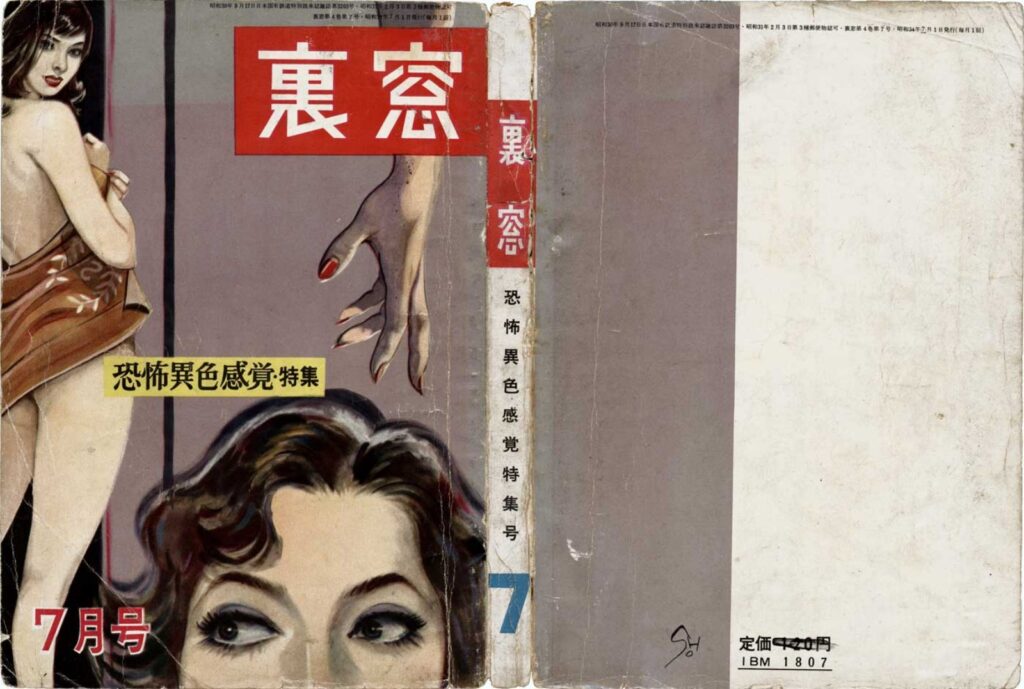
Issue Details
- Volume
- 4
- Issue
- 7
- PDF pages
- 291
Summary
The July 1959 issue of Uramado is organized around a prominent Special Feature on Terrifying Unusual Sensations, combining erotic horror, punishment imagery, supernatural fiction, crime, fetishism, historical inquiry, illustrated narratives, and photography. The opening pages establish this hybrid character immediately. The illustrated Hell Screen presents a sequence of scenes involving nudity, restraint, violence, and grotesque fantasy, followed by Fujisawa Osamu’s Selected Nude Masterpieces, a studio portfolio emphasizing the isolated nude body against a dark background. An editorial miscellany, From the Unsorted Files, then reflects on reader submissions and the magazine’s taste for unusual and psychologically charged material.
Read full summary Close full summary
Table of Contents 23 items
-
Illustrated Tale: Hell Screen
Summary
An illustrated historical erotic tale follows the violent entanglements of figures including 長吉, お絹, 鬼丸, and 秀勇, using rope bondage, captivity, coercion, and supernatural or grotesque imagery to dramatize desire and terror.
-
Selected Nude Masterpieces
Summary
A photographic portfolio presents nude models in a series of carefully arranged, dramatic poses against dark studio backgrounds, emphasizing bodily form, gesture, and staged erotic display.
-
From the Unsorted Files
Summary
This editorial miscellany from the magazine’s unsorted files discusses submitted manuscripts and illustrations, comments on editorial selection and revision, and presents excerpts or concepts involving erotic fiction, rope figures, supernatural motifs, and fetish imagery.
-
The Hanging House
Summary
A serialized supernatural erotic tale set around the Musashiya house, where the spirits of abused and murdered women, strange apparitions, and uncanny transformations draw characters into a cycle of fear, revenge, binding, and hanging. Illustrated scenes emphasize the haunted house, female figures in restraint, and grotesque encounters between the living and the dead.
-
Madam, Your Hand Please
Summary
A serialized erotic narrative follows actress Yumiko through coercive encounters involving abduction, restraint, staged photography and film production, police intervention, and repeated domination by men. The story blends sensational reportage conventions with eroticized captivity and punishment scenes.
-
Female Hara-Kiri in History and Fiction
Summary
This illustrated historical-literary study examines female hara-kiri and related forms of ritual self-sacrifice in Japanese history, comparing documented cases with fictional and theatrical representations. It discusses gendered violence, historical sources, and the eroticized depiction of women’s suffering and execution.
-
Servant of the Feet
Summary
A first-person erotic narrative traces a man’s lifelong obsession with women’s feet, from childhood discoveries through adult encounters involving observation, touch, footwear, stockings, and covert fetishistic behavior. The account presents this fixation as a secretive personal history unfolding across domestic, social, and workplace settings.
-
The Samurai with Two Faces
Summary
A serialized Edo-period erotic horror tale follows samurai Kaneda Sanshiro through sinister dreams, uncanny transformations, violent swordplay, and encounters with a mysterious woman whose shifting faces blur the boundary between supernatural threat and human desire. The narrative includes repeated scenes of captivity, binding, pursuit, and psychological terror.
-
Female Intelligence Agent
Summary
A serialized illustrated espionage fantasy follows a female intelligence agent infiltrating enemy territory, being captured, and enduring interrogation, confinement, forced undressing, physical restraint, and humiliating abuse before attempting escape and rescue. The narrative combines wartime intrigue with intensely coercive and sexualized captivity scenes.
-
Inside the Gray Walls
Summary
A serialized first-person account of prison life follows inmates through intake, solitary confinement, labor, discipline, meals, entertainment, family contact, pardon procedures, and the emotional pressures of incarceration, including male same-sex relationships among prisoners. Illustrated scenes reinforce its sensational, documentary-style portrayal of institutional life and punishment.
-
Aikuchi (Dagger)
Summary
A serialized sensational erotic crime narrative follows Osawa through encounters involving coercion, restraint, sexual menace, and repeated dagger attacks, culminating in revenge and murder. The continuing story shifts between violent confrontations and scenes of captivity, humiliation, and fear involving men, women, and a teacher figure.
-
The Gallows Bed
Summary
A crime-mystery narrative follows the investigation of a strangled woman discovered bound to a bizarre “gallows bed,” with shifting testimonies, suspects, and clues involving rope restraint and sexual intrigue.
-
Strange Museum
Summary
A fictionalized visit to a strange museum presents an eccentric collection of historical, foreign, and fetish-related objects while exploring their uses, origins, and the unsettling fascination they hold for visitors.
-
Hair Wheel
Summary
A serialized erotic narrative follows Snowe, a woman celebrated for her exceptionally long black hair, through courtship, marriage, jealousy, and increasingly coercive and violent fantasies surrounding male desire and control.
-
Mystery of the Heike Village
Summary
A serialized grotesque horror tale follows two traveling medicine merchants who enter a secluded former Heike settlement, where an uncanny female-led community subjects men to bizarre restraints, punishments, and transformations before the travelers struggle to escape.
-
The Cursed Old Man
Summary
A first-person supernatural horror narrative recounts a series of disturbing encounters involving a cursed elderly man, his wife, occult-like phenomena, and increasingly grotesque bodily and psychological transformations.
-
Tales of Supernatural Strangeness
Summary
A serialized collection of sensational Edo-period tales recounts murders, executions, strange deaths, cannibalism, criminal women, tattooing, imposture, and other grotesque incidents drawn from historical anecdotal sources.
-
The Lady and the Dog
Summary
A serialized erotic SM narrative about a wealthy woman who subjects a man to dog-like service, physical discipline, humiliation, and increasingly demanding domestic and sexual control.
-
The Two-Headed Killer
Summary
An illustrated film feature recounting a grotesque supernatural crime story in which a scientist’s experiments produce a murderous two-headed creature pursued by police and investigators.
-
Phantom Samurai: Hama Calendar - Hell of Congealed Fat
Summary
An illustrated serialized erotic adventure set in an Edo-period milieu follows a woman captured and subjected to elaborate rope restraint, humiliation, and coercive sexual violence before being transported toward a remote island.
-
Gift from the Dead
Summary
A serialized erotic crime thriller follows a married couple whose financial troubles, illicit desires, and encounters with a mysterious dead woman draw them into deception, murder, investigation, and psychological terror. The narrative is interspersed with bondage-oriented erotic illustrations depicting restraint, pursuit, captivity, and threatened violence.
-
The Murderous Doll
Summary
A serialized horror narrative follows a couple, a child, and a sinister doll-like presence as unsettling perceptions, psychological disturbance, and violent deaths converge around an apparently murderous supernatural force.
-
Tattoo
Summary
A historical erotic adventure set at a mountain inn during torrential flooding depicts travelers, a female bandit, and male criminals becoming entangled in pursuit, coercion, betrayal, and violent struggle.
Highlights
- Hell Screen opens the editorial body with a heavily illustrated sequence in which nudity, restraint, punishment, and grotesque fantasy are presented in a deliberately archaic pictorial mode. (PDF pp. 6–13).
- Fujisawa Osamu's Selected Nude Masterpieces uses an almost entirely black studio background to isolate the model's body through a succession of curled, reclining, kneeling, and extended poses. (PDF pp. 14–19).
- The Hanging House is one of the issue's longest special-feature narratives, developing a claustrophobic mystery around hanging deaths, hidden architectural spaces, suspicious household members, and repeated threats of strangulation. (PDF pp. 29–46).
- Female Hara-Kiri in History and Fiction examines the representation of women's self-disembowelment in historical materials, theatrical traditions, and fiction, linking scholarship with the issue's larger fascination with bodily extremity. (PDF pp. 59–68).
- Servant of the Feet turns explicitly to foot fetishism, using illustrations and narrative commentary to explore submission, desire, and erotic fixation on women's feet. (PDF pp. 69–80).
- Female Intelligence Agent is an extended illustrated espionage narrative involving clandestine organizations, surveillance, interrogation, and sexualized danger. (PDF pp. 97–112).
- Inside the Gray Walls adopts the voice of prison recollection and shifts the special issue from supernatural terror toward confinement, punishment, criminality, and institutional life. (PDF pp. 113–126).
- Hair Wheel by Shima Fuji combines black-hair fetishism with an uncanny narrative of three brothers, presenting hair simultaneously as erotic object, visual motif, and source of menace. (PDF pp. 164–174).
- The late sequence from Gift from the Dead through The Murderous Doll returns forcefully to the issue's central mixture of death, supernatural revenge, erotic danger, and illustrated grotesquerie. (PDF pp. 243–274).
- Tattoo occupies the final major narrative position, bringing together criminal milieu, bodily inscription, erotic attraction, and violence before the magazine's closing notices and editorial material. (PDF pp. 275–286).
Contributors
Named contributors represented in this issue:
- Enjōji Tatsu
- Fujimi Iku
- Fujisawa Osamu
- Hasegawa Isamu
- Henjūshi
- Kuroba Shin
- Kuroki Shinobu
- Makido Nobuo
- Misaki Yōnosuke
- Naka Yasuhirō
- Nakabayashi Setsuzō
- Nakajima Yoshimi
- Narutaki Saburō
- Sakata Osamu
- Shima Fuji
- Shimamoto Haruo
- Shintani Yoshimi
- Suzuki Kazuo
- Tōge Kōsuke
- Toyama Kazuhiko
- Yakiri Jūhachi
- Yoda Seiichi