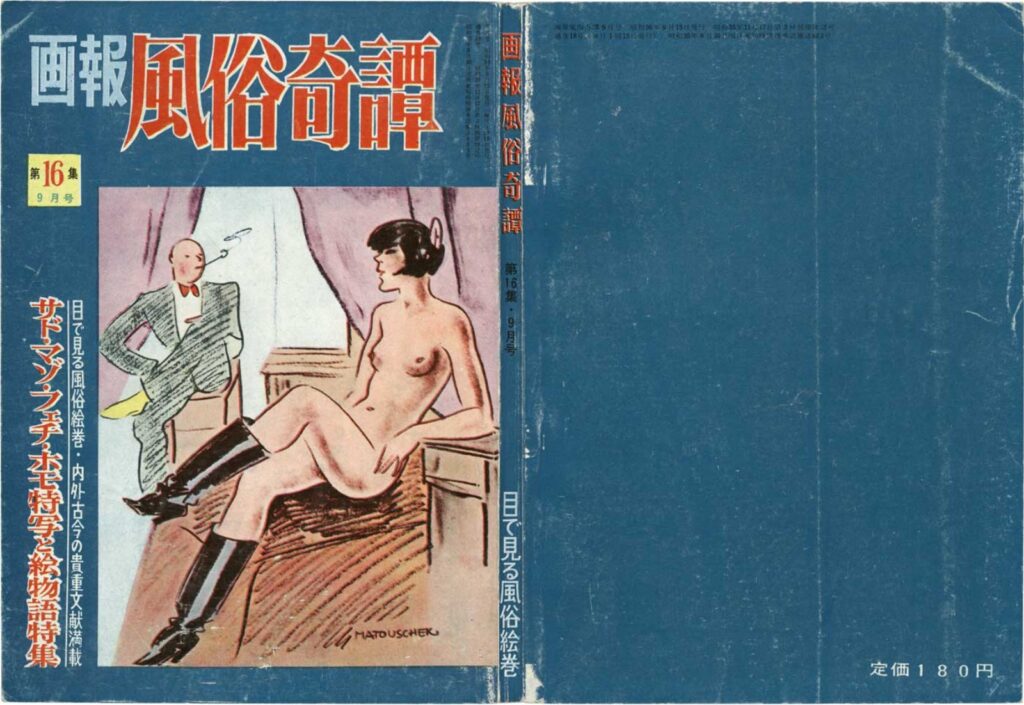
Gaho Fuzoku Kitan
September 1961
← Back to magazine archive
Issue Details
- Issue
- 16
- PDF pages
- 97
Summary
The September 1961 issue of Gaho Fuzoku Kitan, identified on its cover and contents as the sixteenth installment, is organized around an unusually large body of staged bondage photography, supplemented by erotic illustration, fiction, translated or adapted Western material, reader-oriented features, advertisements, and publisher back matter. Its visual identity is dominated by rope as both restraint and spectacle. The principal opening gravure, Sixty Poses of Women in the Ecstasy of Bondage and Torment, moves through boats, stone steps, domestic interiors, gardens, bars, and outdoor locations. The photographs emphasize changes in posture, environment, rope placement, and facial expression, with models posed seated, standing, crouching, bound to furniture or architectural features, and restrained against trees and rough outdoor structures.
Read full summary Close full summary
Table of Contents 9 items
-
Sixty Poses of Women in the Ecstasy of Bondage and Torment
Summary
A photographic portfolio presents women in staged scenes of bondage and torment, showing varied rope restraints, immobilized positions, outdoor settings, suspension, and sensory or pain-oriented tableaux. Captions frame the images as explorations of the psychological and sensory effects of restraint.
-
Six Scenes of Bridge Torment
Summary
A visual feature presents six staged scenes of a woman restrained beneath, beside, and above bridges, emphasizing ropes, suspension, and exposed urban or riverside settings.
-
Kyōda Doll Workshop
Summary
This illustrated erotic narrative visits the secretive Kyōda Doll Workshop, where women are abducted, restrained, and treated as living models or materials for the workshop’s disturbing doll-making practices.
-
Chains and Woman
Summary
A short visual feature depicts a woman bound with chains in a series of staged indoor poses, including immobilization against furniture and other forms of positional restraint.
-
The Cruel Tattoo Hell
Summary
A period erotic picture-story about a tattoo master who subjects women to forced tattooing and escalating bodily torment in a sensational historical setting.
-
Three Women Captured by Indians
Summary
An illustrated captivity fantasy recounts three women being abducted by Indians and subjected to restraint, humiliation, and sexualized coercion during an imagined frontier adventure.
-
Design for Insect Torment
Summary
An illustrated erotic narrative presents an elaborate insect-torment scenario in which a restrained woman is exposed to ants and other insects as part of escalating sensory and bodily punishment.
-
The Man Without a Middle Finger
Summary
A crime-themed erotic narrative follows a wanted, middle-fingerless criminal who abducts the singer Sarii and subjects her to captivity, bondage, gagging, humiliation, and electrical torment while police pursue him. Illustrated scenes emphasize the victim’s physical restraint and the criminal’s coercive control.
-
Readers' Forum
Summary
The Readers’ Forum presents correspondence, reader-submitted photographs and drawings, personal reactions, requests, and editorial responses, functioning as a participatory community space around the magazine’s erotic and bondage-oriented content.
Highlights
- The principal opening gravure, Sixty Poses of Women in the Ecstasy of Bondage and Torment, constitutes an extended photographic taxonomy of rope restraint across boats, steps, gardens, rooms, a bar, trees, and other environments. (PDF pp. 6–37).
- Several photographs deliberately integrate restraint with the physical environment, including bondage in a small boat, on stone steps, against trees, around furniture, and at a bar counter. (PDF pp. 7–8, 11–12, 17–20, 29–34).
- Six Scenes of Bridge Torment uses red-toned illustrations to imagine suspension from bridge beams and arches by wrists, ankles, and complex rope configurations. (PDF pp. 38–45).
- Kyōda Doll Workshop combines prose reportage and illustration around the manufacture of realistic female dolls, treating artificial bodies as objects of erotic fascination and manipulation. (PDF pp. 46–52).
- The Cruel Tattoo Hell by Akagi Keisuke presents an Edo-period sadistic narrative involving coercion, tattooing, and bodily punishment, with illustrations by Oda Toshimi. (PDF pp. 55–61).
- Nutrix Corner's Three Women Captured by Indians introduces Western captivity and bondage imagery, combining translated or adapted narrative with American-style fetish illustrations. (PDF pp. 62–70).
- Design for Insect Torment by Jinbo Yoshichirō constructs an elaborate fictional torment scenario centered on insects, fear, immobilization, and bodily sensation. (PDF pp. 71–77).
- The Man Without a Middle Finger by Sakakibara Fumio shifts into contemporary crime fiction involving captivity, interrogation, and sexualized violence. (PDF pp. 79–84).
- The closing Readers' Forum records questions, personal observations, erotic interests, and editorial responses, providing evidence of the magazine's active reader community. (PDF pp. 93–97).
Contributors
Named contributors represented in this issue: