Beautiful Bondage
February 1964
← Back to magazine archive
Issue Details
- Issue
- 1
- PDF pages
- 32
Summary
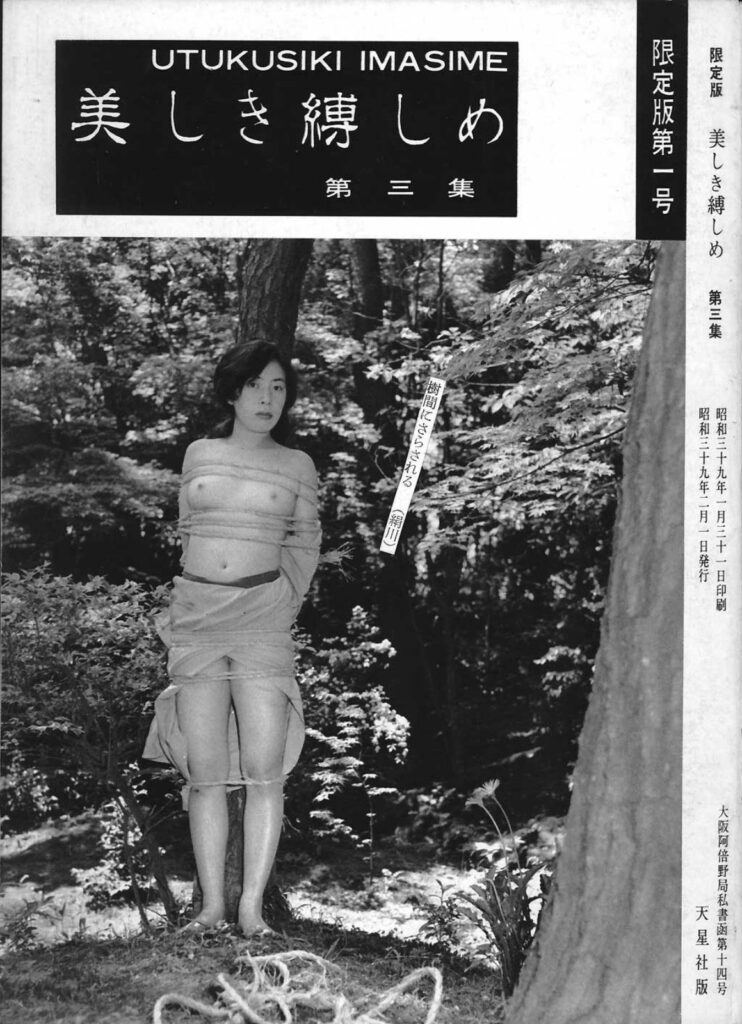
This February 1964 limited edition of Beautiful Bondage is a compact, almost entirely photographic publication devoted to the visual documentation of Japanese rope bondage. The cover identifies the work as 美しき緊しめ 第三集, the third collection in the Beautiful Bondage series, while also marking it as Limited Edition No. 1. Rather than following the mixed editorial structure of contemporary SM magazines, the publication dispenses with essays, fiction, correspondence, and conventional front matter and presents bondage photography as its principal and effectively exclusive subject.
Read full summary Close full summary
Loading PDF…
Highlights
- The cover presents the publication as the third Beautiful Bondage collection and Limited Edition No. 1, using an outdoor tree-side bondage photograph to establish the volume's exclusive focus on rope restraint. (PDF p. 1).
- The opening interior pages establish the portfolio format through multiple photographs per page, pairing nude or partially clothed models with short vertical captions naming or characterizing specific restraints, including gags, torso ropes, and behind-the-back arm positions. (PDF pp. 2–5).
- A broad middle sequence demonstrates considerable variation in rope technique, including overhead wrist restraint, chair and floor bondage, chained ankles, torso harnesses, rope compression across the breasts, and combinations of rope with cloth gags. (PDF pp. 6–13).
- Several photographs emphasize the physical and aesthetic effects of bondage rather than simply recording a pose, concentrating on strained posture, rope impressions, displaced clothing, bodily compression, and the models' expressions under restraint. (PDF pp. 14–18).
- The later portfolio expands the repertoire to include upright, kneeling, seated, architectural, and floor-based positions, along with neck ropes, crotch ropes, wrist-to-structure ties, and densely wrapped upper-body bindings. (PDF pp. 19–24).
- Pages 25–31 function particularly strongly as a visual catalog of contrasting techniques, showing variations in rear wrist restraint, chest harnessing, school or sailor-style clothing, outdoor bondage, full standing ties, and rope patterns viewed from both front and back. (PDF pp. 25–31).
- The final page combines a full-page bondage image with the colophon, identifying Tenseisha of Abeno, Osaka as publisher, the edition as No. 1, the price as 1,000 yen, and explicitly stating that the publication is not sold through bookstores. (PDF p. 32).