Uramado
February 1961
← Back to magazine archive
Issue Details
- PDF pages
- 8
Summary
This February 1961 Uramado segment consists entirely of Selected Masterpieces of Pleasurable Torment Photography, an eight-page bondage portfolio selected and compiled by the editorial department. The photographs present a single female model in a spare interior equipped with modern chairs, wooden flooring, paneled walls, and minimal furnishings. Unlike a narrative picture story, the sequence contains no captions or prose beyond the opening title and editorial credit. Its emphasis is therefore wholly visual: rope placement, posture, furniture, exposure, and the changing relationship between the bound body and the surrounding space.
Read full summary Close full summary
Loading PDF…
Highlights
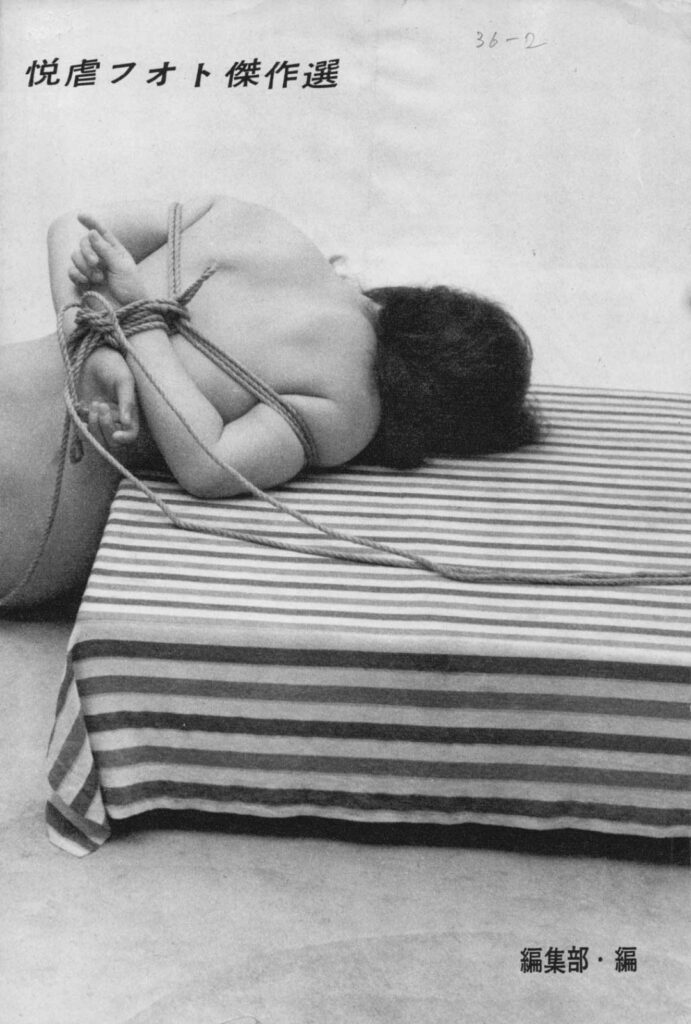
- The opening page identifies the portfolio as Selected Masterpieces of Pleasurable Torment Photography and credits its selection and compilation to the editorial department. (PDF p. 1).
- The first image uses a tightly compressed reclining pose on a striped-covered platform, with the wrists restrained close to the torso and rope crossing the upper body. (PDF p. 1).
- A tubular rocking chair becomes an important restraint and compositional device, integrating furniture, rope, and the model's limbs into a single visual structure. (PDF pp. 2,7).
- Several photographs emphasize the back of the model and the rope arrangement around the upper arms and wrists, making the construction of the restraint especially visible. (PDF pp. 4,6–7).
- The sequence varies between kneeling, seated, and reclining positions, showing how a related upper-body restraint can be photographed as a series of distinct bodily forms. (PDF pp. 2–7).
- A folding ladder or wooden support is incorporated into one nude rear-view composition, extending the portfolio's interest in using ordinary furniture as part of bondage staging. (PDF p. 6).
- The final photograph isolates the model's lower body on a platform while loose rope lies in the foreground, ending the portfolio with a more abstract composition in which the rope itself becomes a visual object. (PDF p. 8).