Uramado
December 1964
← Back to magazine archive
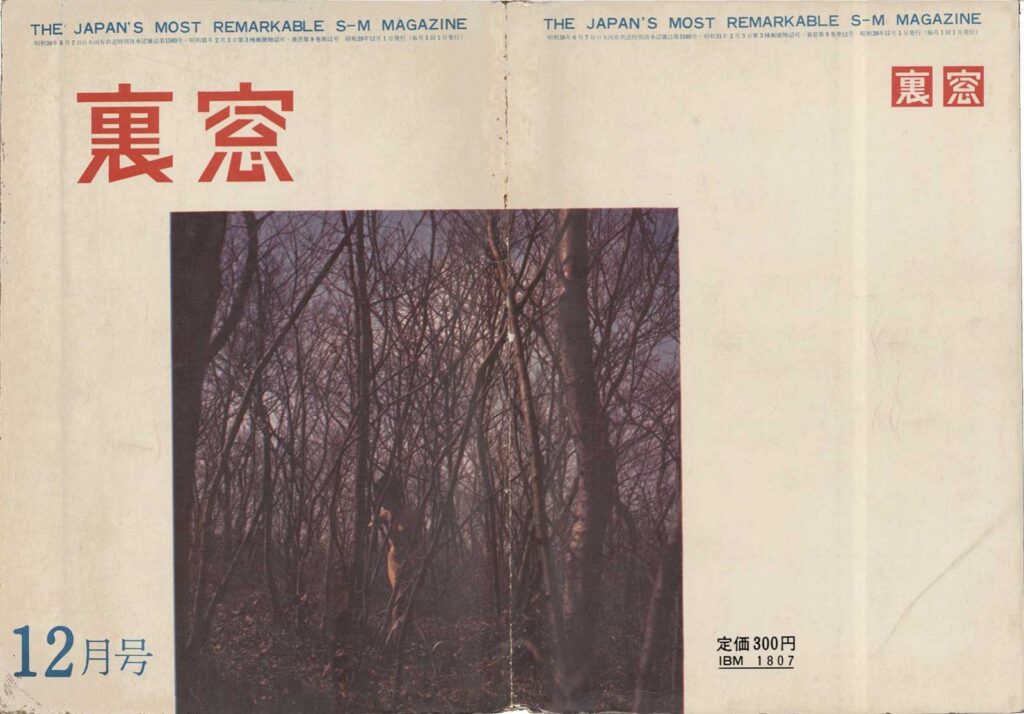
Issue Details
- Volume
- 9
- Issue
- 12
- PDF pages
- 212
Summary
Uramado’s December 1964 issue is a large, densely illustrated SM and popular-culture magazine combining serialized fiction, literary criticism, erotic photography, film commentary, reader correspondence, publishing notices, and extensive commercial back matter. Its editorial identity rests on the interaction of sensational narrative and visual culture: stories of captivity, domination, punishment, psychological disturbance, and forbidden desire are repeatedly accompanied by drawings, photographic plates, film stills, or promotional illustrations.
Read full summary Close full summary
Table of Contents 18 items
-
The Wheel of Cause and Effect
Summary
A serialized narrative of erotic coercion, restraint, humiliation, jealousy, and changing power between its protagonists. Money, status, family background, and social reputation are entangled with repeated reversals of dominance.
-
The Story of Death Island
Summary
An illustrated captivity and conspiracy narrative following police pursuit, interrogation, imprisonment, torture, political violence, and attempted escape on an isolated authoritarian island. The story links criminal organizations, official punishment, corruption, and the objectification and resistance of women prisoners.
-
Hall of Blazing Fire
Summary
A period-style adventure of abduction, bondage, sexualized violence, jealousy, rivalry, captivity, and death. Historical or pseudo-historical martial imagery and criminal hierarchies frame the struggle between vulnerable and coercive characters.
-
The Life of a Certain Slave
Summary
An extended visual narrative of a married couple performing disciplinary and bondage scenarios. A dominant female partner directs the husband through commands, whipping, restraint, humiliation, and theatrical domestic role-play.
-
The Pleasures of Miscellaneous News Items
Summary
An essay on the appeal of tabloid-style news about crime, accidents, scandal, politics, celebrities, family conflict, and social misfortune. It considers how readers combine moral judgment, curiosity, identification, and entertainment when consuming stories of suffering.
-
About the Film Marnie
Summary
A critical discussion of Alfred Hitchcock’s Marnie, addressing theft, childhood trauma, repression, sexuality, marriage, fear, and the film’s psychological construction. The essay also examines color, costume, suspense, performance, and cinematic staging.
-
Prayer to the Goddess Who Is Taken Away
Summary
A serialized narrative of domestication, confinement, commands, punishment, surveillance, sexual coercion, and unstable social power. Its characters move through relationships shaped by animalization, class hierarchy, obsession, resistance, and psychological domination.
-
On the Film Marnie
Summary
A critical discussion of Alfred Hitchcock’s Marnie, addressing theft, childhood trauma, repression, sexuality, marriage, fear, and the film’s psychological construction. The essay also examines color, costume, suspense, performance, and cinematic staging.
-
From My Collection, No. 2
Summary
A collection essay on women in long boots, whips, costume, posture, and visualized female authority. It compares drawings, fashion imagery, film-related pictures, and fetish photographs while discussing how clothing and stance construct erotic power.
-
SM Film Reviews
Summary
A recurring film-critical department focused chiefly on Daydream and Plants on the Sand. It considers erotic representation, adaptation, acting, direction, censorship, public controversy, and the cultural legitimacy of sexual imagery.
-
Uramado Literary Criticism: Truth Within the Mask
Summary
An essay on avant-garde art, masks, faces, walls, towers, and obstructed spaces as forms of psychological and social expression. It contrasts conventional representation with unusual visual forms and links artistic freedom to resistance against institutional and aesthetic constraints.
-
Gordon’s Memory: Readers’ Memories, No. 21
Summary
An illustrated speculative serial involving a theatrical performance, Gorilla Man, Sarea, Ueshima Emiko, Professor Nakamura, hypnosis, memory loss, an eternal queen, and uncertain boundaries between staged violence and supernatural reality. Its epilogue reconsiders identity, perception, and the meaning of the preceding events.
-
Editorial Afterword
Summary
The editors discuss reader responses, submissions, photographs, illustrations, and the magazine’s interest in unconventional erotic, psychological, and sensational subjects. The afterword explains the publication’s editorial position and continuing plans.
-
Readers’ Corner
Summary
A correspondence and community section presenting reader reactions, questions, interpretations, and editorial replies concerning the issue’s fiction, characters, imagery, and treatment of fear, memory, eroticism, and female authority.
-
In the Flowers
Summary
A narrative about Peach, a young woman whose beauty shapes her movement through domestic service, commercial work, relationships, jealousy, and social expectations. The story examines class mobility, gendered labor, emotional dependency, and the commodification of feminine appearance.
-
The Cage
Summary
A psychologically intense narrative of marriage, surveillance, confinement, coercive authority, threats, interrogation, and escape. Dreams, fear, disorientation, and sexualized violence complicate the protagonists’ experience of captivity.
-
The Scoliosis Girls’ Academy
Summary
Illustrated fiction set in an isolated English boarding school where Anne undergoes medical examinations, braces, traction, binding, corrective exercises, and increasingly coercive treatment. The story links class privilege, education, medical authority, bodily discipline, humiliation, and forced obedience.
-
Complete Index of Previous Issues
Summary
A catalogue of earlier Uramado issues listing dates, fiction and nonfiction titles, authors, illustrators, prices, special features, and promotional material. It documents the magazine’s continuing program of erotic fiction, picture stories, essays, mystery and occult themes, and visual publishing.
Highlights
- The formal contents spread documents the issue’s recurring departments, visual credits, serialized fiction, film criticism, and reader-oriented sections. (PDF pp. 4–5).
- The essay The Pleasures of Miscellaneous News Items examines crime, scandal, social suffering, morality, and the reader’s fascination with sensational journalism. (PDF pp. 8–13).
- The illustrated Maggie’s Villa combines a coercive female-centered narrative with large staged photographic plates of women, costume, restraint, and physical confrontation. (PDF pp. 34–39).
- The Story of Death Island develops an extended world of police pursuit, imprisonment, torture, political conspiracy, and attempted escape, supported by several illustrations. (PDF pp. 78–102).
- Scoliosis Girls’ Academy depicts a secluded girls’ school whose medical and educational regime relies on orthopedic braces, traction, immobilization, and enforced obedience. (PDF pp. 122–140).
- SM Film Reviews discusses Daydream and Plants on the Sand alongside debates about censorship, literary adaptation, erotic representation, and artistic freedom. (PDF pp. 148–156).
- About the Film Marnie analyzes Hitchcock’s treatment of trauma, repression, sexuality, criminality, marriage, and visual style, with accompanying film stills. (PDF pp. 175–180).
- Gordon’s Memory closes the fiction program with theater, violence, hypnosis, memory loss, an eternal queen, and uncertainty between performance and reality. (PDF pp. 190–205).
- Reader Corner and the editorial afterword reveal an active relationship between the magazine, its contributors, and readers responding to sensational fiction and erotic imagery. (PDF pp. 206–208).
Contributors
Named contributors represented in this issue: