Uramado
August 1959
← Back to magazine archive
Issue Details
- Volume
- 4
- Issue
- 8
- PDF pages
- 328
Summary
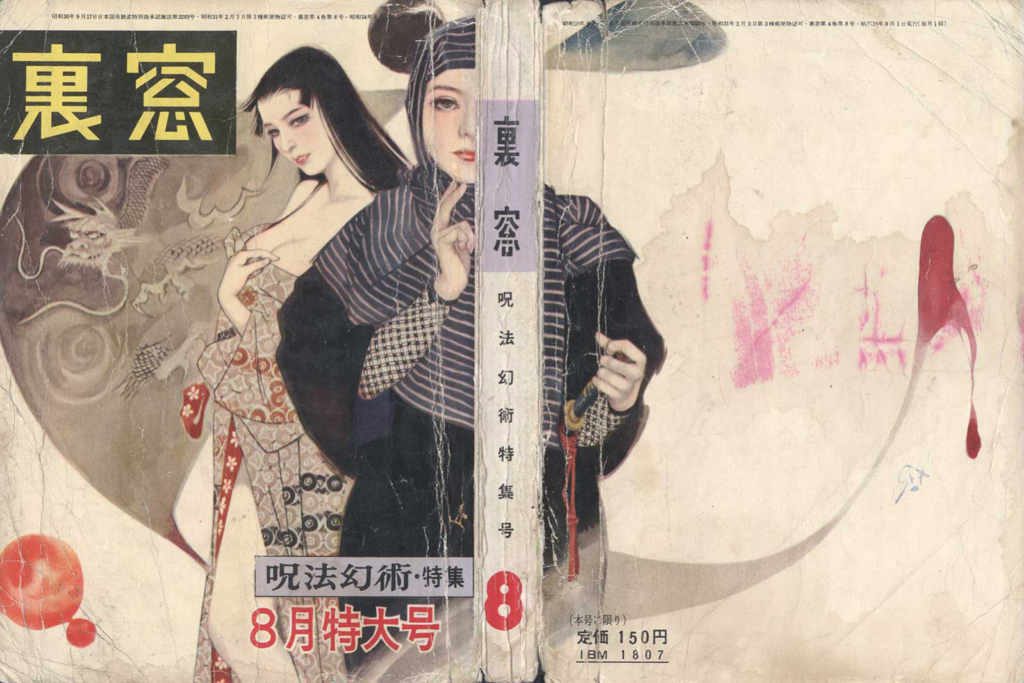
The August 1959 issue of Uramado is an unusually large special number built around curses, magical practices, occult fantasy, supernatural revenge, and illusion, while retaining the magazine’s characteristic mixture of erotic illustration, nude photography, fetish material, historical curiosity, crime, confession, and popular fiction. Its opening sequence juxtaposes the illustrated Beauty and the Beast, in which circus spectacle and coercive eroticism dominate the imagery, with Fujisawa Osamu’s stark Nude Masterpieces portfolio. From the Unsorted Shelf then shifts into first-person sexual confession and psychological reflection, reinforcing Uramado’s interest in abnormal desire as both fantasy and testimony.
Read full summary Close full summary
Table of Contents 25 items
-
Beauty and the Beast
Summary
An illustrated serialized SM story follows a woman captured and restrained by a physically imposing man, with rope bondage, coercion, escape attempts, and escalating confrontations involving additional captors. The narrative alternates between eroticized captivity scenes and dramatic visual tableaux of restraint.
-
Nude Masterpieces
Summary
A photographic feature presents a series of posed nude studies, emphasizing the body, dramatic lighting, sculptural composition, and carefully arranged erotic imagery.
-
From the Unsorted Shelf
Summary
A first-person confession examines a woman’s life with a husband who subjects her to increasingly elaborate bondage, discipline, collars, ropes, and other forms of control, while she reflects on desire, shame, fear, dependency, and whether she is truly a masochist. The account frames these practices within marriage and domestic life.
-
Ghostly Yin-Yang Master
Summary
An Edo-period supernatural erotic tale follows the diviner 彦兵衛 and the young お千代 as occult predictions, ghostly apparitions, possession, and increasingly elaborate acts of binding draw a household into a terrifying web of desire, violence, and death.
-
The Demon-Cursed Blind Doll
Summary
An illustrated Edo-period supernatural tale follows characters caught in a chain of occult curses, sinister apparitions, violent confrontations, and the mysterious “blind doll,” blending eroticized peril with grotesque horror. The narrative is accompanied by dramatic drawings depicting restraint, executions, haunted spaces, and uncanny transformations.
-
Strange Letter
Summary
A first-person gothic mystery begins when a cryptic letter draws the narrator into an unsettling household, where strange instructions, sinister encounters, and gruesome deaths gradually reveal a macabre chain of violence.
-
Strange Incident at the Hour of the Ox
Summary
A historical erotic fantasy follows rival figures whose jealousy and revenge culminate in a supernatural curse enacted through a straw effigy, needles, poison, and ritualized bodily torment. The narrative combines samurai-era intrigue with elaborate scenes of coercion, punishment, and death.
-
A Woman Digs a Hole
Summary
This sensational erotic crime narrative follows a woman and her associates as murder, concealment of a corpse, digging, pursuit, and threats unfold amid domestic and romantic conflict. Its scenes emphasize coercion, fear, bodily vulnerability, and violent revenge.
-
Magic-Trick Town
Summary
A supernatural erotic story set around an illusionist’s curious town, where visions of drowned women, mannequins, paintings, and uncanny transformations blur the boundary between reality and fantasy.
-
Andromeda Picture Story
Summary
An illustrated erotic fantasy in which an artist’s encounter with an imagined foreign woman develops into a sequence of scenes depicting her capture, chaining, immobilization, and submission.
-
Enburi: A Curse Song of Tohoku
Summary
A first-person narrator investigates a Tohoku curse song and recounts encounters with an unsettling old house, a troubled family, and a series of uncanny incidents linked to regional folklore and occult beliefs.
-
Revenge: Female Yasha Extract
Summary
An Edo-period supernatural revenge narrative follows a woman and her adversaries through curses, occult rites, disguises, violence, and schemes for retribution, accompanied by dramatic illustrations.
-
The Devil's Flute Makes Women Dance
Summary
Sugimoto Shun surveys overseas witchcraft, devil worship, curses, séances, and occult magic through sensational murder reports, ritual accounts, and discussions of supernatural fiction. Illustrated episodes of nude women dancing and apparent possession connect these beliefs to erotic fantasy, hypnosis, sexualized performance, and modern popular culture.
-
Troubled Married Women Tomoe
Summary
A serialized erotic narrative follows Tomoe and other married women through clandestine encounters, voyeuristic observation, seduction, blackmail, and humiliating sexual entanglements within a late-Edo-style merchant setting. Illustrated scenes emphasize secrecy, marital betrayal, coercive desire, and the shifting power between women, husbands, servants, and male pursuers.
-
History of Beautiful-Boy Seppuku
Summary
An illustrated historical-literary essay traces the motif of the beautiful young man’s seppuku through early-modern tales and legends, recounting doomed love, male-male bonds, loyalty, revenge, and ritual death in stories such as “Ichiyō no Koi,” “Mokuzu Monogatari,” and the account of Hidetsugu’s final moments.
-
Women's Intelligence Agent, 2
Summary
This illustrated serialized espionage fantasy follows the female agent Loi after her capture by enemy forces, depicting interrogation, coercive restraint, bondage devices, sensory and electrical punishments, and her eventual rescue by allied soldiers.
-
The Island of Strange Female Guardians
Summary
This historical erotic fantasy follows pirates who seize women on a mysterious island ruled by powerful female guardians, whose violent, supernatural authority overwhelms and ultimately destroys their captors.
-
Clouded Rear-Window Glass
Summary
Two reader essays reflect on the issue’s stories, illustrations, photographs, and editorial choices, combining personal reactions with criticism and requests for future erotic material.
-
Dance of the White Blade
Summary
A serialized erotic mystery follows a woman haunted by memories and visions of her dead older sister, whose romantic entanglements, swordplay, and violent fate blur the boundaries between recollection, fantasy, and reality.
-
Slug House
Summary
This illustrated detective-horror story sends an investigator into a sinister house, where locked rooms, strange slug-like traces, blood, suspicious residents, and a possible murder create an atmosphere of grotesque erotic menace.
-
Oryū's Secret Notebook
Summary
An illustrated serialized erotic crime fantasy follows Oryū and Chōtarō as they become entangled with the Black Snake gang through gambling, pursuit, abduction, rope restraint, and supernatural menace.
-
The Mirror Reflects
Summary
An erotic fantasy follows Emmy and Ralph as a mysterious mirror becomes a device for revealing, observing, and reshaping intimate scenes, blending secrecy, pursuit, coercion, and illusion.
-
Selections of Strange Tales and Curious Accounts
Summary
Suzuki Kazuo surveys sensational Edo-period anecdotes drawn from historical writings, combining accounts of strange creatures, curses, ghosts, and other supernatural incidents with stories of prostitutes, brothels, illicit desire, arrests, punishment, and social control. Illustrated scenes and documentary commentary present these materials as curious records of Edo popular culture and sexual life.
-
The Curse of Kangiten
Summary
This illustrated supernatural crime tale follows a private detective investigating Rosita, a mysterious woman linked to murder, theft, hypnotic manipulation, and a talismanic Kangiten image. The investigation leads through secret rooms, sexual coercion, captivity, and a fatal curse attributed to the deity.
-
Hell Doctor
Summary
A serialized erotic-horror story about the sinister physician Suda, whose secret medicines, deception, and coercive “treatments” lead to the abduction, binding, gagging, and sexualized abuse of women. The narrative combines occult medical fantasy with scenes of captivity, punishment, and sadistic restraint.
Highlights
- Beauty and the Beast opens the illustrated editorial material with a circus-set narrative combining erotic spectacle, coercion, whipping, captivity, and dramatic full-page drawings by Koshō Hideo. (PDF pp. 6–13).
- Fujisawa Osamu's Nude Masterpieces is a stark black-background photographic portfolio emphasizing sculptural poses, bodily curvature, and isolated studio presentation. (PDF pp. 14–17).
- Ghostly Yin-Yang Master is the first major story of the occult special feature, developing a lengthy narrative around prophecies, fraudulent spiritual authority, curses, unexplained deaths, and the growing possibility of genuine supernatural power. (PDF pp. 28–57).
- Strange Incident at the Hour of the Ox invokes the traditional ushi no toki curse motif, combining nocturnal ritual, jealousy, violent imagery, and illustrations of clandestine magical practice. (PDF pp. 86–99).
- Enburi: A Curse Song of Tohoku connects the supernatural theme to northeastern Japanese folk custom, pairing regional curse-song imagery with erotic and uncanny illustration. (PDF pp. 131–143).
- History of Beautiful-Boy Seppuku examines accounts and cultural imagery of youthful male ritual suicide, giving the issue a historical and documentary counterpoint to its predominantly fictional supernatural material. (PDF pp. 184–195).
- Women's Intelligence Agent, installment 2, provides a long illustrated modern adventure sequence involving espionage, danger, captivity, and female protagonists. (PDF pp. 196–210).
- Slug House is a grotesque late-issue tale illustrated by Minomura Kou, combining bodily disgust, erotic menace, and the magazine's taste for abnormal or disturbing environments. (PDF pp. 243–255).
- The Curse of Kangiten brings Buddhist-derived religious imagery into the special issue's occult framework and develops a late extended narrative of desire, taboo, and supernatural retribution. (PDF pp. 297–308).
- Hell Doctor forms the final major fictional sequence, using medical grotesquerie, death, legal or courtroom motifs, and dark anecdotal storytelling before the closing editorial and publication material. (PDF pp. 309–325).
Contributors
Named contributors represented in this issue:
- Akitsu Kyōta
- Aoki Misao
- Enjōji Tatsu
- Erigaki Zan
- Fujisawa Osamu
- Gondaibō Donkai
- Hada Hikaru
- Hasegawa Isamu
- Hashizume Hikoshichi
- Hisatomi Kōji
- Iida Toyokichi
- Kuroba Shin
- Naka Yasuhiro
- Nakabayashi Setsuzō
- Nakajima Yoshimi
- Narumi Genkichi
- Odagiri Sō
- Shimamoto Haruo
- Sugimoto Shun
- Suzuki Kazuo
- Takashima Hajime; Ōtaki Sōji
- Ujigawa Ryū
- Yanagi Ayako
- Yoda Seiji