Fuzoku Soshi
August 1953
← Back to magazine archive
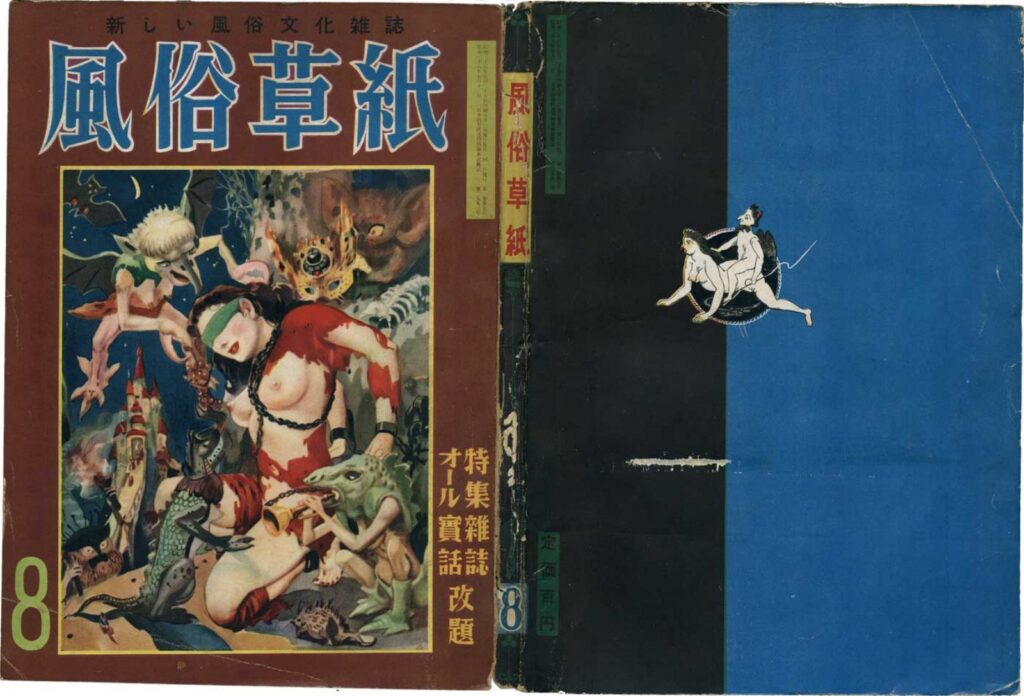
Issue Details
- PDF pages
- 173
Summary
The August 1953 issue of Fūzoku Sōshi is a particularly revealing example of the magazine’s effort to gather many different forms of erotic abnormality into a single visual and literary world. Its 153 printed pages move restlessly among punishment history, bondage illustration, crime fiction, medicalized sexuality, confession, prison narrative, same-sex desire, fetish correspondence, and purported documentary material. Rather than separating these subjects into tidy categories, the magazine places them beside one another so that historical torture, modern seme, sensational journalism, fantasy, and reader testimony continually reinterpret each other. The issue shows Fūzoku Sōshi functioning not simply as an erotic magazine, but as an engine for assembling an emerging SM culture from heterogeneous materials.
Read full summary Close full summary
Table of Contents 27 items
-
Fūzoku Art Museum: Western Punishment Pictures
Summary
A visual feature presenting Western images of punishment, torture, execution, and violent spectacle, including scenes of bodily exposure and women subjected to extreme penalties. Captions frame the images as a gallery of historical punishment pictures and sensationalized erotic violence.
-
Beautiful Sacrifice
Summary
An illustrated feature titled “Beautiful Sacrifice” depicting women placed in coercive and dangerous scenarios involving restraint, whipping, captivity, and threatened bodily harm. The sequence combines eroticized female vulnerability with melodramatic sacrifice and punishment imagery.
-
Summary
An erotic illustration by Kita Reiko depicts women bound with rope in varied poses, emphasizing sensuality, exposure, and physical restraint.
-
Kawatake Mokuami
Summary
Masaoka Iruru’s illustrated essay examines the life and dramatic works of kabuki playwright Kawatake Mokuami, emphasizing his fascination with grotesque, macabre, criminal, supernatural, and sexually charged scenes. Plot episodes and stage illustrations show how murder, ghosts, poison, bodily danger, and eroticized spectacle recur in his theatrical world.
-
Mania Hell
Summary
A grotesque erotic fantasy follows Haneda and the striking Mieko through increasingly extreme scenes of bodily obsession, voyeuristic observation, coercion, and sadistic marital sexuality. The numbered narrative combines fetishistic attention to the body with bizarre, unsettling imagery and domestic power struggles.
-
A Summer Night’s Rhapsody
Summary
A short erotic narrative set on a summer night depicts intimate domestic encounters involving a married couple and the observation of a woman’s body. Its atmosphere emphasizes secrecy, sensual display, and voyeuristic fascination within a private household setting.
-
Reflections on Western Torture
Summary
An illustrated survey of torture, punishment, and execution in Western history, discussing legal and religious justifications, interrogation methods, penal devices, and the treatment of accused people. The article compares historical practices with modern attitudes toward cruelty and judicial punishment.
-
Berlin Night Tales
Summary
A travelogue-style account of Berlin nightlife and erotic entertainment, combining observations of cabarets, performers, sexual spectacle, and postwar urban culture. It emphasizes the transnational circulation of erotic performance and the contrast between European nightlife and Japanese expectations.
-
The Overturned Street
Summary
A serialized erotic narrative follows 洋 and his encounters with 柳沢, 高野, and other figures amid conversations, social gatherings, romantic tensions, and shifting power relations. The story develops an atmosphere of sexual intrigue, humiliation, and sadomasochistic fantasy, accompanied by a staged illustration of the characters.
-
The Rope and Whip That Bit into Her
Summary
An essay drawn from personal-advice cases about an unconventional marital relationship and an affair involving a wife’s younger sister. The account centers on eroticized restraint, whipping, jealousy, secrecy, and the psychological dynamics of coercion and submission within domestic relationships.
-
Acrobat of the Flesh
Summary
An illustrated series of sensational erotic vignettes presenting the body as a circus-like spectacle of contortion, restraint, discipline, and physical endurance. The episodes depict performers subjected to elaborate bindings, difficult positions, whipping, and other staged SM practices, accompanied by grotesque and theatrical imagery.
-
A Secret History of the Torture of Christian Women
Summary
A sensational historical account of the persecution, torture, and execution of Christian women in early-modern Japan, presented through dramatic anecdotes involving Kirishitan believers, officials, informers, and prison authorities. The article is accompanied by eroticized illustrations depicting bound, exposed, and tortured women, combining historical narrative with fetishized visual spectacle.
-
The Town of Masochists
Summary
A first-person erotic memoir follows a shoe-shop clerk whose longstanding fascination with women’s footwear develops into an intense obsession with a beautiful customer. The narrative depicts foot worship, shoe-focused desire, and fantasies of female control and male submission, accompanied by erotic illustrations.
-
Expressions of a Woman Being Tormented
Summary
Itō Seiu discusses and depicts the facial expressions of women undergoing erotic torment, drawing on staged bondage scenes and photographic observation. The accompanying illustrations emphasize tied, restrained, suspended, and otherwise physically constrained women, with attention to pain, fear, endurance, and emotional response.
-
The Secret of the Communal Toilet
Summary
A first-person erotic narrative recounts encounters and voyeuristic observations in a communal toilet, where secrecy, bodily exposure, and illicit sexual conduct generate tension and excitement. Illustrated scenes reinforce the setting’s hidden, theatrical, and transgressive atmosphere.
-
The Male Guardhouse
Summary
A fictional military-barracks narrative follows soldiers whose hierarchical discipline, intimidation, and personal rivalries become entangled with coercive same-sex encounters. The story emphasizes male submission, domination, humiliation, and the eroticized secrecy of life in the guardhouse.
-
Expressions of Female Agony from Drowning and Hanging
Summary
An illustrated forensic-style study examines the facial and bodily signs associated with female drowning and hanging deaths. It discusses postmortem appearance, physiological mechanisms, and visual representations of suffering, presenting death imagery through a sensationalized erotic lens.
-
The Six Women I Tormented
Summary
A first-person erotic account describing six women whom the narrator subjects to rope bondage, whipping, gagging, humiliation, and other forms of sexualized domination. The women are presented in successive case-like vignettes, emphasizing their bodies, reactions, and submission.
-
Punishment Through a Thousand Nights
Summary
An erotic punishment narrative centered on women confined in and subjected to harsh discipline within a reform-school or institutional setting. The scenes depict forced labor, restraint, beatings, gagging, deprivation, and collective humiliation, reinforced by dramatic illustrations of captors and bound bodies.
-
Wounds and Weapons
Summary
A practical medical and forensic discussion of wounds caused by knives, scissors, glass, and other weapons. It distinguishes cuts, punctures, lacerations, and blunt-force injuries, considering bleeding, tissue damage, shock, and fatal outcomes.
-
Lewd Fingers
Summary
A serialized erotic-horror narrative set around a hospital, where nurses, patients, a corpse, and mysterious nighttime visitors become entangled in unsettling encounters. The story combines sexual tension, voyeuristic observation, death, hallucination, and supernatural ambiguity.
-
Tormenting Soft Skin
Summary
A first-person erotic confession about a relationship in which a woman’s responses to harsh caresses, torment, and discipline reveal deeply rooted masochistic desire. The narrative also reflects on secrecy, intimate correspondence, and the psychology of sadomasochistic attraction.
-
Juvenile Prison
Summary
A first-person juvenile-prison record describing confinement, surveillance, forced labor, deprivation, disciplinary punishment, and attempts to escape or resist institutional control. Illustrations emphasize chained prisoners, bodily restraint, and the coercive material environment of the prison.
-
The Tyrant of the Seashore
Summary
An erotic fantasy about a seaside tyrant who dominates and forcibly restrains several women, combining captivity, humiliation, and coercive sexual control in a coastal setting.
-
Wooden-Horse Torment and Pulley Torment
Summary
A mixed historical and practical feature on wooden-horse and pulley torment. It traces the wooden horse through punishment records, presents staged photographs of women subjected to apparatus-based restraint, and offers detailed instructions and safety cautions for recreating the scenes.
-
Lesbos Correspondence
Summary
A reader-correspondence column devoted to women’s same-sex desire, featuring personal letters, relationship concerns, requests for introductions, and discussion of exchanging photographs or meeting discreetly. The editor responds to readers while sustaining a private community organized around lesbian affection and forbidden intimacy.
-
The Stench of Corrupted Sexuality
Summary
A sensational prison-centered account describing female inmates, sexual deprivation, coercive treatment of newcomers, bullying, and oppressive nightly routines inside the cells. The article emphasizes captivity, institutional abuse, humiliation, and the degrading bodily conditions of prison life.
Highlights
- A striking opening “Fūzoku Art Museum” portfolio surveys European punishment and execution imagery, including whipping, drowning, exposure, and bodily mutilation (PDF pp. 3–7).
- Kitahara’s illustrated jungle fantasy turns a bound woman’s encounter with a giant ape into a melodramatic spectacle of danger and helplessness (PDF pp. 8–10).
- Kita Reiko’s “Yōen-zu”, or “Pictures of Bewitching Sensuality,” presents women restrained in several stylized poses and continues her use of the portfolio as a visual taxonomy of seme (PDF pp. 11 and 13).
- “Kawatake Mokuami” opens a serialized historical-theatrical feature framed through crime, punishment, and the grotesque culture of Edo popular drama (PDF pp. 15–22).
- “The Fatal Pleasure of Cosmetics” uses the cosmetics counter and beauty salon as the setting for a modern erotic-crime story of deception, desire, and bodily vulnerability (PDF pp. 23–33).
- “A Summer Night’s Rhapsody” explores feverish desire and nocturnal fantasy through a confessional literary style (PDF p. 34).
- “Reflections on Western Torture” surveys European punishment techniques, including archery, the wheel, horses, and other methods of execution and bodily control (PDF pp. 35–38).
- “Berlin Night Tales” presents the city as a modern landscape of cabaret, prostitution, sexual experimentation, and postwar decadence (PDF pp. 39–44).
- “The Overturned Street” blends urban crime, drugs, medical danger, and sexual intrigue in a long pulp narrative (PDF pp. 45–53).
- “The Rope and Whip That Bit into Her” centers the tactile and psychological effects of restraint, presenting rope and beating as linked erotic instruments (PDF pp. 54–58).
- “Acrobat of the Flesh” follows a circus performer whose body becomes both spectacle and erotic commodity (PDF pp. 59–64).
- “A Secret History of the Torture of Christian Women” converts persecution history into an illustrated catalogue of fire, suspension, exposure, and execution (PDF pp. 65–73).
- “The Town of Masochists” imagines a social world organized around masochistic desire, enslavement, fetish clothing, and ritualized humiliation (PDF pp. 74–80).
- “Expressions of a Woman Being Tormented” studies the face and body under restraint, pain, fear, and exhaustion, turning female response into an object of visual interpretation (PDF pp. 81–86).
- The issue’s final third ranges from “The Secret of the Communal Toilet” and the homosexual prison narrative “The Male Guardhouse” to drowning and hanging studies, “The Six Women I Tormented,” prison memoirs, “Lesbos Correspondence,” and fetish accounts of wooden-horse and pulley torment (PDF pp. 87–150).
Contributors
Named contributors represented in this issue:
- Fukada Tōru
- Fukioka Seijirō
- Hachigishi Giichi
- Hagiwara Hideo
- Hara Junko
- Hayashi Jōsuke
- Hinatsu Yukio
- Ida Takao
- Itō Seiu
- Kita Reiko
- Kitahara Tamaki
- Masaoka Iruru
- Matsuo Akira
- Minami Akio
- Munakata Ayako
- Nakayama Reiko
- Ōtsuka Ruri
- Shima Yukio
- Sonomura Keiko
- Takeno Tōsuke
- Takeoka Kyōhei
- Toba Tamako
- Ueda Seishirō
- Yanome Gen’ichi
- Yasuno Yōji
English Translations from This Issue
- Tormenting Soft Skin — Kita Reiko