Yomikiri Romance
August 1952
← Back to magazine archive
Summary
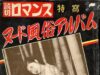
This special extra edition of Yomikiri Romance, titled 特写ヌード風俗アルバム (Special Photography: Nude Customs Album), is less a conventional magazine than an extended photographic portfolio. Across seventy-six pages, it presents staged bondage, captivity, disrobing, bridal-role fantasy, outdoor restraint, same-sex tableaux, and eroticized distress through almost continuous black-and-white photography. Only the contents page and brief introductory material interrupt the visual sequence.
Read full summary Close full summary
Loading PDF…
Table of Contents 12 items
-
Silent Storm
-
Female Body: Light and Shadow
-
Beautiful Cruelty
-
The Tormentor on the Wedding Night
-
Fūryū Hell
-
Expressions of a Bride’s Sexuality on Her Wedding Night
-
The Door of Love and Hate
-
Garden of Hell
-
Trembling Toward Ecstasy
-
Midnight Banquet
-
Strange Transformations of the Nude
-
Lewd Trees
Highlights
- The complete 76-page issue demonstrates that bondage photography could sustain an entire commercial publication without substantial fiction or reportage.
- The twelve titled portfolios create a deliberate progression from captivity and cruelty toward ecstasy, spectacle, and erotic transformation.
- “Quiet Storm” connects postwar photography to the older visual tradition of bodies subjected to landscape, weather, trees, and environmental ordeal (PDF pp. 3–9).
- “Light and Darkness of the Female Body” relocates restraint into ruined interiors, blending crime imagery with the emerging photographic aesthetics of kinbaku (PDF pp. 10–17).
- “Beautiful Cruelty” uses repeated angles and closely related poses to make rope, posture, and bodily line the principal subjects of the photographs (PDF pp. 18–29).
- The album repeatedly transforms simple wrist and torso ties through changes in camera angle, demonstrating how photography expanded the meaning of basic restraint (PDF pp. 12–29, 46–55).
- The wedding-night sequence shows kinbaku absorbing theatrical costume, bridal ritual, and popular melodrama into its visual vocabulary (PDF pp. 30–35).
- “Elegant Hell” uses poles, tatami architecture, and domestic interiors as compositional partners, showing the growing importance of setting in rope photography (PDF pp. 36–41).
- The bridal-expression portfolio emphasizes the model’s face, gesture, and performance, revealing that early kinbaku photography depended on acting as much as tying (PDF pp. 42–45).
- “The Door of Love and Hate” moves bondage firmly into the bedroom and domestic interior, helping detach rope imagery from historical punishment alone (PDF pp. 46–55).
- Photographs paired with small drawings suggest a working exchange between illustrated pose studies and the staging of bodies for the camera (PDF pp. 14, 16, 26–27, 39, 49, 51, 66, 72).
- “Trembling Toward Ecstasy” shifts the emotional language of restraint from suffering toward bodily pleasure, anticipating later SM representations of reciprocal sensation (PDF pp. 58–67).
- The issue documents a broad repertoire of standing, kneeling, seated, reclining, pillar-bound, tree-bound, and floor-bound poses before later technical standardization (PDF pp. 3–69).
- The paired and group scenes expand rope photography beyond the isolated captive and experiment with bodies arranged in collective tableaux (PDF pp. 57, 68–75).
- The final “Lewd Tree” portfolio returns the issue to its opening outdoor setting, completing a visual cycle in which nature, rope, and the photographed body define the album’s historical identity (PDF pp. 74–76).