Article Summary
Itō Seiu gives a compact autobiographical account of how his lifelong interest in depicting women under restraint began during adolescence. He recalls tracing newspaper illustrations, adding ropes to female figures, sketching his newlywed wife while bound, and later using theatrical dressing rooms, onnagata performers, photography, and direct observation to study bodily posture. He rejects elaborate theoretical explanations for his work, comparing his pursuit to an angler following an absorbing hobby and likening his artistic state of mind to Utamaro's creation of shunga. He argues that both arts transform what is conventionally considered ugly into beauty. The second half turns to Kitan Club and Kita Reiko. Seiu praises the commercial acuity behind the magazine, criticizes publishers for prematurely exploiting an inexperienced woman artist, and insists that mastery requires long cultivation, anatomical knowledge, compositional freedom, and years of practice. Historically, the article is notable as Seiu's own account of his working methods, his use of live models and theatrical performers, his understanding of seme imagery as an aesthetic practice, and his early assessment of Kita Reiko.
Translation
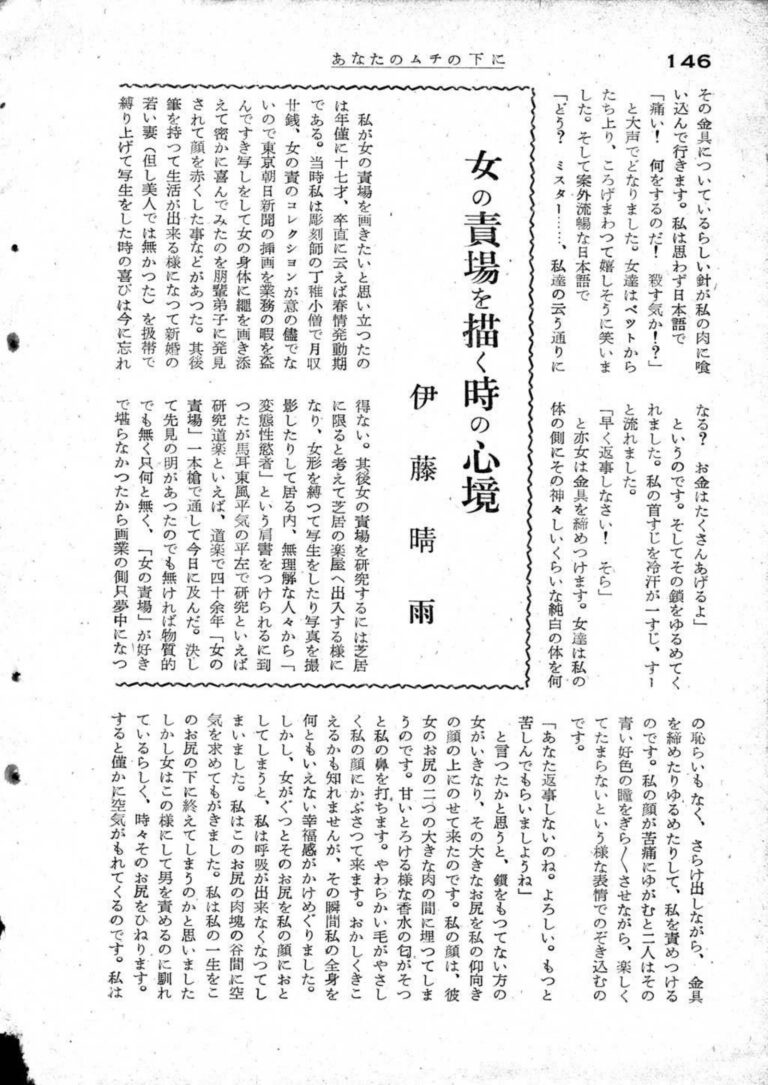
When I first decided that I wanted to draw women in scenes of torment, I was only seventeen years old. To put it frankly, I had reached the age when sexual desire awakens. At the time I was a young apprentice to a sculptor, earning twenty sen a month. Since I could not collect as many images of women being tormented as I wished, I would steal moments from my work to trace illustrations from the Tokyo Asahi Shimbun and add ropes to the women’s bodies. Once, a fellow apprentice discovered me secretly enjoying this activity, and I turned red with embarrassment. Later, when I was able to make a living with my brush, I tied up my young newlywed wife with a shigoki sash and sketched her. I have never forgotten the pleasure I felt then, although she was not a beautiful woman.
After that, I concluded that the theater was the only place to study scenes of women in torment. I began going in and out of theatrical dressing rooms, where I tied up onnagata actors and made sketches or took photographs of them. In the course of this, people who did not understand what I was doing attached the label “sexual deviant” to me. I let it go in one ear and out the other. Call it research if you like, or call it a hobby, but for more than forty years I have pursued the single subject of “women in torment,” and that is how I have arrived at the present day. It was not because I possessed special foresight, nor was I motivated by material gain. I simply loved scenes of women in torment so much that, alongside my ordinary work as an artist, I became absorbed in drawing them again and again.
It is just like an enthusiastic angler searching for a fishing spot. I went farther and farther into deep waters because I found it interesting; there is no difficult theory behind it. I therefore imagine that my state of mind when drawing a woman in torment is much the same as Utamaro’s state of mind when he drew shunga. A scene of a woman in torment is not itself shunga, but the two agree in one respect: both transform ugliness into beauty.
The fact that a magazine called Kitan Club, specializing in seme-mono, was born in Kansai rather than Tokyo demonstrates the intelligence of Kansai people, or, to put it another way, the sharp commercial awareness of people who live in a mercantile city. When I look at the drawings of a woman named Kita Reiko, I see conscientious work, but also a weakness peculiar to women. Tokyo magazine companies and certain connoisseurs have become interested in her because she is a woman artist. Their attempt to turn a newly launched female painter, still wholly unproven, into a person everyone competes to engage is likely to destroy Kita Reiko as an individual. Modern businessmen and publishers do not know how to cultivate people with a future. They too often have the bad habit of overrating only those who are already established. To educate Kita Reiko thoroughly and raise her into a person of real accomplishment will require at least another ten years.
I did not even complete elementary school satisfactorily. As a painter, I have not yet escaped the realm of amateur work. An artist who cannot construct a composition without first making a nude study cannot draw the human figure in action. Only after one has driven the structure of the human body deeply into one’s mind and become able to compose scenes of torment freely in every direction can one be called fully competent. Beyond that, it becomes a question of skill. In drawing women in torment, one may then reach what Laozi supposedly called “the realm of great subtlety after nine years.”
Translation Notes
The title's 責場, read semeba or seme-ba, literally means a place or scene of punishment, torment, or interrogation. In this translation it is rendered contextually as “scene of torment” or “woman in torment.” It is related to seme, a central term in historical Japanese erotic and kinbaku discourse for torment, punishment, or aggressive treatment.
扱帯 is read as shigoki or shigoki-obi, a soft sash used with kimono. Seiu says he used one to bind his newlywed wife for sketching.
女形 refers to male kabuki or theatrical performers specializing in women's roles. Seiu's statement indicates that he used such performers as bound models as part of his visual research.
馬耳東風 and 平気の平左 are idiomatic expressions indicating complete indifference to criticism. They are translated together as letting the accusations go in one ear and out the other.
一本槍 means pursuing a single approach or subject exclusively. Here it emphasizes Seiu's decades-long concentration on women in scenes of torment.
六可敷 is an older or playful orthographic form of 難しい, “difficult” or “complicated.”
歌麿 is Kitagawa Utamaro, the celebrated ukiyo-e artist. 春画 means explicitly erotic prints or paintings.
責物 is rendered as seme-mono, meaning material or works centered on punishment, torment, bondage, or related imagery. The printed question mark after “specializing in seme-mono” appears to be Seiu's own humorous qualification.
引っ張り凧 describes someone in great demand and pulled in many directions. Seiu uses it critically, arguing that premature attention from publishers and enthusiasts could damage Kita Reiko's artistic development.
The passage about a “weakness peculiar to women” reflects Seiu's period-specific and explicitly gendered judgment. It has been translated directly rather than softened.
The final attribution to Laozi and the wording “九年にして大妙の域に到る” could not be matched confidently to a standard Laozi passage. It may be a loose quotation, variant saying, typographical error, or idiosyncratic recollection. 大妙 is translated provisionally as “great subtlety.”
Uncertain readings:
- The phrase transcribed as 「女の責のコレクション」 on PDF page 140 is clearly associated with collecting images of women under torment, but the precise grammatical construction is slightly unusual.
- The word transcribed as 「扱帯」 on PDF page 140 appears to refer to a shigoki sash; the historical orthography may permit another specialized reading.
- The magazine description on PDF page 141 reads 「責物専門(?)」; the parenthetical question mark is printed in the article.
- The phrase describing publishers' behavior is read as 「既成の人物斗りを買い被る悪習が多い」. The character 斗り is an older orthographic form of ばかり.
- The final quotation is read as 「九年にして大妙の域に到る」. The attribution to Laozi and the exact reading of 大妙 require human verification.