Yamashiro: Flowers at Kinkaku-ji, Princess Yuki
Summary
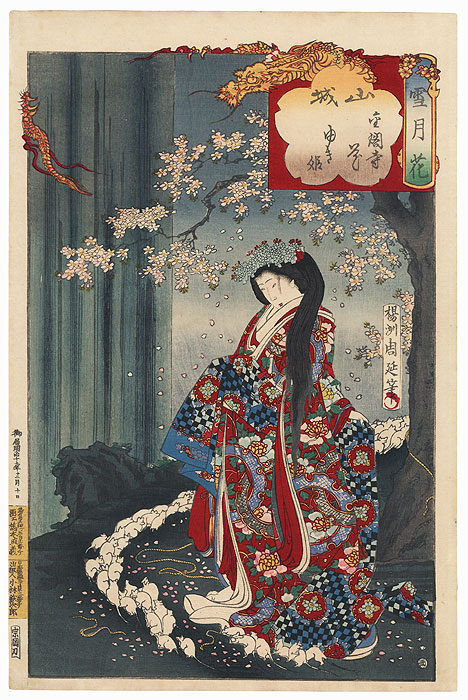
Princess Yuki stands beneath a flowering cherry tree in the garden of Kinkaku-ji after using fallen petals to draw a magical mouse with her toes. Yellow rope lies loosened on the dark ground around her feet, alluding to the bindings from which the animated mice have rescued her. Chikanobu renders the celebrated kabuki episode as an elegant historical beauty print, emphasizing the princess's richly patterned robes, long black hair, falling blossoms, and composed demeanor rather than the violence of her captivity.
Visual Description
The composition presents a solitary young woman standing slightly right of center beneath the spreading branches of a cherry tree. Princess Yuki wears an exceptionally elaborate multi-layered costume dominated by saturated red, blue, turquoise, cream, and black. Her outer robe contains alternating floral, geometric, cloud, and brocade-like patterns, while long red-lined panels descend almost to the ground. One pale foot extends forward from beneath the robes, visually linking her body to the scattered petals and rope below. Her face is lowered and turned slightly toward the left, with narrowed eyes and a calm, inward expression. Her exceptionally long black hair falls in two heavy streams almost to her ankles, signaling the historical or theatrical character rather than contemporary Meiji dress. Above her, pale cherry blossoms spread across twisting branches against a gray-green background. Individual petals drift around her head and collect on the ground. A dark rock formation occupies the lower left and right edges, while a low irregular white border of stones or accumulated pale forms encloses part of the foreground. A length of yellow rope lies in loose curves near her feet, with separated strands suggesting that it has been gnawed through or cast off. Small dark forms among the rope and petals may represent the magical mice central to the episode, although their details are difficult to resolve at the supplied size. The title occupies a decorative cartouche in the upper right, ornamented with a dragon and floral forms. A narrow green panel reads 雪月花, while the larger cream area identifies Yamashiro, Kinkaku-ji flowers, and Yuki-hime. The artist's vertical signature appears at middle right. Publication, registration, carving, and publisher inscriptions run along the left and lower margins. The sheet retains broad margins and appears substantially complete, with no indication that it formed part of a diptych or triptych.
History and Context
Historical Context
Princess Yuki is a fictional kabuki heroine in Gion Sairei Shinkōki, particularly the celebrated fourth-act scene commonly called Kinkakuji. Within the play, she is the daughter of the murdered shogun Ashikaga Yoshiteru and is presented as a granddaughter or descendant of the renowned painter Sesshū. Matsunaga Daizen, responsible for her father's death, holds her captive and orders her to paint a dragon on the ceiling of the Golden Pavilion. When she refuses or fails to comply, she is tied to a cherry tree. Remembering the legend that Sesshū once drew a mouse with his tears while bound to a pillar, Yuki gathers fallen cherry petals with her toes and draws a mouse on the ground. Her artistic power animates the image; the mouse multiplies or comes alive and gnaws through the ropes, enabling her escape.
Print History
The sheet was published in Tokyo by Kobayashi Tetsujirō in August 1884 as number 30 of Chikanobu's Setsugekka series. Institutional impressions are documented in the Fukuoka City Museum, Keio University Libraries, the Scripps College collection, and ukiyo-e portal databases. The design circulated as an independent vertical ōban print. Surviving examples vary in trimming, fading, pigment intensity, registration, and the preservation of the margins and publisher inscriptions.
Cultural Context
The image translates a famous kabuki scene into the refined language of late nineteenth-century bijinga and historical printmaking. Rather than depict the moment of assault or the princess struggling against visible bonds, Chikanobu represents the magical aftermath: the rope lies defeated at her feet, petals drift through the air, and the heroine stands in elaborate costume beneath flowering branches. The scene joins several important cultural themes, including filial duty, artistic inheritance, female endurance, supernatural animation, the prestige of Sesshū, and the seasonal symbolism of cherry blossoms. The petals evoke beauty and impermanence while also becoming the physical medium through which Yuki creates her rescuing mouse.
Series Context
Setsugekka organizes historical, legendary, literary, and theatrical subjects through the poetic triad of snow, moon, and flowers. Each numbered design associates a province or famous place with one of these seasonal motifs and a named figure or narrative. The series allowed Chikanobu to combine historical costume, landscape, theatrical memory, and bijinga. Number 30 represents the flower category through the cherry blossoms of Kinkaku-ji in Yamashiro Province.
Known Variants
Multiple institutional and commercial impressions are known. Some retain complete outer margins and publication inscriptions, while others are trimmed closer to the image. Color differences are especially apparent in the gray-green background, red robes, blue textile passages, yellow rope, and pale cherry blossoms. No substantially altered recut state has been established in the sources reviewed.
Collection History
From the collection of Zetsu Nawa.
Relevance to Kinbaku
The print is directly relevant to the cultural history of rope restraint because its narrative depends on Princess Yuki having been tied to a cherry tree. Chikanobu depicts the moment after release: severed or loosened rope lies at her feet while the magical mice complete their rescue. The subject is theatrical, coercive, and supernatural rather than erotic or technical.
Historical Connections
The design records the continuing popularity in the Meiji period of an Edo-period kabuki scene in which rope functions as an instrument of confinement and threatened coercion. It shows how audiences could recognize binding to a fixed natural object as a dramatic sign of captivity, while release from the rope becomes proof of artistic and supernatural power. The image contributes to the broader history of restraint imagery, but it does not document an actual penal procedure or establish a direct lineage to modern erotic kinbaku.
Iconographic Connections
Although the rope is no longer wrapped around the figure, it remains conspicuous in the foreground as a narrative residue of restraint. Its loose yellow curves contrast with the vertical fall of Yuki's hair and robes, while the pale foot, petals, and suggested mice direct the viewer toward the mechanism of escape. The absent bindings are therefore as meaningful as visible bondage: the picture invites viewers familiar with the play to reconstruct the immediately preceding image of Yuki tied to the tree. The combination of elaborate costume, long hair, exposed foot, fixed tree, scattered petals, and discarded rope creates a highly aestheticized representation of captivity and release.
Interpretive Cautions
The print does not show a detailed tying configuration and should not be used to reconstruct historical rope technique. It depicts a fictional kabuki heroine after a magical escape, not an actual prisoner or consensual bondage scene. The richly dressed female figure and visual beauty of the composition do not make the subject erotic. Theatrical associations with suffering and exposed vulnerability may interest kinbaku researchers, but resemblance to later bondage aesthetics does not demonstrate direct transmission. Some small foreground forms are difficult to resolve and should not be described as individual mice without comparison to a higher-resolution institutional image.
Research Value
The print is valuable because it represents rope through its aftermath rather than through a bound body. It demonstrates how discarded rope can carry the memory of captivity and make liberation legible. Comparison with actor prints and illustrated versions that show Yuki still tied to the cherry tree could reveal how artists selected different moments of the same narrative. The work also supports research into fixed-point restraint in kabuki, the transformation of suffering into bijinga, the relationship between women and magical artistic power, and the reuse of Sesshū's mouse legend in popular theater.
Themes
Subjects and Keywords
Sources
- Fukuoka City Museum and DNP Art Communications Image Archives: 雪月花 山城 金閣寺 花 ゆき姫, collection number FCM1993B04007 — Confirms the title, artist Yōshū Chikanobu, Meiji 17 date, vertical ōban format, dimensions of 36.3 by 24.5 centimeters, signature, registration inscription, and the kabuki narrative in which Princess Yuki draws mice that chew through her ropes.
- Keio University Libraries, George S. Bonn Collection of Ukiyo-e in the Meiji Period: Snow Moon Flower: Yamashiro Kinkakuji Temple Flower, call number 201X@325 — Confirms Chikanobu, the Snow Moon Flower series, the Yamashiro and Kinkaku-ji title, publisher Kobayashi Tetsujirō, vertical ōban format, signature, and carver Muneoka.
- Art Research Center, Ritsumeikan University, ARC Ukiyo-e Portal: 「雪月花」「山城」「金閣寺花」「ゆき姫」 — Confirms series number 30, August 1884 publication, Tokyo production, artist signature and address, publisher Kobayashi Tetsujirō, Muneoka carving credit, and ōban nishiki-e format.
- Ruth Chandler Williamson Gallery, Scripps College: Yamashiro, Flowers of Kinkaku-ji, Princess Yuki, No. 30 from the series Snow, Moon, Flowers, collection number 93.6.118 — Confirms artist, title, series number, date, full-color woodblock medium, and the narrative of Princess Yuki drawing a mouse with petals so that it comes alive and chews through her ropes.
- Cultural Japan: Snow, Moon, and Flowers: Yamashiro, Kinkaku-ji Flowers, Princess Yuki — Provides aggregated institutional comparison records for the title, series, artist, date, publisher, and series number.
- Fuji Arts: Yamashiro, Flowers of Kinkaku-ji, Princess Yuki, No. 30 — Provides the supplied comparison image and a specialist-market identification of the artist, title, series, number, subject, and 1884 date.