Urazato and Tokijirō in the Snow-Torment Scene
Summary
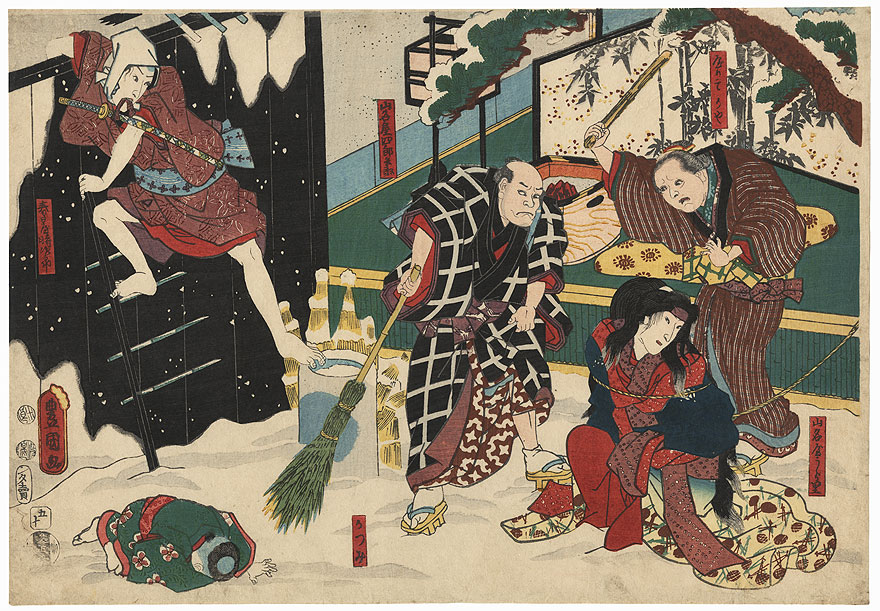
The triptych depicts the climactic winter punishment of the courtesan Urazato. At the right she kneels in the snow with rope passing around her upper body and extending toward an attendant or tormentor standing behind her. A second man raises a bamboo rod or switch as though preparing to strike. At the left, Tokijirō enters through a dark doorway, one foot lifted as he steps into the snow, while another figure lies collapsed nearby. The crowded theatrical composition joins binding, beating, exposure to winter weather, romantic rescue, and institutional control within the pleasure-quarter setting.
Visual Description
The three sheets form a continuous snow-covered exterior beside a pleasure-house interior. On the right sheet, Urazato kneels in a red and dark-blue patterned kimono. Her long black hair has come loose and falls over her shoulders. A rope crosses or encircles her upper torso and appears to draw her arms behind or close to her body. The rope continues diagonally toward the right edge, where it is controlled by a standing man in a brown-striped robe. He leans over Urazato and grips the line while raising a long bamboo switch or cane above his shoulder. His posture and grimacing expression indicate active punishment. In the center, another man in a black-and-gray checked robe advances with a large bundled broom, staff, or beating implement held downward. His body angles toward Urazato, reinforcing the encirclement of the captive. Behind them is a raised room with bedding, painted sliding screens, and decorative bamboo and pine imagery. On the left, Tokijirō emerges dramatically through a black doorway or gate. Snow falls around him and clings to the roof and architecture. He wears a red patterned robe over pale garments, carries a sword, and raises one hand near his face while stepping forward. A smaller figure in green and red lies face-down in the snow near the lower-left corner. Actor and role cartouches identify the principal characters. Kunisada's Toyokuni signature and publisher or approval marks appear near the lower-left margin.
History and Context
Historical Context
Urazato and Tokijirō are the tragic lovers of a popular narrative rooted in eighteenth-century pleasure-quarter culture. Urazato is a courtesan of the Yamanaya house, while Tokijirō is her young merchant lover. Their forbidden relationship leads to separation and punishment. In the best-known snow scene, Urazato is bound and exposed to winter weather by the brothel authorities. Tokijirō attempts to reach or rescue her, and the suffering of the lovers became a celebrated subject in shinnai narrative, kabuki, illustrated fiction, and ukiyo-e.
Print History
Kunisada repeatedly represented Urazato and Tokijirō in actor prints, literary comparisons, and theatrical triptychs. The story offered him opportunities to depict current performers, spectacular snow effects, elaborate costumes, romantic suffering, and the emotional contrast between helpless captivity and imminent rescue. Institutional records document important Kunisada portraits of Ichikawa Danjūrō VIII as Tokijirō and Bandō Shūka I as Urazato in the early 1850s.
Cultural Context
The licensed pleasure quarters tightly regulated the movement, debts, and relationships of courtesans. In fictional and theatrical narratives, attempts to maintain forbidden attachments or escape contractual obligations could result in confinement and punishment. The Urazato story transformed these structures into romantic tragedy, inviting sympathy for a woman subjected to institutional violence because of her emotional attachment to a customer.
Series Context
The triptych appears to commemorate a kabuki staging of the Urazato-Tokijirō snow scene rather than belonging to a numbered print series. The actor cartouches, dramatic mie-like poses, and continuous stage architecture identify it as a theatrical souvenir and performance record.
Known Variants
Individual sheets may survive separately, and complete triptychs can differ in trimming, alignment, paper tone, snow printing, pigment saturation, and preservation of the black doorway. No alternate compositional state has been confirmed.
Collection History
Related Kunisada representations of the same characters are held by the National Museum of Japanese History, Tokyo Metropolitan Library, Adachi City collection, and other Japanese institutions. From the collection of Zetsu Nawa.
Relevance to Kinbaku
The triptych is directly relevant to the visual history of Japanese rope restraint. Urazato's binding is integrated into a broader punishment combining immobilization, beating, public exposure, cold, institutional authority, and romantic helplessness. The image predates modern erotic kinbaku and represents coercive kabuki seme, but it helped establish a durable iconography of the beautiful bound woman.
Historical Connections
The work demonstrates that rope restraint was a readily understood part of mainstream theatrical imagery by the mid-nineteenth century. Binding does not operate alone: it enables prolonged exposure, prevents escape, and makes Urazato available for beating and observation. Such combinations of rope, helplessness, beauty, and ordeal formed part of the visual archive later encountered by seme and kinbaku illustrators.
Iconographic Connections
Urazato's lowered body, constrained arms, prominent rope, loosened hair, richly patterned kimono, surrounding male tormentors, raised implement, and snow-covered setting concentrate attention on suffering without extensive nudity. The diagonal rope line connects the captive directly to the authority figure controlling her. Tokijirō's approach supplies the counter-image of rescue and emotional attachment.
Interpretive Cautions
The scene depicts non-consensual punishment within a kabuki narrative. It should not be described as consensual bondage or a safe tying method. The visible rope path is incomplete, and its arrangement may reflect stage convention and pictorial clarity rather than actual penal practice. The female character is portrayed by a male kabuki actor. Modern erotic readings should be separated from the print's original theatrical, romantic, and institutional contexts.
Research Value
This is a particularly strong object for studying the convergence of rope, snow exposure, beating, courtesan labor, theatrical performance, and rescue fantasy. Comparison with Kunisada's isolated 1852 portrait of Urazato shows how the same narrative could be represented either as a close psychological image of the captive or as a multi-figure scene revealing the entire machinery of punishment.
Themes
Subjects and Keywords
Sources
- Fuji Arts: Utagawa Kunisada, Urazato and Tokijirō, inventory 746176 — Provides the supplied comparison image, identifies the artist and principal characters, and gives a publication range of 1847–1852.
- Ritsumeikan University Art Research Center: Documentation of Ichikawa Danjūrō VIII and the Urazato-Tokijirō performance tradition — Documents the September 1852 Kawarazaki-za performance in which Ichikawa Danjūrō VIII played Tokijirō and Bandō Shūka I played Urazato, noting the acclaim received by the pairing.
- National Museum of Japanese History: Akegarasu yume no awayuki: Kasugaya Tokijirō and Yamanaya Urazato, collection H-22-1-1-244 — Confirms the play title, principal characters, Kunisada or Toyokuni III attribution, and institutional cataloging of the Urazato-Tokijirō subject.
- Tokyo Metropolitan Library via Ukiyo-e.org: Akegarasu yume no awayuki: Kasugaya Tokijirō and Yamanaya Urazato, record N244-005 — Confirms Kunisada's authorship and the Japanese play and character titles through a related 1855 actor print.
- Adachi City Cultural Heritage Archive: Akegarasu yume no awayuki: Ichikawa Danjūrō VIII as Kasugaya Tokijirō and Bandō Shūka I as Yamanaya Urazato, record 15637 — Confirms the actors, roles, artist, play title, and the established pairing of Danjūrō VIII as Tokijirō with Bandō Shūka I as Urazato.
- Ota Memorial Museum of Art: Edo no Koi exhibition discussion of Urazato and Tokijirō — Places Urazato and Tokijirō among famous Edo-period tragic lovers and explains the story's themes of overwhelming desire, separation, and romantic suffering.
- Machida City Museum of Graphic Arts: Kunisada exhibition catalog discussion of Urazato and Tokijirō — Explains that Urazato is punished by exposure to snow because of her relationship with Tokijirō and provides authoritative theatrical and iconographic context for Kunisada's representations.
- National Diet Library: Akegarasu yuki no sōbana, bibliographic ID 000007275104 — Documents an 1825 illustrated literary adaptation centered on Urazato and Tokijirō, confirming the story's circulation in popular print culture before this theatrical triptych.