Two Men Embracing While a Woman Watches
Summary
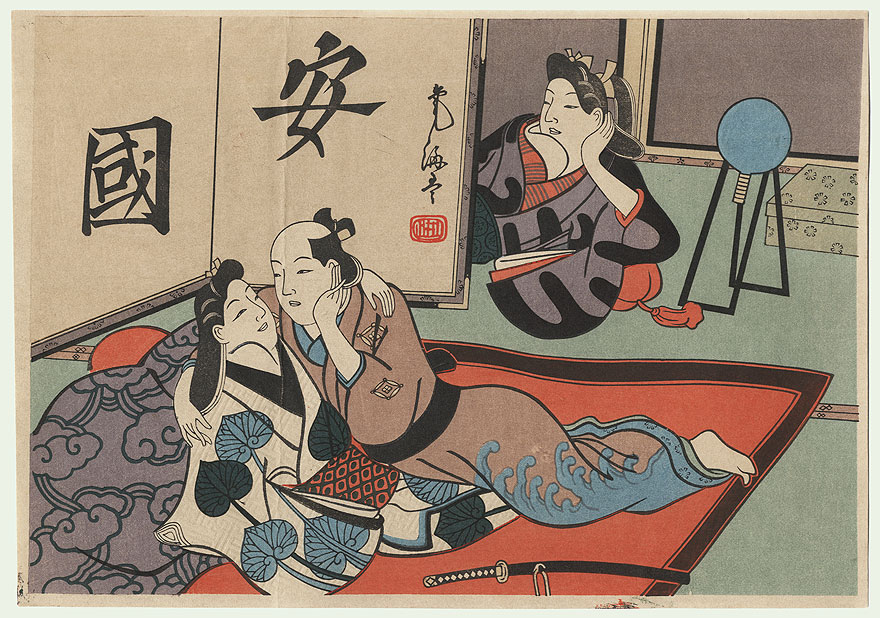
Two men recline closely together on bedding in a Japanese interior. The man in the brown robe supports and embraces the man in the patterned white robe, bringing their faces into intimate proximity. In an adjoining room, a woman leans on one hand and watches through the open partition. A sheathed sword lies near the bedding, while large calligraphic characters on hanging panels dominate the wall behind the men. The image suggests an emotionally or erotically charged encounter complicated by observation, secrecy, or discovery.
Visual Description
The composition is arranged diagonally across an interior divided by sliding panels. At lower left, a man in a pale robe patterned with large blue-green leaves reclines against dark bedding decorated with curling waves. His head tilts backward toward a second man, and his eyes are nearly closed. The second man wears a brown robe over a blue garment patterned with stylized waves. He bends over the reclining figure, placing one arm around his shoulders and touching or supporting his cheek with the other hand. Their faces approach closely, creating the central point of intimacy. A dark sword scabbard and hilt lie horizontally near the lower edge of the red-bordered bedding. At upper right, a woman sits in a separate room. She wears a gray-purple robe with bold black motifs and a red-striped collar. Resting her cheek on one hand, she looks toward the men with an expression that may convey boredom, concern, surprise, jealousy, amusement, or quiet observation. A round blue fan stands behind her. Large hanging calligraphic panels occupy the wall behind the male couple, including the prominent characters 安 and 國. A vertical artist signature and red seal appear between the calligraphic panels and the woman's room.
History and Context
Historical Context
The figures have not been identified. They may be characters from a novel, serialized story, theatrical narrative, humorous episode, or independently conceived genre scene. The sword suggests that at least one male figure may be a samurai or retainer, but costume alone is insufficient to establish a specific identity.
Print History
The design appears to belong to the late-Meiji continuation of color woodblock illustration. Artists associated with the ukiyo-e lineage supplied prints for albums, novels, newspapers, and literary magazines, often presenting psychologically suggestive domestic moments rather than the explicit sexual encounters characteristic of earlier shunga. The probable attribution to Mizuno Toshikata is based on the visible signature placement and stylistic resemblance, but no matching authoritative catalog record has been located.
Cultural Context
Male-male intimacy had a long visual and literary history in Japan, particularly through narratives involving samurai, wakashū, actors, monks, and urban pleasure culture. By the Meiji period, however, changing legal, medical, and social discourses altered how same-sex behavior was represented and understood. This image is unusually indirect: intimacy is conveyed through embrace, facial proximity, reclining posture, and voyeuristic observation rather than explicit nudity or intercourse.
Series Context
No series or original publication has been identified. The horizontal proportions and possible fold or central join are compatible with a literary frontispiece, album leaf, or magazine illustration.
Known Variants
The supplied reproduction shows a vertical line near the center that may be a fold, sheet join, or crease. Other impressions could preserve margins, publication text, or clearer signature details. No alternate state has been confirmed.
Collection History
No museum accession, original publisher record, or earlier provenance has been located. From the collection of Zetsu Nawa.
Relevance to Kinbaku
The print does not depict rope restraint and has no direct technical relationship to kinbaku. Its relevance is contextual: it documents intimacy, bodily closeness, observation, gender ambiguity, and same-sex desire within late-Meiji visual culture, themes that complicate any history of erotic representation focused exclusively on bound women and male-female domination.
Historical Connections
Histories of kinbaku developed within a much broader visual environment that included heterosexual and same-sex intimacy, theatrical gender performance, voyeurism, erotic literature, and representations of bodies arranged for observation. This print helps reconstruct that surrounding culture, although it contains no rope, binding, torture, or physical immobilization.
Iconographic Connections
The reclining body, intimate bodily arrangement, concentrated gaze, opened room, hidden observer, patterned clothing, and sword create an atmosphere of private desire and possible discovery. Later erotic illustration likewise used interiors, spectators, partially concealed figures, and asymmetrical knowledge to construct tension. These are broad compositional connections rather than direct kinbaku motifs.
Interpretive Cautions
The men's proximity strongly suggests intimacy, but the exact action and relationship cannot be proven without the original literary context. The scene could represent romantic affection, consolation, illness, drunkenness, comedy, rescue, seduction, or theatrical performance. It should not automatically be called explicit shunga, because no genital exposure or sexual act is shown. The woman may be spying, waiting, observing casually, or occupying a separate narrative moment.
Research Value
The work is useful as a comparative object that broadens the Kinbaku Research Platform beyond restraint scenes. It supports research into male-male representation, spectatorship, emotional intimacy, and the transformation of erotic imagery during the Meiji period. Identifying the original publication would be essential for determining whether the image concerns homosexuality, adultery, theatrical disguise, illness, or another narrative theme.
Themes
Subjects and Keywords
Sources
- Fuji Arts: Japanese woodblock print, inventory 496037 — Provides the supplied comparison record and sales provenance, but its non-descriptive listing does not establish the artist, title, date, or subject.
- University of Oregon, Jordan Schnitzer Museum of Art research pages: Mizuno Toshikata, artist profile — Provides biographical context for Toshikata, his Meiji-period genre prints, bijin imagery, literary illustrations, and activity as a designer and illustrator.
- The Walters Art Museum: Works by Mizuno Toshikata — Provides institutional comparisons for Toshikata's figures, interior scenes, signatures, color palette, and Meiji-period woodblock production.
- Freer Gallery of Art and Arthur M. Sackler Gallery: Shunga, homosexual scene, object S2010.18.101 — Provides institutional context confirming that male-male sexual and intimate subjects formed part of Japanese woodblock and shunga production, but it does not identify the supplied print.
- National Gallery of Victoria: Interpreting Shunga Scroll: Sex and Desire between Women in Edo's Floating World — Provides scholarly context for interpreting same-sex imagery in Japanese erotic art and cautions against mapping modern identity categories directly onto premodern or early modern images.