Tokyo Nichinichi Shimbun, No. 900
Summary
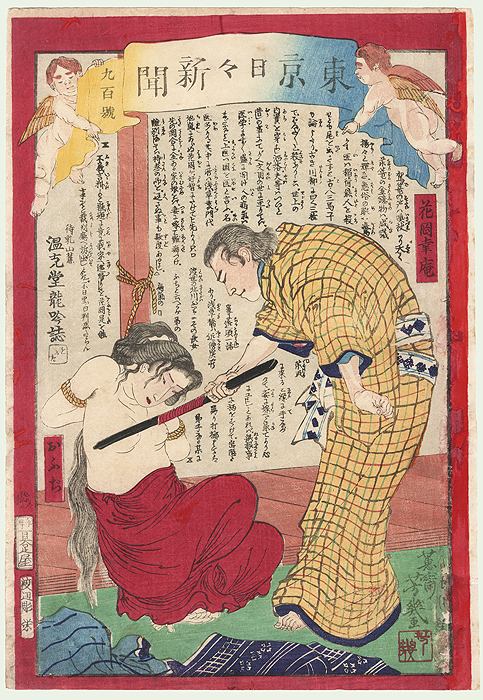
A kneeling woman is confronted by a standing man who bends over her, seizes or controls her long hair, and places a sword or sword-like weapon across the front of her neck. Her upper body is exposed, her red lower garment spreads around her legs, and her head tilts downward beneath the pressure of the weapon. The scene is embedded within the decorative format of an illustrated newspaper sheet, with a large block of narrative text behind the figures and the Tokyo Nichinichi Shimbun title held aloft by two winged figures.
Visual Description
The print is enclosed by a broad red border. At the top, two winged putti support a blue-and-white banner reading Tokyo Nichinichi Shimbun. A circular cartouche at upper left identifies issue No. 900. The center contains tightly arranged vertical newspaper text. In the foreground, a woman kneels on a green floor covering. Her long black hair falls across her shoulders and toward the floor. Her torso is substantially exposed, while a voluminous red garment covers her lower body. She wears jewelry or ornamental bands at the neck and wrist. A man in a yellow checked kimono stands over her from the right. He grips her hair or holds her head in position with one hand while extending a sheathed or partially drawn sword horizontally across her throat with the other. His posture is controlled and deliberate, while hers is compressed, off-balance, and submissive under threat. Discarded or folded blue garments and a dark patterned textile lie in the foreground. Text cartouches, the artist inscription, production seals, and publisher marks occupy the margins.
History and Context
Historical Context
The identities of the depicted man and woman have not been securely established from the supplied image. The central narrative presumably explains the reported incident, but the complete text requires specialist transcription before either figure can be identified responsibly.
Print History
Tokyo Nichinichi Shimbun illustrated-news prints were produced during the early Meiji period, when traditional woodblock publishers adapted ukiyo-e conventions to the expanding newspaper market. Yoshiiku designed many sheets in the series, transforming written reports into vivid scenes of crime, accidents, unusual behavior, scandal, punishment, and social disruption. Issue No. 900 is documented in institutional collections as a design by Ochiai Yoshiiku, with text by Onkodō Ryūgin and carving by Watanabe Horiei.
Cultural Context
Illustrated-news prints, or shinbun nishiki-e, occupied a transitional space between Edo-period narrative prints and modern mass journalism. They borrowed newspaper names and reports while retaining the dramatic color, compressed action, actor-print gestures, and decorative framing of commercial ukiyo-e. Their stories were frequently sensational, moralizing, theatrical, or emotionally charged. The image therefore should not automatically be treated as a literal eyewitness record, even when based on a reported event.
Series Context
The Tokyo Nichinichi Shimbun series presented individual news stories as vertical ōban prints. A characteristic header supported by winged figures identifies the newspaper, while the issue number and dense text lend documentary authority. Yoshiiku's foreground illustrations convert the report into an immediate visual drama. Number 900 belongs to the mature phase of this format and was published in January 1875.
Known Variants
Institutional impressions may vary in paper tone, registration, color intensity, trimming, and preservation. The supplied image appears to retain most of the decorative border. No alternate compositional state has been confirmed.
Collection History
A cataloged impression is held by the Edo-Tokyo Museum, and related catalog records are maintained by the University of Tokyo and other Japanese research collections. From the collection of Zetsu Nawa.
Relevance to Kinbaku
The print is relevant to the broader visual history of coercive restraint, although it does not depict rope bondage. The woman's movement is controlled through hair pulling, bodily positioning, close physical dominance, and the placement of a weapon across her throat. The image demonstrates how vulnerability and immobilization could be communicated in nineteenth-century popular imagery without formal tying.
Historical Connections
The scene belongs to a late nineteenth-century visual culture in which arrest, assault, punishment, murder, and interpersonal violence were made legible through controlled postures and emphatic gestures. It provides evidence for the circulation of images centered on bodily domination, but it does not document a specific rope-restraint practice or establish a direct lineage to modern kinbaku.
Iconographic Connections
Elements relevant to later bondage and SM imagery include the kneeling posture, exposed upper body, long disordered hair, asymmetric power relationship, physical control of the head, a weapon held at the throat, the aggressor's composed stance, and the victim's constrained downward posture. The theatrical clarity of the arrangement turns coercion into the central visual event.
Interpretive Cautions
No rope is visible, and the scene should not be cataloged as an example of historical kinbaku technique. The man's grip and weapon produce situational restraint rather than tied restraint. The partial nudity and close bodily domination may appear erotically charged to a modern viewer, but the original function was likely sensational narrative illustration rather than explicitly erotic publishing. A full translation of the accompanying report is necessary before claims about motive, consent, crime, punishment, or the relationship between the figures can be made.
Research Value
The sheet broadens kinbaku research beyond rope configurations by documenting adjacent visual strategies of immobilization and threatened control. It is useful for examining how posture, hair, weapons, clothing, and spectatorship constructed vulnerable bodies in Meiji popular media. Comparison with rope-bound prisoners, kabuki scenes, torture imagery, and later SM illustration may clarify which visual conventions persisted and which were transformed.
Themes
Subjects and Keywords
Sources
- Edo-Tokyo Museum Digital Archives: Tokyo Nichinichi Shimbun Newspaper, No. 900, collection record 90200112 — Confirms the title, issue number, artist Ochiai Yoshiiku, writer Onkodō Ryūgin, carver Watanabe Horiei, and institutional dimensions of 36.5 by 25.1 centimeters.
- University of Tokyo, Interfaculty Initiative in Information Studies: Illustrated-news print catalog: Tokyo Nichinichi Shimbun, No. 900 — Confirms the January 1875 date, publisher identified as Ningyōchō Gusokuya, artist Yoshiiku, dimensions, and the indexed opening phrase of the narrative.
- Chiba City Museum of Art: Yoshitoshi and Yoshiiku Illustrated Newspapers exhibition checklist — Confirms the series cataloging, Meiji 8 publication date, publisher Gusokuya Kahei, writer Onkodō Ryūgin, artist Yoshiiku, and carver Watanabe Horiei.
- International Research Center for Japanese Studies: Database of Folklore Illustrations: Tokyo Nichinichi Shimbun, No. 900 — Confirms the existence of the sheet and its attribution to Ikkeisai Yoshiiku, also known as Utagawa Yoshiiku.