The Wife and Children of Katō Ichiemon Captured
Summary
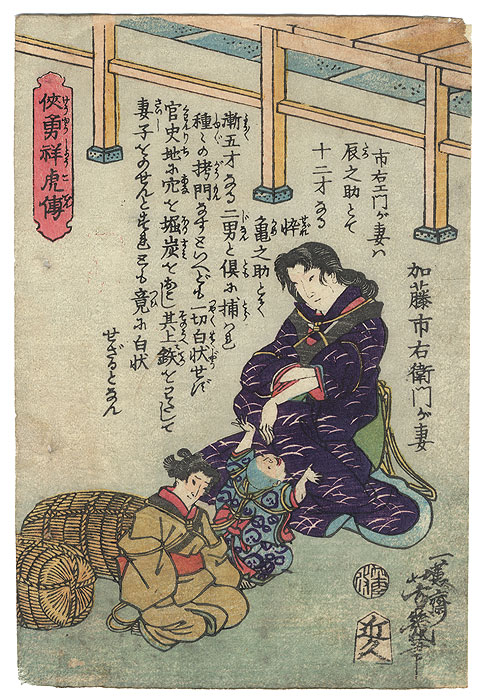
A woman identified by the adjacent text as the wife of Katō Ichiemon kneels beneath an open wooden structure while holding a small child across her lap. A second child crouches beside a large woven travel basket. A yellow rope or cord passes behind the woman and appears to secure her arms or upper body, indicating that the family has been captured or placed under restraint. The surrounding prose narrates the seizure of Ichiemon's wife and children by officials searching for him.
Visual Description
The illustration occupies the lower half of a vertically oriented book page, with narrative text filling the space above and around the figures. At right, the mother kneels in a dark indigo robe patterned with pale curved strokes. Her head is lowered, her hair has loosened around her face, and her expression appears exhausted or resigned. A small child in a brightly patterned blue, green, and purple garment lies partly across her lap, one arm extended outward. The woman's forearms are held close together in front of her, while a yellow rope or cord emerges from behind her body and trails toward the floor, suggesting restraint behind the back or around the torso. At lower left, an older child kneels beside a large cylindrical woven basket, wearing a tan robe with a red collar and sash. The child looks toward the mother and infant with a solemn expression. Wooden posts and crossbeams overhead establish a government building, checkpoint, storehouse, or covered public structure. The book title appears in a pink cartouche at upper left. Yoshiiku's signature, seals, and a small publisher mark appear near the lower-right corner.
History and Context
Historical Context
Katō Ichiemon appears in popular narratives concerning the Shimabara-Amakusa rebellion of 1637–1638. The precise relationship between the literary figure in Kyōyū shōkoden and a documented historical participant requires further study. The printed narrative appears to describe officials searching for Ichiemon and seizing his wife and young sons when he cannot be found.
Print History
Kyōyū shōkoden was a small illustrated popular book written by Rōgetsutei Arindo and illustrated by Yoshiiku. A National Institute of Japanese Literature catalog record describes it as a single printed volume measuring approximately 18 by 12.4 centimeters. Other surviving pages include supernatural, martial, and rebellion-related imagery, suggesting a compact narrative combining history, legend, religious conflict, and heroic adventure.
Cultural Context
The Shimabara-Amakusa rebellion was led largely by impoverished farmers and rōnin in Kyushu and included many Christians. Tokugawa authorities suppressed the uprising and subsequently tightened the prohibition of Christianity. Nineteenth-century publishers dealing with this material often disguised personal names and historical references to avoid censorship. The capture of a fugitive's family belongs to a broader narrative culture in which political rebellion was represented through domestic suffering, pursuit, imprisonment, martyrdom, and divided loyalties.
Series Context
The volume appears to retell the rebellion through heroic and sensational episodes rather than offering a documentary chronicle. Its title, Kyōyū shōkoden, associates exemplary courage with tiger imagery. The present page shifts attention from armed protagonists to the consequences suffered by a fugitive's family.
Known Variants
Individual pages from the book may survive detached, mounted, or marketed as separate prints. Color saturation, trimming, binding holes, paper wear, and page order may differ. The supplied image appears to be an individual page removed from the original volume.
Collection History
A bibliographic record for the complete book is held by the National Institute of Japanese Literature. From the collection of Zetsu Nawa.
Relevance to Kinbaku
The image is relevant to the history of rope and restraint because it depicts the apparent detention of a woman together with her children during a political search. Rope is shown as an instrument of state or official coercion applied within a family setting rather than in an execution, theatrical torture, or erotic scene.
Historical Connections
The page contributes to the visual history of rope as a means of arrest and control. Unlike spectacular semeba or execution imagery, the restraint is understated and embedded in a scene of family displacement. This suggests that rope could signify official custody even when the depicted body was not arranged as the central spectacle.
Iconographic Connections
The woman's lowered head, compressed kneeling posture, closely held arms, trailing rope, vulnerable children, and travel basket communicate captivity and loss of agency. The rope is less visually elaborate than in later bondage imagery, but it changes the meaning of the maternal group from travelers or refugees into detainees.
Interpretive Cautions
The precise rope path is partly hidden by the woman's clothing and the child in her lap. It is therefore unclear whether her wrists, elbows, torso, or clothing are secured. The page is a literary illustration produced more than two centuries after the Shimabara rebellion and should not be treated as an eyewitness record of seventeenth-century arrest technique. The scene is coercive, familial, and political, with no erotic content.
Research Value
The print is valuable because it broadens the archive beyond highly theatrical or sexualized restraint. It documents rope in relation to state pursuit, fugitive families, children, transportation, and collective punishment. It also demonstrates how subtle signs of binding function within illustrated books, where prose and image jointly establish captivity.
Themes
Subjects and Keywords
Sources
- National Institute of Japanese Literature, Union Catalogue of Early Japanese Books: Kyōyū shōkoden, bibliographic record 300083992 — Confirms the Japanese title and reading Kyōyū shōkoden, identifies Rōgetsutei Arindo as the author and Keisai Yoshiiku as illustrator, and records the object as one printed volume measuring approximately 18 by 12.4 centimeters.
- Fuji Arts: Utagawa Yoshiiku print, inventory 669185 — Provides the supplied comparison image and attribution to Yoshiiku, but does not provide a scholarly title, date, or full narrative identification.
- Japanese Antiquarian Auction Archive: Yoshiiku, Kyōyū shōkoden, two-page koban illustration with skeleton apparition — Identifies another illustration from Kyōyū shōkoden as a Yoshiiku design dated Ansei 6, 1859, and records dimensions consistent with a small illustrated book.
- Ota Memorial Museum of Art: Ochiai Yoshiiku exhibition and artist overview — Provides authoritative biographical context for Yoshiiku, his training under Kuniyoshi, and his work in historical, warrior, sensational, humorous, and illustrated-news genres.
- Sendai City cultural-program documentation: Keian Taiheiki episode guide, episode 13: Katō Ichiemon — Documents Katō Ichiemon as a character in popular historical storytelling concerning a dispossessed rōnin and anti-shogunal conflict, providing comparative narrative context rather than direct identification of the supplied page.