The Villain Mokichi and His Wicked Wife Escape Their Bonds
Summary
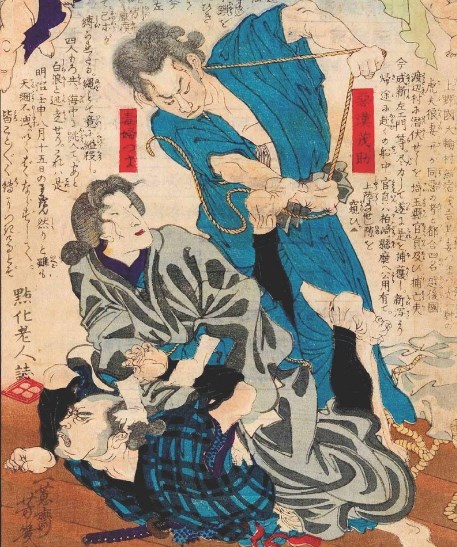
A sensational early-Meiji illustrated news scene depicts three alleged criminals struggling with rope during an attempted escape. A man in a vivid blue garment stands at the upper right, pulling forcefully on a rope while gripping or controlling the bound wrists of the central woman. The woman, dressed in a gray robe with a large dark pattern, kneels or crouches over a third figure in a blue-and-black checked garment. Rope, hands, sleeves, and bodies interlock across the composition, turning the reported escape into a compressed image of struggle, restraint, and disorder. Dense vertical news text surrounds the figures, while red name cartouches identify participants in the story.
Visual Description
The print is organized as a tightly compressed vertical composition containing three overlapping figures. At upper right, a man in a bright blue robe bends forward with a strained expression. A length of tan rope passes across or behind his upper body and extends into his raised right hand. With his other hand he appears to seize, manipulate, or loosen rope around the central figure's wrists. The central woman wears a gray kimono patterned with large black radiating forms. She crouches diagonally across the image, her pale face turned toward the left and her expression controlled rather than visibly panicked. Her hands are gathered close to her torso, where rope and another figure's hands overlap. Beneath her, a man in a dark blue checked garment lies or falls sideways across the lower portion of the sheet. His head is at lower left, his face contorted, and one arm extends upward into the central knot of limbs. A short sword or scabbard lies along the lower edge. The background is largely unmodulated paper filled with columns of handwritten-style Japanese text. Narrow red cartouches punctuate the composition near the upper man and central woman. Purple ornamental forms appear near the upper corners. The sheet is cropped close to the printed image, and some outer margins may have been trimmed.
History and Context
Historical Context
The illustrated account concerns a man called Mokichi, although one cartouche may give a variant reading resembling Mosuke. A contemporary or near-contemporary narrative summarized in later catalogs states that Mokichi was an itinerant or masterless man from Ōwa Village in Kōzuke Province and that he, his wife, and other alleged criminals were captured in Niigata Prefecture in 1872. The exact identities and biographies of the participants have not been independently reconstructed from legal records in this analysis.
Print History
The print was issued in 1874 as number 220 of Yoshiiku's illustrated Tokyo Nichi Nichi Shimbun series. The underlying event was reportedly described in an October 1872 newspaper article and concerned an arrest made in August 1872. The time between the newspaper report and the color print reflects the transformation of news into a separately marketed visual commodity rather than immediate daily illustration. Museum records at Fukuoka City Museum and the Edo-Tokyo Museum document impressions of No. 220.
Cultural Context
Illustrated news prints flourished during the early Meiji period as publishers combined the authority and novelty of modern newspapers with the established visual vocabulary of ukiyo-e. Sensational crime stories, violent incidents, scandals, disasters, and morally charged biographies were especially suited to the format. The use of the label dokufu, often translated as poisonous woman or wicked woman, belongs to a gendered discourse that turned women associated with crime, sexuality, transgression, or resistance into recognizable popular-media types. The print therefore records not only an alleged escape but also the formation of modern mass-media narratives about criminality and dangerous femininity.
Series Context
Tokyo Nichi Nichi Shimbun was among the most influential nishiki-e shinbun series. Yoshiiku, who had trained under Utagawa Kuniyoshi and had previously produced dramatic actor prints and violent subjects, adapted his crowded compositions, expressive faces, and strong color contrasts to illustrated journalism. The series presented stories in a hybrid format: an independent color image, extensive prose, numbered news branding, and identifying cartouches. It helped establish a visual bridge between Edo-period print culture and Meiji-period commercial journalism.
Known Variants
Institutional and commercial records document more than one surviving impression of No. 220. Catalog titles vary, and the principal man's name may be read as Mokichi in the prose but differently in one cartouche. Differences among impressions may include trimming, fading, paper condition, color strength, repairs, and loss at the edges. No distinct recut state has been established in the sources reviewed.
Relevance to Kinbaku
The print is highly relevant to the visual history of rope restraint because rope is not incidental: it organizes the entire action and joins the figures physically and narratively. The scene concerns criminal capture and escape rather than consensual erotic bondage, and it should not be treated as direct evidence for modern kinbaku practice.
Historical Connections
The image documents how rope restraint could be represented in an early Meiji crime narrative intended for mass circulation. It belongs to a period when older practices of binding, transport, arrest, and punishment coexisted with new police, legal, and journalistic institutions. Its value lies in showing that rope remained immediately legible as a technology of custody and as a dramatic visual sign of capture, escape, and social disorder.
Iconographic Connections
The composition concentrates attention on gathered wrists, taut rope, loops crossing the upper man's body, and the physical leverage created by pulling against bound limbs. The rope links all three figures into a single diagonal structure. These elements may interest kinbaku researchers studying recurring visual motifs such as wrist restraint, rope tension, struggle, asymmetrical posture, bodily compression, and the transformation of restraint into spectacle.
Interpretive Cautions
The image should not be described as erotic kinbaku without additional evidence. The central woman is visually prominent and physically entangled with male figures, but the accompanying context is a sensational crime report. The print offers no secure evidence about consensual practice, erotic intent, specialized tying schools, or an uninterrupted historical lineage leading to twentieth-century kinbaku. The depicted rope arrangement may also prioritize pictorial clarity and dramatic movement over technically accurate restraint.
Research Value
The print is valuable for comparing representations of rope across late Edo and early Meiji media. It can support research into the shift from theatrical and legendary restraint scenes to supposedly factual illustrated journalism; the gendered construction of the dokufu; the visual rhetoric of escape; and the degree to which artists reused kabuki-like gesture, facial expression, and bodily arrangement when depicting contemporary crime. A high-resolution institutional image and full transcription of the prose would permit closer study of the event, names, rope action, and moral framing.
Themes
Subjects and Keywords
Sources
- Fukuoka City Museum via Cultural Japan: Tokyo Nichi Nichi Shimbun, No. 220, cataloged as 東京日々新聞二百二拾號; artist Ochiai Yoshiiku; dated 1874 — Confirms artist, series number, date, and the existence of an institutional impression.
- Edo-Tokyo Museum via Cultural Japan: Tokyo Nichinichi Shimbun Newspaper, No. 220 — Provides a museum comparison record for the same numbered print and series.
- Japan Search and ARC Ukiyo-e Portal: 東京日々新聞 220号 悪漢茂吉と毒婦つまが縄ぬけ逃亡 — Supports the descriptive Japanese title and links the work to Japanese institutional and university catalog records.
- Booksellers Association of Japan catalog: Ochiai Yoshiiku, Tokyo Nichi Nichi Shimbun No. 220: 悪漢茂吉と毒婦つまが縄ぬけ逃亡 — Supports the Japanese descriptive title, artist, Meiji 7 date, approximate dimensions, series background, and summary of the 1872 incident.
- Richard Neylon Rare Books: 悪漢茂吉と毒婦つまが縄ぬけ逃亡, Tokyo Nichi Nichi Shimbun No. 220 — Provides a comparison impression, romanized title, physical dimensions, publication context, and discussion of the Mokichi or Mosuke name discrepancy.
- Research report on digitized non-textual historical materials: Scholarly tabulation of nishiki-e news prints including 悪漢茂吉と毒婦つまが護送中に逃亡, Yoshiiku, and Gusokuya — Supports the attribution to Yoshiiku, the escape-under-guard subject, and the publisher identification Gusokuya.