The Lonely House on Adachi Moor in Northern Japan
Summary
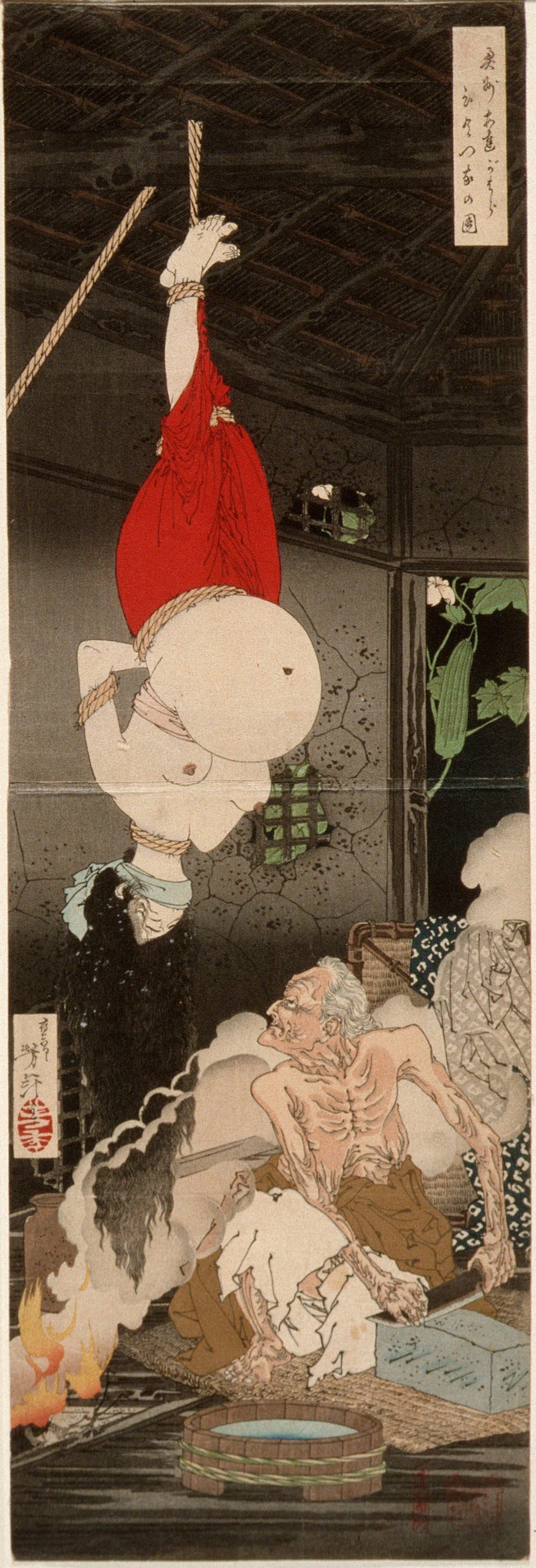
Inside a dilapidated rural house, a heavily pregnant woman hangs upside down from the rafters while an emaciated old woman crouches below sharpening a knife. The suspended victim's ankles are tied together above her head, her arms are secured behind her, a rope passes around her waist, and her mouth appears gagged. Her red garment has fallen toward her torso, exposing her abdomen and breasts. Below, the elderly woman prepares a blade beside a bucket, fire, household tools, bedding, and baskets. The scene represents the moment before the demon hag of Adachigahara murders the traveler and removes her unborn child.
Visual Description
The unusually narrow vertical diptych emphasizes height, inversion, and the distance between victim and attacker. The upper half is dominated by the blackened rafters of a decaying house. A rope descends from the ceiling and secures the victim by both ankles, leaving her body completely inverted. Her pale legs rise vertically into the dark roof space. Additional rope encircles her ankles, waist, forearms, and upper body. Her arms are folded or drawn behind her, and a pale cloth crosses her mouth and neck. Her vivid red robe has fallen downward under gravity, gathering around her chest and shoulders while leaving her swollen abdomen and much of her torso exposed. Her long black hair hangs toward the floor, where its ends approach the smoke and fire. At lower right, a skeletal elderly woman crouches beside a rectangular sharpening stone and draws a long knife across its surface. A second gaunt figure or doubled phase of the hag appears bent over near the fire and bucket, possibly representing successive action, supernatural transformation, or a compositional narration of movement. Steam or smoke rises around the figures. A wooden tub filled with water stands in the foreground. Baskets, bedding, cloth, kitchen implements, and a hanging gourd populate the cramped interior. Through a broken opening at right, green gourds or vines contrast with the dark room. The title appears in a vertical cartouche at upper right, and Yoshitoshi's signature and seal appear near the lower left.
History and Context
Historical Context
The demon hag of Adachigahara belongs to a long supernatural tradition associated with Kurozuka, or the Black Mound, in present-day Fukushima Prefecture. Versions differ, but the hag is generally described as an old woman who offers shelter to travelers and murders them in her isolated house. In some retellings she especially targets pregnant women because she seeks the blood, liver, or other organs of unborn children. The tale later became associated with the Noh drama Kurozuka, also known as Adachigahara, and was adapted for kabuki, jōruri, literature, and popular visual art. Yoshitoshi selects the most physically horrifying episode rather than the later discovery or supernatural confrontation.
Print History
Yoshitoshi produced the diptych in 1885, during the mature period in which he increasingly combined traditional supernatural narratives with precise drawing, psychological suspense, selective color, and complex spatial construction. Rather than showing the actual cutting or death, he depicts preparation and suspended anticipation. The work became one of Yoshitoshi's most recognizable independent designs and is preserved in several major museum collections.
Cultural Context
The Adachigahara legend combined Buddhist moral themes, fear of isolated places, anxiety about deceptive hospitality, pregnancy, maternal vulnerability, cannibalism, and the unstable boundary between human and demon. Stage adaptations often complicated the hag by presenting her as a suffering or cursed being rather than a simple monster. Yoshitoshi's image, however, concentrates on the threatened victim and the old woman's methodical preparation, creating horror through stillness and imminent action.
Series Context
The diptych was published independently. It is often grouped in exhibitions and scholarship with Yoshitoshi's late supernatural and ghost imagery, but it does not belong to his later numbered series New Forms of Thirty-Six Ghosts.
Known Variants
Museum impressions differ in paper tone, color saturation, trimming, registration, and preservation of the dark roof and smoke effects. Some reproductions join the two sheets with a conspicuous horizontal seam, while better-preserved impressions retain subtler alignment. No fundamentally different compositional state has been confirmed.
Collection History
Cataloged impressions are held by the Los Angeles County Museum of Art, the Minneapolis Institute of Art, the Fine Arts Museums of San Francisco, the Worcester Art Museum, and other collections.
Relevance to Kinbaku
This is one of the most important pre-twentieth-century Japanese images of inverted rope suspension. The victim is not merely tied but organized through a complete visual system of inversion, multiple restraint points, gravity, clothing displacement, bodily exposure, and anticipated torment. The scene is punitive, murderous, and theatrical rather than erotic kinbaku, yet its imagery became highly significant to later Japanese representations of rope suffering.
Historical Connections
The diptych proves that complex inverted suspension was a legible and commercially circulated visual motif in Meiji-period print culture. It belongs to a longer history of supernatural, theatrical, punitive, and torture imagery rather than to a documented erotic rope practice. Later Japanese artists and commentators interested in seme and kinbaku repeatedly returned to Yoshitoshi's treatment of the inverted body, making the print an important object in the reception history of rope imagery.
Iconographic Connections
Features later associated with kinbaku and seme imagery are unusually concentrated here: both ankles tied together to a high suspension point, arms folded and secured behind the body, a waist or torso rope, apparent gagging, total inversion, exposed breasts and abdomen, long hair hanging under gravity, a brilliant garment drawn away from the body, helpless suspension over an active torment scene, and a strong contrast between the immobilized victim and the deliberate calm of the aggressor. The rope is both mechanical and compositional, extending the figure vertically through the entire upper half of the design.
Interpretive Cautions
The scene depicts attempted murder of a pregnant woman and should not be romanticized as consensual bondage. It is based on supernatural folklore and theatrical storytelling, not a technical record of a historical punishment or erotic session. Some visible rope paths may have been adjusted for visual clarity, and the physical safety or feasibility of suspending a pregnant body in this manner is irrelevant to the narrative purpose. Claims that the print directly created modern kinbaku should be avoided unless supported by specific evidence of reception and transmission.
Research Value
The work is exceptionally valuable for research into the visual genealogy of inversion, suspension, female suffering, and rope spectacle. It permits close study of how gravity transforms clothing, hair, posture, and bodily exposure; how restraint produces narrative suspense; and how later kinbaku artists could reinterpret non-erotic punishment imagery. It also provides a strong comparison with kabuki semeba prints, execution images, prisoner portraits, and twentieth-century rope illustration.
Themes
Subjects and Keywords
Sources
- Los Angeles County Museum of Art: Tsukioka Yoshitoshi, The Lonely House on Adachi Moor in Northern Japan, accession M.84.31.138a-b — Confirms the artist, English title, 1885 date, diptych format, medium, dimensions, and Herbert R. Cole Collection provenance.
- Minneapolis Institute of Art: Picture of the Lonely House at Adachigahara in Ōshū — Confirms the title and subject and describes the pregnant woman as bound, gagged, and suspended upside down while the old woman sharpens a knife.
- Fine Arts Museums of San Francisco: The Lonely House on Adachi Moor, Oshu adachigahara hitotsuya no zu — Confirms the Japanese romanized title, artist, 1885 date, and museum cataloging of the work.
- Worcester Art Museum: Picture of the Lonely House on Adachigahara Moor in Ōshū — Confirms Yoshitoshi's authorship and identifies the publication date as September 1885.
- Fine Arts Museums of San Francisco via Ukiyo-e.org: The Lonely House on Adachi Moor, collection record 1980.1.87 — Records the vertical diptych dimensions, publisher Matsui Eikichi, block carver Chokuzan, artist, title, and 1885 date.
- Christie's: Tsukioka Yoshitoshi, Ōshū Adachigahara hitotsuya no zu — Provides contextual discussion of the Adachigahara legend, its theatrical history, and Yoshitoshi's emphasis on the moment immediately before violence.