The Dream of the Fisherman's Wife
Summary
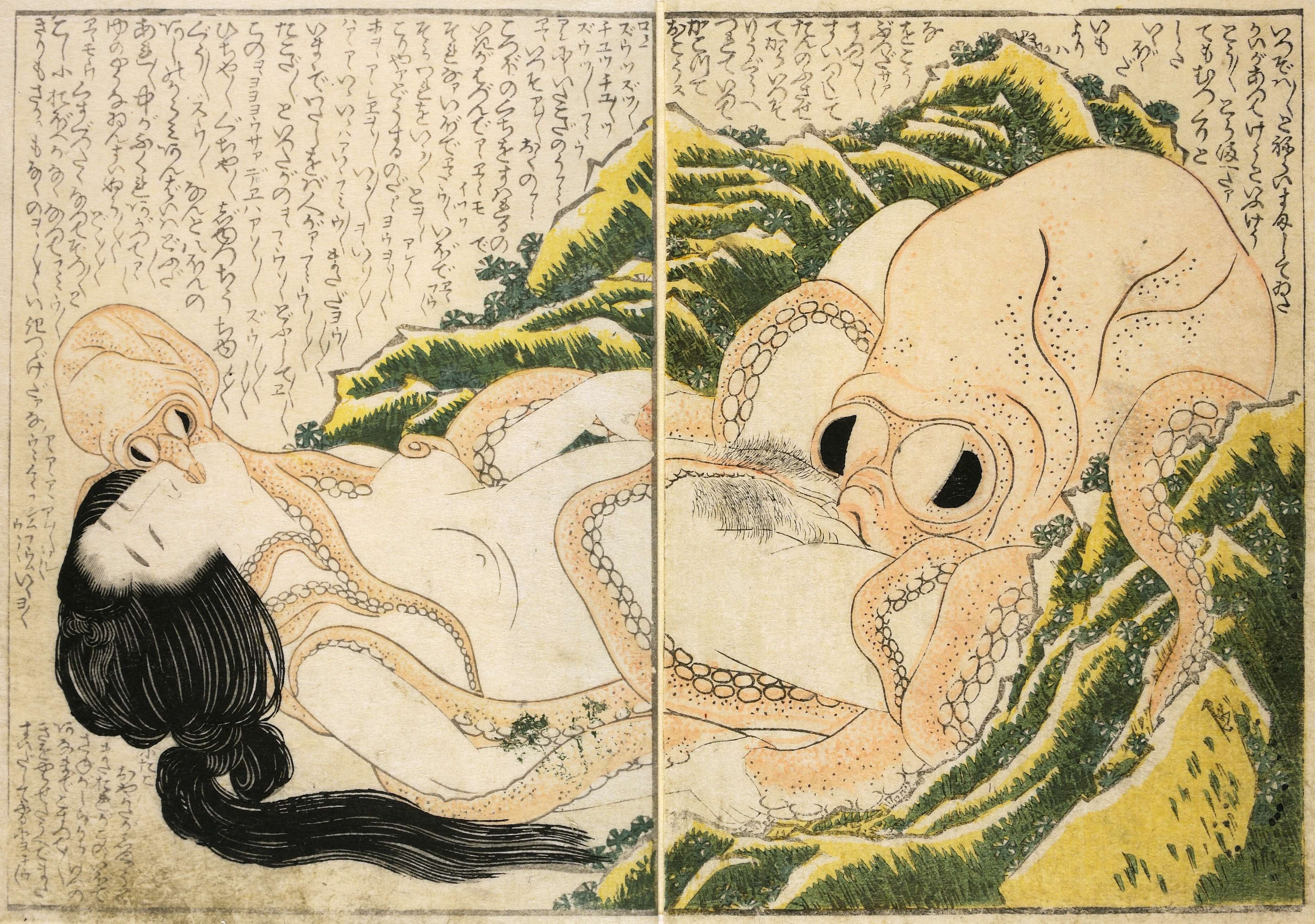
A nude woman identified conventionally as an ama, or female shell diver, reclines among rocks and aquatic vegetation while engaged sexually with two octopuses. The larger octopus occupies most of the right-hand page and performs oral sex on her, while its tentacles curl around her thighs, torso, and arms. A smaller octopus at the left touches her mouth and breast. Dense handwritten dialogue fills the open areas around the bodies and records the participants' voices and expressions of pleasure. The image is one of the best-known surviving examples of Edo-period shunga.
Visual Description
The composition spans two facing book pages divided by a prominent central gutter. The woman lies diagonally from the lower left toward the center, her head tilted backward and her eyes closed. Her long black hair is tied behind her head and trails in a thick dark mass along the lower edge, providing the strongest area of black in the design. Her body is pale and largely unshaded, making it visually distinct from the patterned vegetation and the speckled orange-pink bodies of the octopuses. The smaller octopus approaches from the upper left, pressing its head toward the woman's mouth while one tentacle reaches across her chest. The much larger octopus dominates the right page, its bulbous head and large dark eyes positioned close to her lower body. Multiple tentacles coil around her legs, hips, waist, arms, and hands. She actively grasps several tentacles rather than appearing simply pinned beneath them. Green and yellow seaweed or coastal vegetation surrounds the figures, forming an irregular enclosure that contrasts with the pale bodies. Japanese dialogue is written in loose, flowing columns across the upper left, upper right, and lower-left margins. No separate title cartouche, artist signature, publisher mark, censor seal, or date seal is visible in the supplied opening. The uploaded image has been digitally cropped and assembled so that the two leaves appear as a continuous spread; the central gutter remains visible.
History and Context
Historical Context
The woman is not securely identified as a historical individual. She is generally interpreted as an ama, a professional female diver associated with gathering shellfish, seaweed, or pearls. Scholars have connected the composition to the popular legend of Princess Tamatori, a diver who entered the palace of the Dragon King to recover a stolen jewel and was pursued by sea creatures. The image does not, however, illustrate the conventional heroic climax of that story directly. It transforms motifs of the female diver, the marine realm, and the Dragon King's creatures into an erotic fantasy.
Print History
The design was issued as a double-page opening in Kinoe no komatsu, a three-volume erotic picture book published in Edo in 1814. Each volume combined color illustrations with extensive erotic dialogue and prose. The opening was not originally an independent single-sheet print, although it has often been reproduced, cropped, separated from its book context, or presented as a standalone artwork. The conventional title The Dream of the Fisherman's Wife is a later Western title and can misleadingly imply both a husband and a dream, neither of which is established by a printed title in the original opening. The shorter catalog designation Tako to ama, Octopus and Shell Diver, describes the visible subject more directly.
Cultural Context
Shunga were commercially produced erotic images and illustrated books consumed by diverse audiences during the Edo period. They combined explicit sexual representation with humor, fantasy, literary allusion, exaggerated anatomy, and written dialogue. The inscriptions were integral to the experience, supplying voices, jokes, erotic instructions, and narrative context that cannot be recovered from the image alone. This opening also participates in a longer visual and literary tradition surrounding ama divers and supernatural encounters with marine creatures. Its later reception has been shaped heavily by Western collecting, censorship, psychoanalytic interpretation, Japonisme, and its perceived relationship to modern tentacle erotica.
Series Context
Kinoe no komatsu is a three-volume shunga publication designed by Hokusai in 1814. The title is written with playful or phonetic characters and is commonly translated as Young Pines or Pine Seedlings on the First Rat Day. The books contain multiple erotic encounters linked by prose and dialogue. The octopus-and-diver opening is the most internationally famous design from the set, but it should be understood as one component of a larger book rather than an isolated fantasy without textual or material context.
Known Variants
Multiple surviving copies and detached openings are documented. Differences may include color saturation, registration, wear, trimming, staining, worm damage, page separation, repairs, and the degree to which the two facing leaves have been digitally reunited. Modern reproductions often crop the margins, retouch discoloration, remove the gutter, alter color balance, or omit portions of the dialogue. The supplied image is identified by its filename as a cropped version associated with the British Museum record and appears to have been digitally assembled from two facing leaves.
Relevance to Kinbaku
The image is relevant to research on bodily enclosure, entanglement, immobilization, and eroticized control, but it contains no rope and does not depict kinbaku. The octopus tentacles function as fantastical organic restraints while also serving as sexual partners, framing devices, and compositional lines.
Historical Connections
The opening belongs to the history of Edo-period erotic publishing rather than to a documented tradition of rope bondage. Its historical importance for kinbaku research lies in demonstrating that eroticized restriction, bodily capture, and enveloping forms appeared in Japanese visual culture through media other than rope. It may be compared with scenes of capture by serpents, ghosts, demons, textiles, hair, or supernatural creatures, but such comparisons establish shared visual concerns rather than direct technical or genealogical continuity.
Iconographic Connections
The tentacles wrap around the woman's thighs, torso, arms, wrists, and hands, creating an image of total bodily enclosure. Their curves guide the viewer across the gutter and bind the two pages into a single composition. The woman's grasping of the tentacles complicates a simple victim-and-captor reading, as the image and dialogue emphasize active participation and pleasure. For kinbaku readers, the most relevant visual features are the distribution of pressure across the body, the use of encircling lines to direct attention, the contrast between mobility and containment, and the transformation of entanglement into an erotic spectacle.
Interpretive Cautions
This is not an image of rope bondage, hojojutsu, arrest, punishment, or modern kinbaku. The tentacles are imaginary anatomical extensions rather than evidence of historical restraint technique. Interpretations that describe the woman as assaulted or helpless should be weighed against the erotic dialogue, her physical engagement with the tentacles, and scholarship emphasizing mutual pleasure. Conversely, the presence of pleasurable dialogue does not require modern viewers to adopt a single interpretation of consent. The popular English title is not original and should not be used as evidence that the scene is a dream or that the woman is a fisherman's wife. Claims that the design directly originated modern Japanese tentacle pornography or modern kinbaku should be framed as reception history rather than an uninterrupted lineage.
Research Value
The opening offers a particularly rich case for studying how erotic art visualizes restraint without rope. It permits comparison among bodily entanglement, written expressions of pleasure, fantastical anatomy, and the physical structure of the book opening. It is also valuable for examining how later cropping and standalone reproduction detach shunga from their narrative and material contexts. A complete transcription and translation of the surrounding dialogue would strengthen analysis of agency, consent, humor, and the roles assigned to each octopus.
Themes
Subjects and Keywords
Sources
- The British Museum: Print; book illustration; shunga, museum number OA+,0.109 — Confirms the work as a shunga opening from the woodblock-printed book Kinoe no komatsu, identifies Katsushika Hokusai as the artist, dates it to 1814, and records publication in Edo.
- The British Museum: Collection search result for JCF8648 and OA+,0.109 — Corroborates the artist, Bunka-era classification, 1814 production date, and Edo publication.
- Perspective: actualité en histoire de l'art: Katsushika Hokusai, Le Rêve de la femme du pêcheur, opening from Kinoe no komatsu, British Museum OA+,0.109 — Documents the image as an opening from Kinoe no komatsu and associates the reproduced example with the British Museum.
- Obelisk Art History: The Dream of the Fisherman's Wife by Katsushika Hokusai — Provides a comparison image and summarizes the conventional English title, 1814 date, artist attribution, subject, and alternative title Octopus and Shell Diver.
- Wikimedia Commons: The Dream of the Fisherman's Wife, British Museum, version 1, cropped — Identifies the uploaded digital image as a cropped and digitally altered version in which the two book leaves were brought together.