The Crucifixion of Asakura Tōgo
Summary
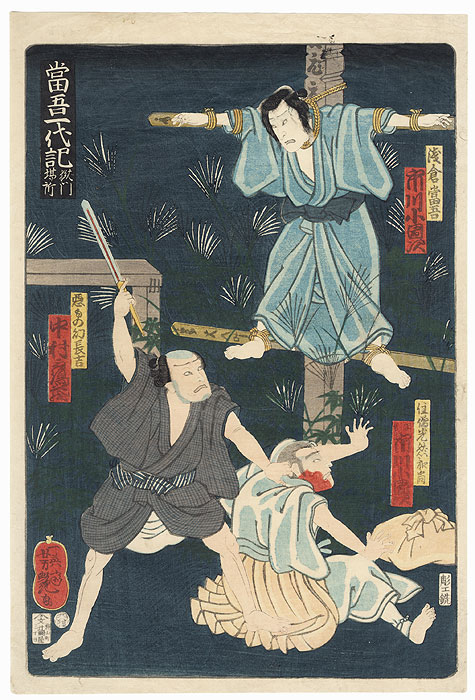
The print represents a theatrical execution-ground scene centered on Asakura Tōgo, who is bound upright to a wooden post with his arms extended. Below him, the villain Gen Chōkichi attacks or restrains the monk Kōnen, creating a second knot of violence beneath the elevated prisoner. The nearly black background, radiating graphic marks, exposed limbs, forceful gestures, and red actor-role cartouches transform punishment into a concentrated kabuki spectacle.
Visual Description
A dark blue-black background fills most of the vertical sheet and sharply isolates three figures. At the upper right, Asakura Tōgo is secured to a tall wooden post. Thick yellow rope passes around the post and across his upper torso, neck or shoulder area, upper arms, forearms, and wrists, forcing his arms outward. His pale blue striped robe is gathered at the waist, his lower legs are exposed, and his feet hang above the action below. His face is turned downward with an expression of pain, strain, or apprehension. At lower left, a muscular man in a dark, finely patterned robe stands with legs spread. He raises a long object resembling a sword, staff, or execution implement in his right hand while using his other hand to seize the fallen figure by the head or hair. The third man collapses backward in pale blue and tan garments, one arm flung upward and his head forced toward the floor. White radiating marks punctuate the dark field and heighten the violence. A platform or low architectural structure appears behind the attacker. Red cartouches identify the actors and roles, while the series title is printed vertically in white at upper left. Yoshitsuya's signature and publisher or approval marks occupy the lower-left corner.
History and Context
Historical Context
Asakura Tōgo is the theatrical name used for Sakura Sōgorō, a legendary village headman associated with Sakura Domain. According to the popular narrative, he petitioned higher authority against oppressive taxation and suffered execution with members of his family. He subsequently became a symbol of principled resistance, peasant suffering, and posthumous vengeance. Because direct representation of contemporary political grievances could attract censorship, theatrical and literary retellings altered names and circumstances. Asakura Tōgo is therefore best understood as a kabuki and popular-literary character derived from the Sakura Sōgorō tradition rather than as an unmediated historical portrait.
Print History
Yoshitsuya's Tōgo ichidaiki designs belong to the flourishing visual culture surrounding the Tōgo or Sakura Sōgorō legend. The series included scenes of prayer, public festivals, imprisonment, execution, ghosts, and other episodes. Actor cartouches identify specific performers, indicating that the prints were closely connected to theatrical presentation. The supplied sheet was cataloged in 1861 and represents the execution-ground scene.
Cultural Context
Stories about Asakura Tōgo combined political grievance, filial and familial suffering, moral sacrifice, supernatural revenge, and kabuki spectacle. The condemned petitioner could be represented as a righteous martyr, while corrupt authorities and criminal agents supplied dramatic antagonists. Execution and torture scenes allowed actors and printmakers to stage extreme bodily vulnerability while preserving a moral distinction between unjust authority and virtuous resistance.
Series Context
The Life of Tōgo appears to have been conceived as a sequence of actor prints covering multiple scenes from the dramatic cycle. Surviving catalog records identify sheets titled the prayer scene, festival scene, execution-ground scene, lodging-house scene, and other episodes. The series title unifies theatrical moments that may otherwise have circulated as individual prints.
Known Variants
Other impressions may differ in saturation of the dark background, registration, trimming, paper tone, and preservation. The thin radiating marks and small seal details are particularly vulnerable to fading or abrasion. No alternate compositional state has been confirmed.
Collection History
A matching impression is documented through the Waseda University Theatre Museum Digital Archive under record 100-9652. From the collection of Zetsu Nawa.
Relevance to Kinbaku
The print is directly relevant to the visual history of Japanese restraint because Asakura Tōgo's body is displayed through an extensive rope configuration securing him to an upright post. The ropes immobilize his torso and all four limbs while making the mechanics of punitive control visible. The scene predates modern erotic kinbaku and represents theatrical execution, but it forms part of the nineteenth-century visual archive of bound, suspended, and publicly exposed bodies.
Historical Connections
The image demonstrates how elaborate rope restraint could function as the visual centerpiece of a mainstream kabuki actor print. Rope signifies state or institutional power, converts the condemned man's body into a public spectacle, and communicates his inability to resist. Its publication in 1861 shows that audiences were familiar with detailed images of punitive binding before the formation of twentieth-century erotic kinbaku media.
Iconographic Connections
The prisoner is arranged in a cruciform posture, with both arms stretched outward and secured separately to the post. Additional rope appears at the upper torso, shoulders, forearms, and wrists, while the lower legs are tied against the support. His clothing remains largely intact but is displaced enough to expose the calves and emphasize bodily strain. The elevated helpless figure, taut visible rope, distressed expression, and violence occurring below create a visual grammar later encountered in torture and bondage illustration.
Interpretive Cautions
The print depicts actors performing a fictionalized execution scene. It is not a technical diagram of Edo-period restraint and does not prove that the exact rope arrangement was used in an historical execution. The term crucifixion is a useful descriptive translation for the posture, but the Japanese title identifies the scene as an execution ground rather than invoking Christian crucifixion. The scene is coercive, violent, and non-consensual. Any erotic interpretation belongs primarily to later reception and should not replace its kabuki, political, and martyrdom contexts.
Research Value
The sheet is especially valuable because it shows a full-body male post restraint with multiple attachment points rather than a simple wrist tie. It permits analysis of how theatrical binding balances narrative legibility, bodily display, and graphic composition. Comparison with other Tōgo prints, kabuki semeba scenes, penal imagery, and later SM illustration may clarify the migration of cruciform and post-binding motifs across Japanese visual media.
Themes
Subjects and Keywords
Sources
- Waseda University Theatre Museum Digital Archive via Ukiyo-e.org: Utagawa Yoshitsuya, Tōgo ichidaiki: Gokumon basho, record 100-9652 — Confirms the artist, Japanese series and scene titles, 1861 date, and the actor-role identifications for Asakura Tōgo, Kōnen Oshō, and Gen Chōkichi.
- Fuji Arts: Utagawa Yoshitsuya, The Crucifixion of Asakura Togo, 1861, inventory 1098349 — Provides the supplied comparison image, English catalog title, artist attribution, 1861 date, and commercial record for the print.
- Ritsumeikan University Art Research Center via Ukiyo-e.org: Utagawa Yoshitsuya, Tōgo ichidaiki — Confirms Yoshitsuya's authorship of prints from The Life of Tōgo and documents another scene from the same visual cycle.
- British Museum: Asakura Togo borei, museum number 2008,3037.21325 — Provides authoritative context for Ichikawa Kodanji IV's portrayal of Asakura Tōgo and the character's connection to the kabuki play Higashiyama sakura zōshi.
- British Museum: Scene from Sakura sōshi with Asakura Tōgo haunting those responsible for his crucifixion, museum number 2008,3037.19505 — Documents the established kabuki tradition of Asakura Tōgo's execution and subsequent ghostly revenge.
- National Institute of Japanese Literature: Research discussing The Life of Asakura Tōgo and its popular-literary context — Documents the wider nineteenth-century publication history of Asakura Tōgo narratives and the 1855 book The Life of Asakura Tōgo.